For the first time in many years, all 15 out of 15 key socio-economic targets were fulfilled and exceeded. This impressive growth picture not only affirms the resilience and strength of the economy but also opens up new prospects for 2026.
Solid foundations
According to Do Thi Ngoc, Deputy Director General of the Statistics Office (Ministry of Finance), the 2020–2025 term was an “unprecedentedly extraordinary” period. The economy simultaneously faced the Covid-19 pandemic, the Russia–Ukraine conflict, trade wars, supply chain disruptions, and severe climate change impacts.
“However, under decisive and synchronised leadership and governance, Viet Nam’s economy still achieved comprehensive results,” Ngoc affirmed. GDP growth during this period averaged around 6.2% per year. Excluding 2021, which was heavily affected by the pandemic, growth in 2022–2025 reached 7.13%, surpassing the target set.
Looking back over 40 years of Doi Moi, Dr Nguyen Dinh Chuc, President of the Institute of Viet Nam World Economy, noted that GDP has increased more than 60-fold compared with 1986, while per capita income has risen over 30 times. Viet Nam now maintains diplomatic relations with 194 countries and has 38 strategic partners, including all permanent members of the United Nations Security Council. The national brand value ranks 32nd among 193 countries.
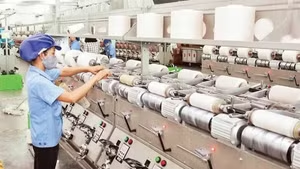
At the macro level, inflation has been kept below 4%, while public debt declined from 44.3% of GDP in 2020 to around 35% of GDP in 2025, creating important fiscal space. Total import–export turnover in 2025 exceeded 930 billion USD, placing Viet Nam among the world’s top 20 trading economies. Disbursed FDI reached a record 27.6 billion USD, the highest in five years, with 83% channelled into processing and manufacturing.
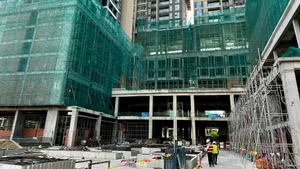
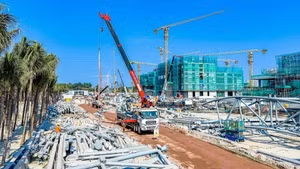
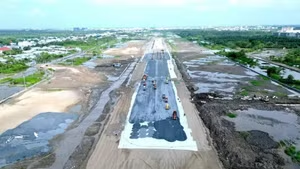
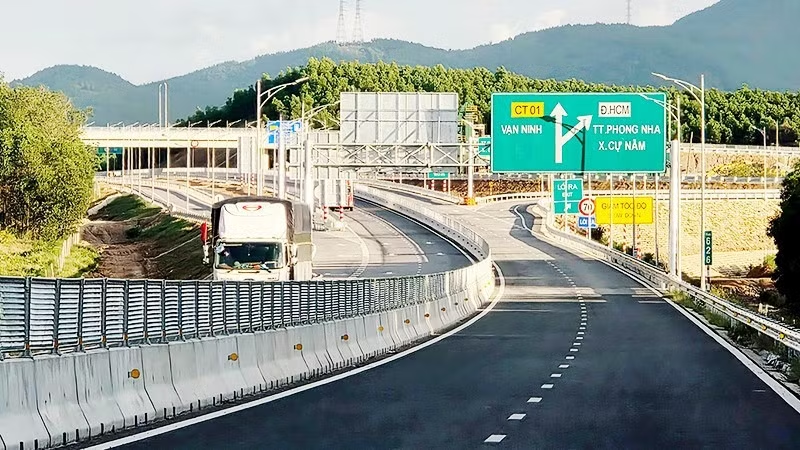
Notably, infrastructure saw breakthrough progress, with 3,245 km of expressways completed, surpassing the 3,000 km target. The digital economy accounts for around 14% of GDP, growing by 9–10% annually, faster than overall economic growth. These figures are not merely achievements but a “launch pad” for a new development phase.
New opportunities amid global restructuring
Entering 2026, the global economy is forecast to slow to about 2.6%, according to the World Bank (WB). Trade uncertainties, geopolitical conflicts, and protectionist trends remain major challenges.
Yet within these challenges lie opportunities. According to Mariam J. Sherman, World Bank Director for Viet Nam, Cambodia, and Laos, Viet Nam enters the new year with strong growth momentum, building on the impressive results of 2025. Stable macroeconomic fundamentals, low inflation, and public debt within safe limits provide Viet Nam with “ideal” fiscal space to increase investment in infrastructure, skills, and reforms. This is an advantage not all emerging economies possess in a volatile global context.
Another key opportunity stems from the restructuring of global supply chains. As multinational corporations continue to diversify production, Viet Nam has emerged as a strategic destination thanks to its favourable geographical location, extensive FTA network, solid industrial base, and competitive workforce. FTSE Russell’s upgrade of Viet Nam’s stock market classification further reinforces international investor confidence and opens the door to attracting high-quality capital flows in the coming period.
In particular, the wave of FDI shifting into high-tech and green technology sectors is creating new development space. Rather than relying solely on labour cost advantages, Viet Nam now has the opportunity to climb the global value chain, engaging more deeply in higher value-added segments associated with digital transformation, innovation, and energy transition.
According to Dr Nguyen Dinh Chuc, defining science and technology and the private sector as primary drivers of growth is not a short-term decision but a long-term strategic orientation for the next development phase.
“To achieve the goal of double-digit growth, the contribution of total factor productivity (TFP) needs to reach around 55%. This means science and technology, innovation, and digital transformation will play a pivotal role. This is the opportunity for Viet Nam to shift its growth model from breadth to depth, from dependence on capital and labour to reliance on knowledge and technology,” he emphasised.
Alongside this, after 40 years of Doi Moi, the private sector is recognised as one of the most important drivers of the economy. Beyond increasing in number, the next phase aims to develop large-scale private enterprises capable of leading and participating deeply in global value chains.
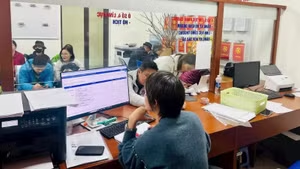
From a policy perspective, Do Thi Ngoc noted that the achievements of the past term have strengthened the confidence of the business community and investors. With macroeconomic stability and enhanced resilience, the Government has greater room to act flexibly and proactively in response to external shocks.
Removing the “bottleneck of bottlenecks” to break through
Despite broad opportunities, experts caution against complacency. Dr Nguyen Dinh Chuc pointed out that institutions remain the “bottleneck of bottlenecks”. Overlapping management thinking, complex procedures, and inconsistent implementation could dampen development momentum.
Mariam J. Sherman stressed that strong institutions are the foundation for effective implementation of strategies. In addition, Viet Nam needs to focus on three strategic “touchpoints” in 2026 and beyond.
The first is improving the efficiency of public investment, particularly in energy, transport, and logistics infrastructure projects, which are decisive for national competitiveness.
The second is enhancing the business environment towards greater transparency, stability, and predictability. Investors require clear and consistent regulations to confidently expand production.
Finally, investment in high-quality human resources cannot be overlooked. The new growth model demands higher skills. Education, training, and skills upgrading must go hand in hand with infrastructure development. This is not only an immediate requirement but also a prerequisite for fully capitalising on the wave of high-tech FDI, green transition, and digital transformation.
The year 2026 is not merely a chronological milestone but the starting point of a new development cycle, with higher, better-quality, and more sustainable growth targets.
The achievements of 2025 and the entire past term have laid a solid foundation in macro stability, infrastructure, institutions, and social confidence. Amid profound global economic restructuring, Viet Nam has the opportunity to transform from a “low-cost factory” into a high-tech, green, and digital manufacturing hub.
That confidence stems not only from growth figures but also from the aspiration for self-reliance cultivated over decades of reform. As Mariam J. Sherman observed, this is a “moment of optimism” as Viet Nam enters a new era with a vision of a modern, self-reliant, and high-income economy.
Before the new opportunities of 2026, the key is not merely to maintain growth momentum but to leverage these opportunities to elevate the country’s position in the global value chain. If institutional bottlenecks are effectively removed, the role of science and technology and the private sector fully harnessed, and macro stability firmly maintained, Viet Nam can confidently embark on a new cycle of faster, greener, and more sustainable growth.
In 2025, Viet Nam’s GDP was estimated at around 510–514 billion USD (ranking 32nd globally and fourth in ASEAN). Per capita income exceeded the 5,000 USD mark for the first time, reaching approximately 5,026 USD, while gross national income (GNI) per capita stood at 4,750 USD. Viet Nam has entered the group of upper-middle-income countries.
![[Video] State Bank conducts 618 inspections, warns of risks of circumventing credit regulations](https://en-cdn.nhandan.vn/images/j0QNt7m_5iy1OXpnUKiwG2YZUw4C9wk8Oka98qtvALC1WRgXv96juFQdrr4_mVgJ/thanhtra.jpg.avif)