A prominent feature of Viet Nam’s economy during a turbulent period is its sustained growth rate, ranking among the highest in the world, strengthening its endogenous capacity and demonstrating its resilience against external shocks.
Proud achievements
During the 2021–2025 period, Viet Nam achieved and surpassed 22 out of 26 key socio-economic targets; specifically, in 2024–2025, it achieved and surpassed all 15 out of 15 socio-economic targets. The average GDP growth rate for the entire period reached approximately 6.3% per year; the size of the economy increased from 346 billion USD in 2020 to 510 billion in 2025, a jump of five ranks, placing it 32nd in the world; GDP per capita is projected to increase from over 3,500 USD/person/year to approximately 5,000 USD/person/year, placing Viet Nam in the upper-middle-income group. Total export turnover is expected to surpass 900 billion USD by 2025, propelling Viet Nam’s trade volume into the top 20 globally.
During the 2021–2025 period, Viet Nam achieved and surpassed 22 out of 26 key socio-economic targets; specifically, in 2024–2025, it achieved and surpassed all 15 out of 15 socio-economic targets. The average GDP growth rate for the entire period reached approximately 6.3% per year; the size of the economy increased from 346 billion USD in 2020 to 510 billion in 2025, a jump of five ranks, placing it 32nd in the world; GDP per capita is projected to increase from over 3,500 USD/person/year to approximately 5,000 USD/person/year, placing Viet Nam in the upper-middle-income group. Total export turnover is expected to surpass 900 billion USD by 2025, propelling Viet Nam’s trade volume into the top 20 globally.
Notably, the economy is returning to a high growth trajectory, but inflation is consistently controlled below 4%, and major economic balances are ensured. This is also the period when Viet Nam reduced public debt from 44.3% of GDP in 2020 to 35–36% of GDP; reduced the budget deficit while state budget revenue increased 1.36 times compared to the previous term (estimated at 9.6 trillion VND); the foreign exchange market is relatively stable, and lending interest rates have decreased, positively impacting the recovery and development of businesses.
With many outstanding achievements in macroeconomics, the International Monetary Fund (IMF) ranked Viet Nam among the top 10 countries with the highest growth rates in the world, according to the World Economic Outlook report published in October 2025.
The socio-economic development achievements of the 2021–2025 period can be summarised by the concepts of “resilience” and “breakthrough,” demonstrating resilience. In the first year of the term, despite the severe impact of the COVID-19 pandemic and the decline in global trade, Viet Nam’s economy still achieved positive growth at 2.58%, while many countries experienced recession and negative growth.
From 2022 onwards, the National Assembly and the Government intensified urgent measures to support production and business, reform administrative procedures, and promote economic recovery, resulting in a breakthrough GDP growth of 8.02%.
Notably, in 2025, based on a thorough assessment of the practical situation and the country’s development needs, the Government proposed and submitted to the Central Party Committee and the National Assembly a conclusion and resolution adjusting the GDP growth target to 8% or higher, instead of the initial target of 6.5%.
According to Associate Professor, Dr. Tran Dinh Thien, this way of framing the issue reflects the aspirations, the will to surpass oneself, and the great political determination of the Party, State, National Assembly, and Government to lead the country into a new stage of development.
National Assembly representative Phan Duc Hieu, a member of the National Assembly’s Economic and Financial Committee, emphasised that the resilience of the Vietnamese economy is demonstrated through two important aspects.
Firstly, the internal capacity of the economy has been enhanced through data on GDP growth rate, the increase in GDP size, and total import and export turnover; many other macroeconomic indicators are also positive.
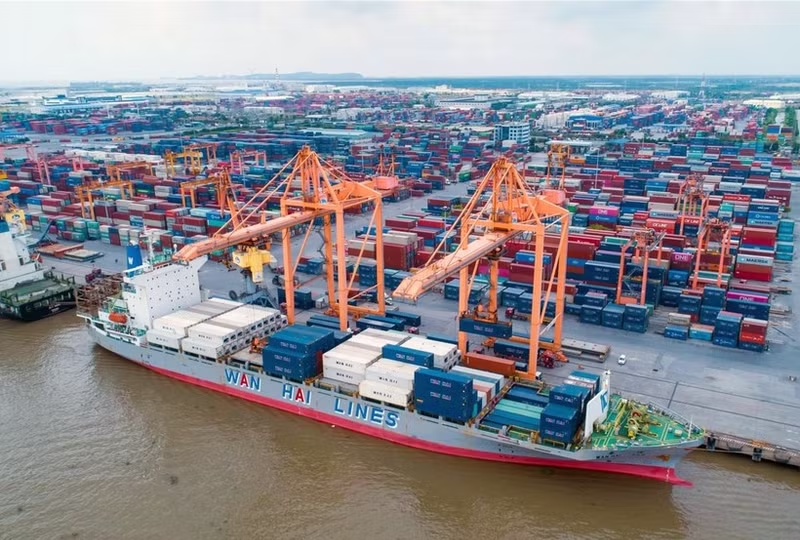
Secondly, Viet Nam has continued to be a reliable destination for foreign investors as global investment flows fluctuate and restructure after the COVID-19 pandemic; total import and export turnover continues to set new records, despite the negative impacts from the reciprocal tax policies of the US administration.
In the context of the 2021–2025 period, which presents many difficulties and challenges compared to the previous period, these results are highly commendable and a source of pride.
New growth drivers for the 2026–2030 period
Besides the effective utilisation of traditional growth drivers, the 2021–2025 period also marks the strong development of economic activities based on new growth models, including innovation, the digital economy, the green economy, and renewable energy, especially in the final year of the term.
Resolution No.57/NQ-TW of the Politburo on breakthroughs in the development of science, technology, innovation, and national digital transformation, and Resolution No.68/NQ-TW on the development of the private economy, have boosted technological restructuring, bringing Viet Nam’s innovation ecosystem into a phase of deep and broad development with over 4,000 startups, two unicorns, and becoming an attractive destination for technology capital in the region.
Along with this, it has attracted the participation of over 1,000 partners into Viet Nam’s innovation ecosystem, including leading technology corporations such as NVIDIA, Google, Meta, Samsung, Qualcomm… through the connection of the National Innovation Center (NIC).
The private sector also had a breakthrough year with over 300,000 newly registered and reactivated businesses in 2025, bringing the total number of active businesses in the economy to over 1 million.
According to Dr. Le Duy Binh, CEO of Economica Viet Nam, the implementation of Resolution No.68/NQ-TW has opened up breakthroughs in private sector investment activities, bringing new vitality to the economy.
To achieve continuous double-digit growth for many years, Viet Nam needs to maintain macroeconomic stability as an "unchanging" factor and effectively control inflation. This requires harmonious coordination between fiscal and monetary policies, ensuring that money flows are activated and allocated most effectively, and directing credit towards sectors that create value for the real economy.
Economist Tran Du Lich
From the perspective of a statistician, Dr. Nguyen Thi Huong, Director of the General Statistics Office, believes that the stable macroeconomic environment, increasingly favourable investment conditions, and strengthened market confidence during the 2021-2025 period have created a key foundation for Viet Nam to attract high-quality foreign investment amidst the strong shift in global supply chains.
These factors serve as necessary conditions for the formation of breakthrough growth drivers from 2026 onwards, enabling Viet Nam to maintain stable and sustainable double-digit growth in the following period. In addition, the acceleration of public investment disbursement, especially for key infrastructure projects, and the process of institutional reform and streamlining of the administrative apparatus during the 2021–2025 period have contributed to unlocking resources, unleashing production capacity, opening up new development opportunities, and creating a foundation and expectation for rapid and sustainable development in the 2026–2030 period.
According to economist Tran Du Lich, to achieve continuous double-digit growth for many years, Viet Nam needs to continue maintaining macroeconomic stability as an "unchanging" factor and effectively control inflation. This requires seamless coordination between fiscal and monetary policies, ensuring that money flows are activated and allocated most effectively, and directing credit gradually towards sectors that create value for the real economy.
While traditional growth drivers have reached their limits, new growth drivers need to be promoted, based on the application of science and technology, innovation, the digital economy, and institutional reforms aimed at enhancing competitiveness, transparency, and efficiency.
The great achievements of the 13th National Congress have laid a solid foundation, contributing to the country's rapid progress into a new era.