This is not merely a local economic development strategy, but also a major political task aimed at safeguarding energy security for the wider region.
Vast renewable energy potential
According to the Lam Dong Department of Industry and Trade, the province currently has 104 power generation projects in operation, with a combined installed capacity of more than 8,241 MW.
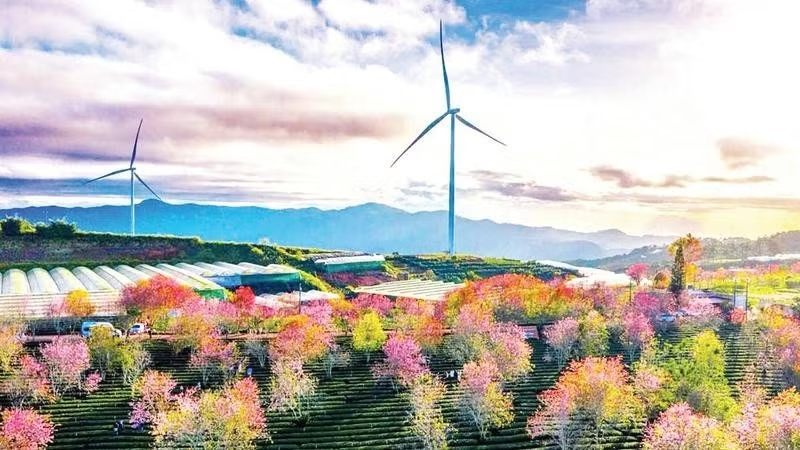
These include six thermal power projects accounting for nearly 53% of total capacity; 58 hydropower projects accounting for over 28%; 28 utility-scale solar power projects accounting for more than 14%; 11 wind power projects accounting for 4.9%; and one 10 MW diesel power project on Phu Quy Island.
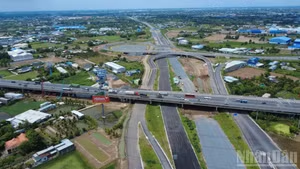
Lam Dong is also integrated into the national power transmission system, with 500 kV, 220 kV and 110 kV transmission lines, ensuring electricity supply for the province’s socio-economic development and for the South Central Coast and Central Highlands. This is a strategic advantage that provides a solid foundation for the province to engage more deeply in the national energy supply chain.
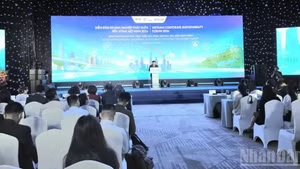
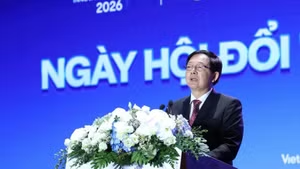
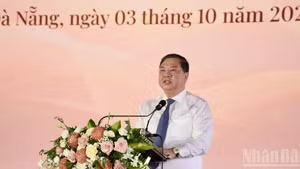
Affirming Lam Dong’s substantial energy potential, Vice Chairman Le Trong Yen said the province has clearly identified its goal of becoming a regional energy centre, particularly through the development of renewable energy linked to green growth and sustainable development.
The Standing Board of the Provincial Party Committee has drawn up a scenario for double-digit growth during the 2026-2030 period. To achieve this target, the industrial sector must grow by around 14.5-15%, with energy projects playing a pivotal role and requiring launch and implementation on schedule.
“With strong political determination and a strategic vision, Lam Dong is proactively updating and supplementing project lists in the national power development plan and the provincial master plan, while also creating favourable conditions and opening the door wider to strategic investors in the energy sector,” Yen stressed.
Under the National Power Development Plan for 2021-2030, with a vision to 2050 (National Power Development Plan 8), the total renewable energy capacity allocated to Lam Dong Province amounts to 5,625.6 MW. This includes an additional 338.6 MW of hydropower capacity, 300 MW of pumped-storage hydropower, an increase of 642 MW of onshore wind power, and an offshore wind power development orientation of 2,000 MW. Solar power capacity is set to increase by a further 2,195 MW, alongside an additional 150 MW of rooftop solar.
These figures highlight Lam Dong’s increasingly prominent role in the national energy security strategy, while also opening up substantial scope for the locality to attract high-quality investment capital.
Removing bottlenecks to unlock investment resources
Alongside its potential and advantages, energy development in Lam Dong still faces a number of obstacles related to planning, investment procedures and land issues. Notably, overlaps between energy planning and mineral planning have directly affected the progress of several projects. The province has been actively working with central ministries and agencies to remove these bottlenecks in order to accelerate the implementation of key energy projects.
Nguyen Ba Ut, Director of the Lam Dong Department of Industry and Trade, said Lam Dong has deployed comprehensive solutions to effectively harness its potential and promote the development of electricity and energy. Various economic sectors have been encouraged to participate in investment, helping power generation and distribution to achieve strong growth and become an important driver of socio-economic development.
Lam Dong is stepping up efforts to attract and develop offshore wind power projects, a field widely assessed as highly promising under National Power Development Plan 8. The province aims to attract around 2,000 MW during the 2025-2030 period and about 2,300 MW in the 2031-2035 period, in combination with other forms of renewable energy to serve domestic demand and exports.
From the perspective of sectoral management, Pham Nguyen Hung, Director of the Electricity Authority under the Ministry of Industry and Trade, noted that several key projects, such as the Don Duong pumped-storage hydropower plant, play a crucial role in regulating the energy system as the share of renewable energy continues to rise. He emphasised that the province needs to work closely to review land-use planning, land-use plans and site clearance. This is an important task that contributes to ensuring national energy security in the long term.
Assessing Lam Dong’s efforts to remove difficulties, Deputy Minister of Industry and Trade Nguyen Hoang Long said that many of the province’s proposals have been fundamentally addressed through a National Assembly resolution issued in December last year on mechanisms and policies for national energy development in the 2026-2030 period.
In the coming period, ministries and agencies will continue to issue guiding decrees to clarify technical details, while upholding the spirit of decentralisation and delegation of authority to localities in the implementation of energy projects.
The Deputy Minister urged Lam Dong to resolutely implement projects in line with approved plans and to promptly review projects that fail to meet timelines in order to propose replacement options and prevent the waste of resources. At the same time, for projects included in post-2030 planning lists, investment procedures should be initiated early to ensure energy security for long-term growth objectives.
Against the backdrop of warnings about potential power shortages during the 2027-2029 period, the Ministry of Industry and Trade has noted that Lam Dong should prioritise power generation projects capable of delivering early results. In parallel, the province should work directly with major investors, require clear commitments on progress, and resolutely replace those that fail to meet requirements.