Bridges paving the way to the future
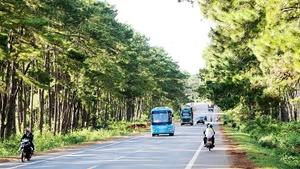
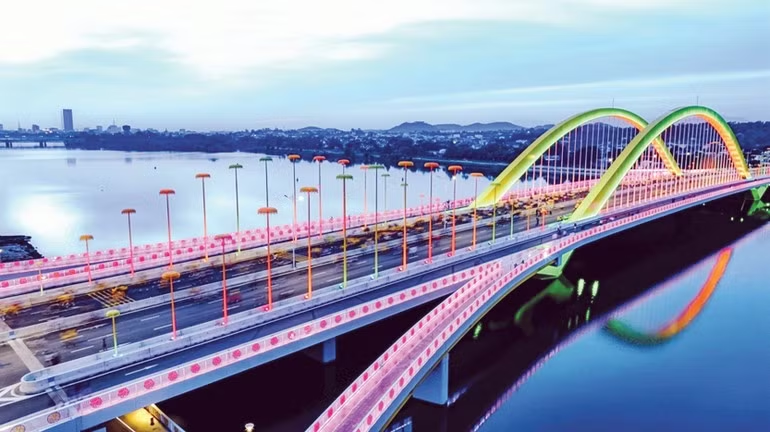
In recent years, the project to upgrade Nguyen Hoang Street and construct a bridge across the Perfume River has quickly become a symbol of an expanding Hue. With total investment of over 2.28 trillion VND (87.5 million USD), the project has been under way since late 2022. The bridge is around 380 metres long, with multiple lanes and pavements, forming a new transport axis linking the city centre with the western urban area.
This is one of Hue’s flagship transport infrastructure projects for the 2021-2025 period. Along this route, numerous residential, commercial and service developments have emerged and continue to take shape, helping to expand the city’s urban space in a modern manner while remaining harmonious with the Perfume River landscape.
The Nguyen Hoang Bridge has been hailed by experts and city leaders as a new architectural symbol of Hue. Since opening to traffic, the bridge has eased pressure on national highways and inner-city roads, opened up space for the development of satellite urban areas, and given fresh impetus to services, commerce and tourism.
“When I see the flow of vehicles crossing the new bridge, I think of Hue’s future as both a heritage destination and a dynamic, modern city,” said Nguyen Duc Phu, a construction worker on the Nguyen Hoang Street project.
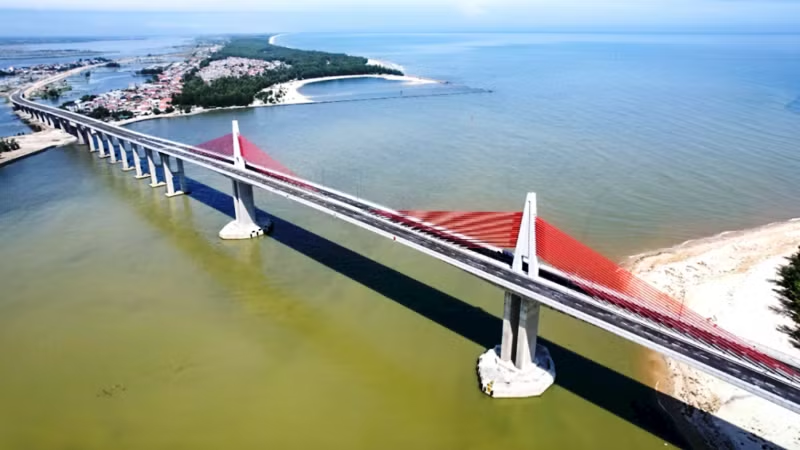
To the east, one of the most prominent projects of 2025-2026 is the coastal road and the overpass spanning the Thuan An estuary, now nearing completion. The project has a total length of nearly 8 km, including a 2.36 km bridge across the estuary, with an investment of almost 2.4 trillion VND (92.1 million USD). This is the first section of a planned coastal road running along the shoreline, linking with major national highways and the regional transport network.
According to the schedule, the Thuan An Bridge is set to enter technical operation in late March, opening up a new eastern gateway for the city. Once open to traffic, it will significantly reduce travel time from the city centre to the coast and expand Hue’s urban space eastwards. The coastal road will not only serve transport needs but also act as a new development axis for resort tourism, maritime logistics services and the fisheries economy.
A driving force for the economy and people’s livelihoods
Hue’s infrastructure vision has extended to the Tam Giang Lagoon area, the largest lagoon system in Southeast Asia, which offers advantages in tourism, aquaculture and a distinctive riverside way of life.
Along the Tam Giang Lagoon, where the city plans to break ground on a new bridge in 2026, construction preparations are already under way. The Tam Giang Lagoon bridge project, linking Phu Vang Commune with Phu Vinh Commune, will be around 3 km long with total investment of more than 1 trillion VND (38.4 million USD). It is expected to mark a turning point for this lagoon region, which is rich in potential but has long been constrained by limited transport connectivity.
The project will create a breakthrough in intra-regional transport links, shortening the distance from the lagoon area to the city centre. In addition, two other bridge projects, Ha Trung and Vinh Tu, are also included in the city’s plans.
Vo Thi Ly, an aquaculture farmer in Phu Vinh Commune along the Tam Giang Lagoon, said: “In the past, getting to the city meant taking a long detour or relying on ferry services. If there is a bridge, transporting shrimp, fish and other goods will be much easier. It will also make life less arduous for our children travelling to school.”
Alongside this, the extension of To Huu Street to Phu Bai Airport is regarded as a strategic transport corridor, directly connecting the urban centre with the international aviation gateway. Once completed, the nearly 10 km route will reduce travel time and unlock land reserves for urban, industrial and logistics development on both sides of the road.
According to experts, transport infrastructure is the crucial lever for local economic growth. For Hue, a heritage city undergoing transformation as it becomes a centrally governed municipality, synchronised investment in major transport corridors will create strong spillover effects.
This will stimulate investment once infrastructure is in place, attract businesses in tourism, services, real estate and clean industries, raise land values and expand urban space. Coastal areas, lagoon-side zones and the western parts of the city are gradually seeing the emergence of new residential quarters and urban developments.
As travel times shorten, job opportunities increase, logistics costs fall, access to healthcare and education improves, and living standards rise.
According to Hue Chairman Nguyen Khac Toan, upgrading key transport corridors is not only about short-term economic gains but also about creating long-term opportunities for investment, enhancing competitiveness and forming new growth poles in the central coastal economic region.
Clear evidence can be seen in the city’s impressive socio-economic achievements: local economic growth of 8.5-9%, state budget revenue far exceeding projections at nearly 15 trillion VND (575.9 million USD), and total social investment reaching 40 trillion VND (1.5 billion USD).