Arbitration and mediation as pillars of a competitive economy
In the context of rapidly changing international trade and investment, driven by supply‑chain shifts, digital transformation and technological development, commercial disputes are growing in scale, complexity and cross‑border dimensions.
This situation demands legal certainty and effective protection of the lawful rights and interests of citizens and enterprises, which is a crucial factor in achieving sustainable economic development.
Mai Luong Khoi, Deputy Minister of Justice, stressed that a fast‑growing, sustainable economy requires not only resources and technology but also a stable, transparent and predictable legal environment in which property rights, freedom to conduct business and freedom of contract are safeguarded, and disputes are resolved promptly, fairly and efficiently.
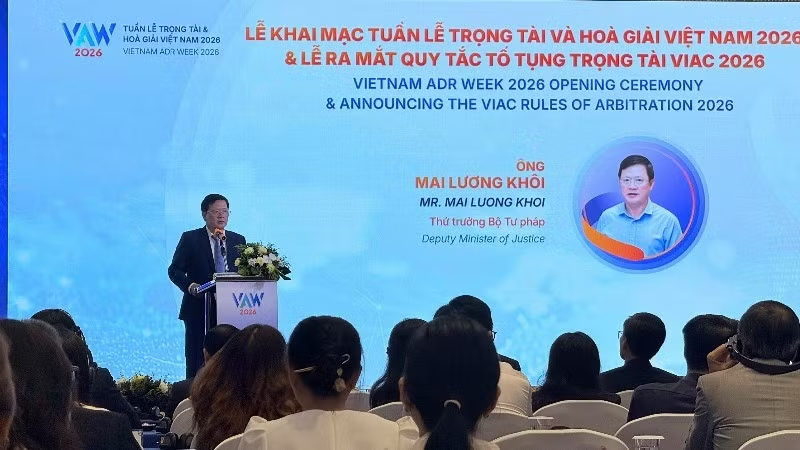
Against the backdrop of Viet Nam pressing ahead with renewing its growth model, improving institutions, unlocking resources, enhancing competitiveness and expanding international cooperation, commercial arbitration and mediation are becoming increasingly important as legal institutions supporting investment and business activities. They help protect the lawful rights and interests of parties while bolstering business and investor confidence in Viet Nam’s legal environment.
Affirming the necessity of arbitration and mediation in the era of globalisation, Nguyen Khanh Ngoc, President of the Viet Nam Lawyers’ Association, noted that arbitration, mediation and alternative dispute‑resolution methods are more relevant than ever as mechanisms thanks to their flexibility, effectiveness and alignment with international standards.
Arbitration and mediation are not only modern, flexible dispute‑resolution methods but are increasingly asserting their vital role in improving the investment and business environment and enhancing national competitiveness.
As disputes in investment, business and trade continue to rise, countries and enterprises seeking sustainable development must adopt appropriate strategies to prevent and mitigate conflicts and, when disputes occur, ensure effective resolution mechanisms. Arbitration and mediation are therefore assuming an increasingly important role.
“Arbitration and mediation are not only modern, flexible dispute‑resolution methods but are increasingly asserting their vital role in improving the investment and business environment and enhancing national competitiveness,” Ngoc emphasised.
Given the importance of arbitration and mediation amid domestic, regional and global trade fluctuations, institutional reform that reflects Viet Nam’s circumstances while approaching international practice should be prioritised.
Reforming Viet Nam’s arbitration framework for global integration
To gradually raise Viet Nam’s standing as a reliable arbitration destination in the region, completing the legal framework, improving human‑resource quality, strengthening judicial support and deepening connections with the international arbitration community will be particularly significant in the coming period.
Professor Dr Le Hong Hanh, President of the Viet Nam International Arbitration Centre (VIAC), observed that it is essential to raise the international competitiveness of Vietnamese arbitration centres to keep pace with the country’s progress, since institutions and law are being positioned as Viet Nam’s competitive advantage in a new era of development.
“Asia is emerging as a dynamic region for arbitration jurisprudence, and alternative dispute‑resolution methods open many opportunities for rising jurisdictions such as Viet Nam. In that context, continually improving the quality of arbitration and alternative dispute‑resolution procedures is important in consolidating the trust of the business community and international investors in Viet Nam’s legal environment,” Professor Hanh stressed.
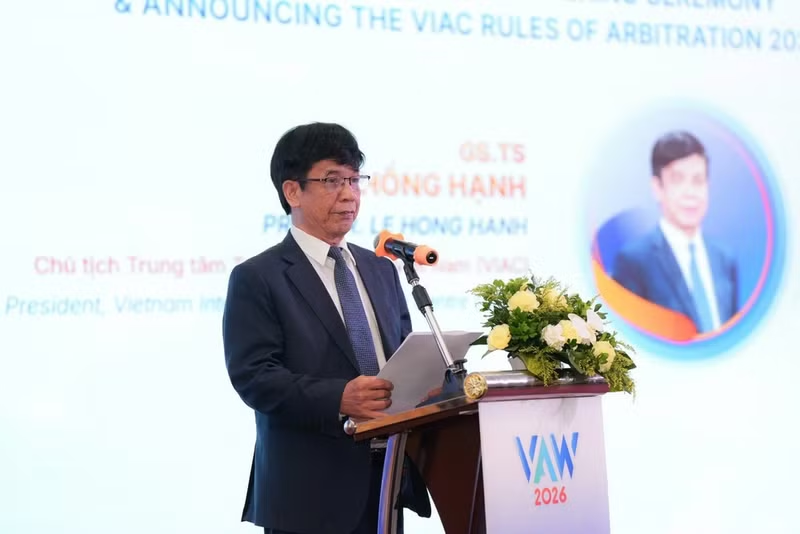
He affirmed that VIAC will continue to drive reform activities, including issuing the 2026 Arbitration Rules with a focus on innovation and practical significance, moving towards more modern, flexible rules better suited to current dispute‑resolution practice.
Vu Anh Duong, Executive Vice‑President of VIAC, explained that the Rules have been drafted and refined with the core orientation of adhering to international development trends, enhancing the efficiency of arbitral proceedings and promoting digitalisation and the application of technology in arbitration and alternative methods.
Revising the Rules is not only intended to respond to changes in the practice of resolving international commercial disputes but also to raise the quality of arbitration services in Viet Nam amid growing expectations from the business community and investors for transparency, efficiency and predictability.
"Meanwhile, multi‑party disputes, chain disputes and disputes arising from multiple contracts are increasingly prevalent worldwide. The trend towards digital transformation and the digitalisation of arbitral proceedings has also become an inevitable requirement for modern arbitration centres,” Duong affirmed.
With the launch of the VIAC Arbitration Rules 2026, it is hoped there will be a significant step forward for arbitral procedure in Viet Nam, contributing to enhanced capacity to handle complex, cross‑border disputes in the years ahead.
He added that Vietnamese arbitration should aim not only to resolve domestic disputes but also to handle disputes with foreign elements. Therefore, to enhance competitiveness, procedural rules must come closer to international norms.
Businesses today, he noted, care not only about the quality of dispute resolution but also about the “procurement experience” of proceedings, demanding faster, more transparent and more cost‑effective procedures. For that reason, the 2026 Arbitration Rules have been built on three main orientations: aligning with international arbitration trends; improving procedural efficiency in terms of time, cost and user experience; and promoting digital transformation in arbitration activities.
With the launch of the VIAC Arbitration Rules 2026, it is hoped there will be a significant step forward for arbitral procedure in Viet Nam, contributing to enhanced capacity to handle complex, cross‑border disputes in the years ahead.