The pioneers’ footsteps
With no land to cultivate and no agricultural qualifications, Colonel Hoang Phuong Thao (a police officer seconded to serve as Chief Inspector of Ca Mau Province) and construction engineer Ta Van Lam faced considerable scepticism when they first set foot in the rice fields. When they conceived the idea of growing organic rice and sugar-free rice for export, some bluntly stated that they had never even planted rice before, yet they dreamed of bringing rice to the world market. However, the pressing question — why, after a lifetime of rice farming, do people remain poor, and why does the rice from their homeland continue to be sold in low-value segments? — spurred these self-taught individuals to take the plunge.
From these concerns, Colonel Thao diligently researched and successfully developed a liquid crystalline organic compound for rice fertilisation, along with technology for separating glucose from rice. Engineer Lam, meanwhile, chose to live and work alongside farmers on each plot of land. The turning point came when Ha Thanh Dien (Misun Group), bringing investment resources and a desire to connect with consumers through charitable trips in 2019, gave birth to the Ong Dien rice brand right in the rice-shrimp farming area of Ca Mau.
By 2020, more than 100 hectares of ST24 and ST25 rice, applying sugar separation technology, had covered the fields in Lang Tron Ward, Ca Mau Province. A notable achievement came in late 2025 and early 2026, when the first shipment of 212 tons of Ong Dien rice was exported to the US, along with 28 tonnes to Japan.
Recalling the early days full of hardship, engineer Lam reminisced about the nights when farmers secretly sowed extra seeds, the fear of draining water from the fields, or the heartache of harvesting rice before the heading stage. People even lost sleep worrying about the white smoke rising from herbicide spraying.
He recounted: “To convince them, I personally drank the extract right in the field to prove that the compound extracted from the plants was completely safe for humans and crops. My belief truly blossomed when the rice yielded 700-1,000 kg per hectare.”
Along with rice, the rice-shrimp farming model brings double benefits with the addition of snakehead fish and prawns, helping farmers in Lang Tron earn 80-150 million VND/hectare/year. Even those who initially resisted most strongly later voluntarily participated, expanding the cultivated area to 238 hectares.
Colonel Thao shared: “The fact that Ca Mau rice can be exported to demanding markets is the culmination of perseverance and unwavering belief in lasting value.”
Bringing the flavour of the countryside to the open sea
Despite these bright spots, the overall picture of Ca Mau’s rice industry still faces numerous challenges. Located at the end of the Mekong River, Ca Mau’s land frequently suffers from drought and freshwater shortages during the dry season. Climate change and land subsidence further exacerbate salinity intrusion into inland areas. The only solution for survival and breakthrough is collaboration and a shift in mindset.
Trinh Van Cuong, Director of Vinh Cuong Cooperative, the unit implementing the 1-million-hectare high-quality rice project in Ca Mau, said: “The cooperative is implementing about 13,000 hectares in Ca Mau, An Giang, and Tay Ninh, investing 5-12 million VND/hectare and providing technical support to ensure the product meets export standards to Europe.” Similarly, 278 members of the Ba Dinh Agricultural, Fisheries and Service Cooperative (Vinh Loc Commune, Ca Mau Province) have also specialised in organically cultivating ST24, ST25, and BL9 rice varieties.
Director Nong Van Thach shared: “Thanks to the guaranteed purchase by businesses, each rice crop brings in 45-50 million VND/hectare. Our BL9 variety was recently recognised as the best rice in the Mekong Delta.”
The formation of large-scale raw material areas is helping Ca Mau farmers gradually move away from fragmented farming practices. By the end of 2025, the province had 27 companies linked with 50 cooperatives and cooperative groups, covering an area of over 53,350 hectares, with a consumption volume of approximately 320,142 tonnes, accounting for 16.7% of the province’s total production.
Engineer Nguyen Tran Thuc, Head of the Crop Production and Plant Protection Sub-Department of Ca Mau, said: “Participating in the linkage chain increases the value of rice by 200 to 1,000 VND/kg compared to conventional farming.”
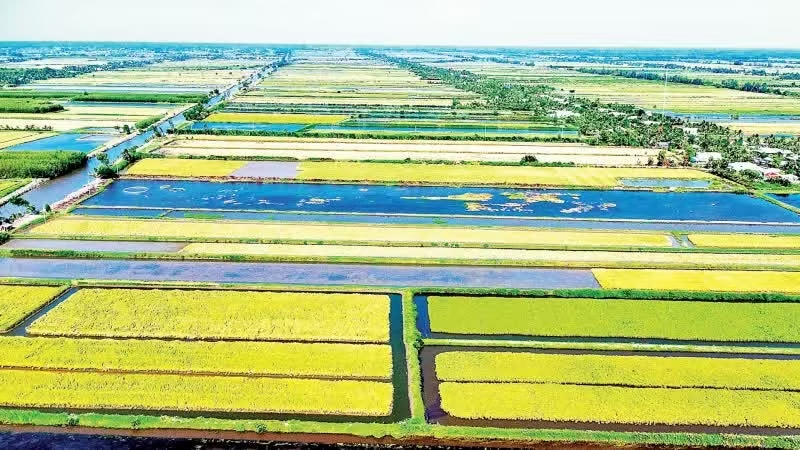
To enhance competitiveness, Ca Mau is using ecological models as a foundation. Of the province's current 180,000 hectares of rice cultivation, 94,000 hectares follow the rice-shrimp farming model, with the potential to expand by another 25,000 hectares. This farming model is also proving effective on the fields of nearly 200 farmers belonging to the High-Quality Clean Agricultural Products Cooperative in Lang Tron Ward.
Nguyen Hong Khanh, a member of Lang Tron Cooperative, happily stated: “At the end of 2025, while rice prices plummeted in many places, my family still sold our rice at 11,000 VND/kg. Thanks to the guaranteed purchase by the enterprise, my family is assured profit of over 300 million VND.”
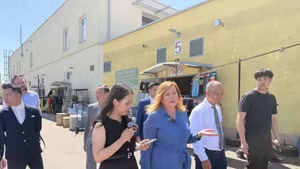
After directly inspecting the fields, Ho Trung Viet, Head of the Communication, Education and Mass Mobilisation Department of the Ca Mau Provincial Party Committee, commented: “The absence of pests and diseases in the organic rice fields of Lang Tron is a clear difference compared to fields that overuse chemicals. Farmers here have also successfully applied advanced processes, helping many areas achieve VietGAP, Global GAP, and other stringent international standards such as USDA, EU, and JAS.”
With a vision to 2030, Ca Mau aims for 70% of its rice production to be consumed outside the province and exported, while the area of high-quality, low-emission rice is expected to reach 55,000 hectares.
To realise this goal, Le Van Su, Vice Chairman of the Ca Mau Provincial People’s Committee, said that the provincial government and relevant agencies are actively supporting farmers in promoting the application of science and technology in every stage of cultivation and strengthening supply chain linkages. “When science and technology serve as a springboard and the supply chain is closely linked, Ca Mau’s ecological rice will truly enhance its value and confidently bring its ‘alluvial flavour’ to conquer the world market,” Le Van Su shared the direction.
With the power of technology and a collaborative mindset, the “ecological revolution” on the saline land is opening a new chapter, enabling Ca Mau rice to overcome natural barriers and confidently reach bigger and further horizons.