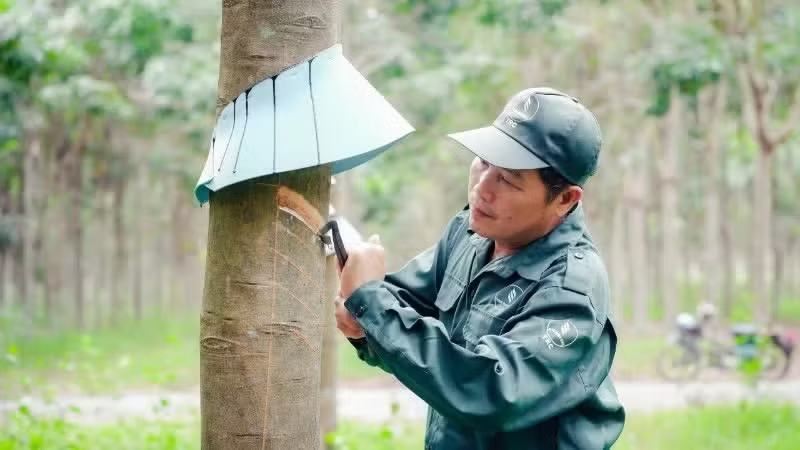
At a time when rubber prices remain favorable, enterprises under the Vietnam Rubber Group (VRG) in Tay Ninh are entering the 2026 production season with positive prospects in terms of output, business efficiency and sustainable development.
As key production units of the rubber industry, Tan Bien Rubber Joint Stock Company and Tay Ninh Rubber Joint Stock Company have also emerged as bright spots in coordinating with functional forces to maintain security and order and protect sovereignty in border areas.
Accelerating the new tapping season
At Tay Ninh Rubber Company, the 2026 tapping season began simultaneously on April 20, with more than 4,150 hectares put into exploitation.
Nguyen Hong Thai, General Director of Tay Ninh Rubber Company, said that in the first four months of 2026, the enterprise sold nearly 2,610 tonnes of products, earning more than 193 billion VND in revenue, with pre-tax profit exceeding 69 billion VND and after-tax profit reaching nearly 61 billion VND.
This result continued the positive growth momentum recorded in 2025, when Tay Ninh Rubber Company achieved an output of more than 9,052 tonnes, revenue of nearly 612 billion VND and after-tax profit of nearly 209 billion VND. Its average productivity reached more than two tonnes per hectare, placing it among the high-performing units in the sector.
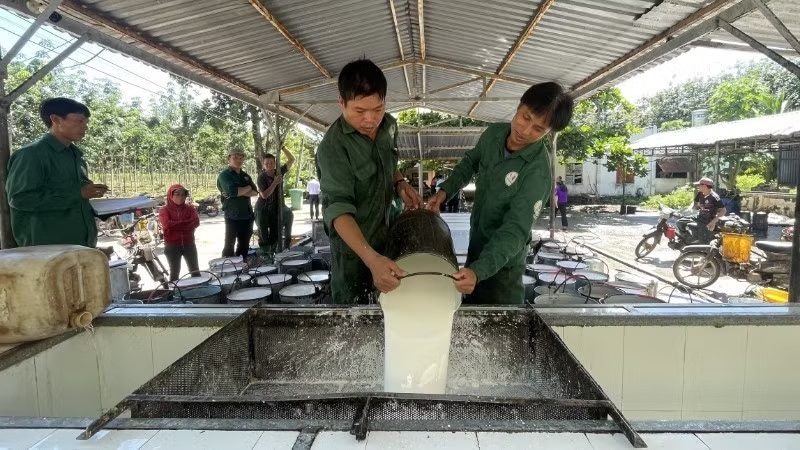
Meanwhile, Tan Bien Rubber Company entered the 2026 production year with a plan to harvest 3,550 tonnes of latex from more than 2,540 hectares under exploitation. The enterprise aims to achieve revenue of more than 824 billion VND and pre-tax profit of over 379 billion VND in 2026.
In 2025, despite difficulties caused by a shortage of tapping workers and low plantation productivity, Tan Bien Rubber Company exceeded most of its production and business targets. Its harvested output reached more than 3,513 tonnes, while sales volume stood at nearly 11,945 tonnes. Total revenue reached more than 855 billion VND, up nearly 35% compared with the plan, and pre-tax profit exceeded 276 billion VND.
Notably, the company has continued to promote the purchase of latex from smallholder farms and finished rubber products in order to make full use of processing capacity, while helping stabilise outlets for rubber growers in the area.
Digital transformation and green production to enhance competitiveness
As export markets impose increasingly strict requirements on environmental standards and traceability, both enterprises have stepped up the application of science and technology as well as digital transformation.
Tay Ninh Rubber Company is among the pioneers in implementing a traceability system in line with the European Union Deforestation Regulation (EUDR), while digitalising plantation management, labor, finance and supply chains.
The enterprise has also maintained international certifications in quality, environment and sustainable forest management, aiming toward the goal of net-zero emissions by 2050. In 2026, the company will continue to complete its carbon footprint management system under ISO 14067, implement ISO 50001 energy management, and expand the use of electric vehicles in production activities.
Similarly, Tan Bien Rubber Company has completed VFCS/PEFC sustainable forest management certification for its entire managed area of more than 6,300 hectares, while building a comprehensive traceability database to meet EUDR requirements.
According to business leaders, compliance with green standards not only helps maintain export markets but also lays the foundation for a long-term sustainable development strategy.
“Living border markers” in frontier areas
Alongside production and business tasks, rubber enterprises in Tay Ninh also play an important role in maintaining security and order and protecting national border sovereignty.
Rubber plantations stretching along the border not only provide livelihoods for thousands of workers, but also help build a firm all-people national defense posture in the country’s frontier areas.
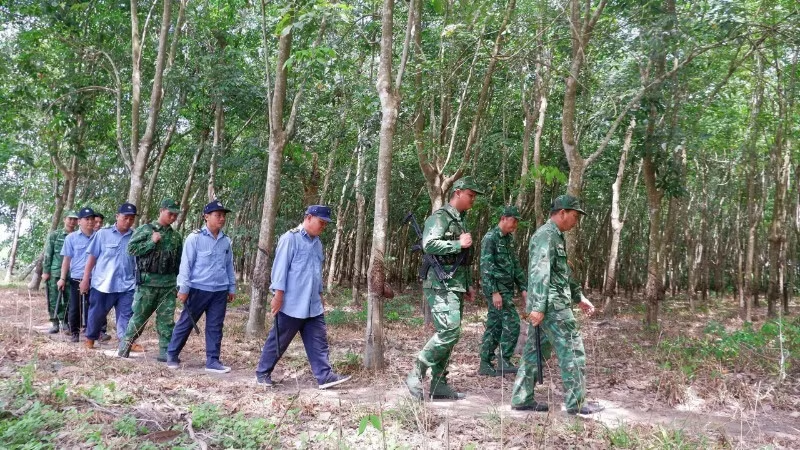
At Tan Bien Rubber Company, the coordination model between the enterprise, the Tay Ninh Border Guard Command and Suoi Lam Border Guard Station has been effectively maintained since 2012.
Along the approximately 14.5-kilometer border section managed by the company, rubber workers are regarded as “living border markers”. They both engage in production and support functional forces in keeping track of the local situation, promptly detecting and preventing violations of the law.
In 2025 and the first five months of 2026, the company’s production team coordinated with Suoi Lam Border Guard Station to organise 12 patrol and sweep operations, with 45 participants. They detected nine people involved in rubber latex theft and recovered more than 162 kilograms of latex of various types.
Tran Van Toan, Deputy General Director of Tan Bien Rubber Company, said that most workers operating in border areas have received legal information and education, while also improving their awareness of the responsibility to protect the national borderline and border markers.
“Workers are present on the ground every day, so they understand the local situation very well. When they detect any unusual signs, they immediately report them to the border guard force. It can be said that workers are the ‘eyes’ supporting border guards in protecting the border,” Toan said.
In addition to coordinating patrols and ensuring security, the company’s technical staff also support border guards in caring for, managing and exploiting rubber areas under their management, thereby strengthening the bond between the military, local people and enterprises in border areas.
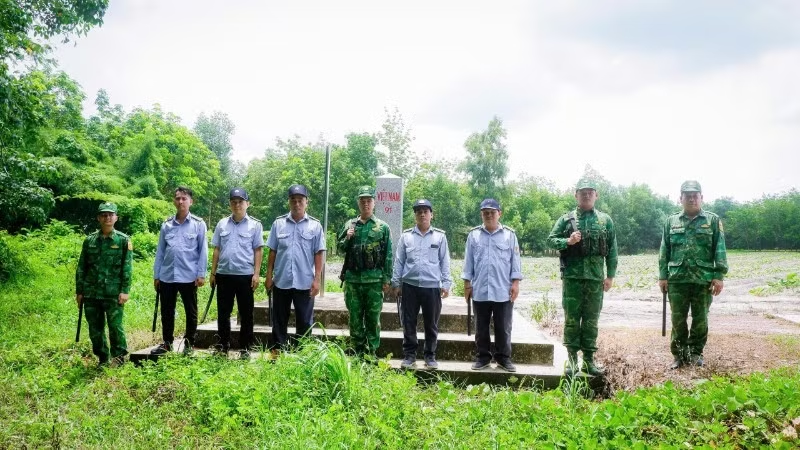
Similarly, Tay Ninh Rubber Company has also maintained effective coordination with police forces and local authorities in protecting assets and ensuring security and order in project areas and border localities.
In 2025, the company coordinated with the Tay Ninh Provincial Police and border localities to organise 95 intensive patrols with 217 participants. They detected and handled 15 cases of rubber latex theft involving 19 people, seizing 254 kilograms of latex and many means of violation.
At the same time, the enterprise has regularly organised activities to disseminate legal knowledge and raise awareness of drug prevention and control, fire prevention and fighting among workers. These efforts have contributed to building a safe and stable production environment and improving law observance among communities in border areas.
Corporate development linked with social responsibility
In parallel with production activities, rubber enterprises in Tay Ninh have continued to devote significant resources to social welfare.
In 2025, Tay Ninh Rubber Company spent more than 1.6 billion VND on social welfare activities in localities, while also supporting the Trade Union Shelter Fund, caring for workers’ livelihoods and assisting communities in border areas.
At Tan Bien Rubber Company, the “Comrades’ Houses” model launched by the company’s Party Committee has helped build and repair many houses for Party members and workers facing difficult circumstances.
Tran Van Toan emphasised: “The homes built in border areas not only help workers settle down and stabilise their lives, but also strengthen their trust in and attachment to the enterprise.”
As the 2026 harvesting season begins, from the vast green rubber forests along the southwestern border, rubber enterprises in Tay Ninh are demonstrating a sustainable path: developing the economy in tandem with green transformation, caring for workers’ lives, and joining hands to safeguard peace in the country’s frontier areas.





![[Video] Resolution No. 10 repositions FDI in Viet Nam's new development strategy](https://en-cdn.nhandan.vn/images/5992a12dd6e78b9bfb434962ff1830731c3ef6c1538d722fbb2593b0fa31ecfea73ea406e335bb4f889623e75863a3fa5de1ba084f5b1db0b5788c84a44f1d4c/anh-dai-dien.jpg.avif)