At the seminar entitled "Regenerative Agriculture – A sustainable path for Vietnamese agriculture", many domestic and international experts concurred that transitioning to regenerative farming has shifted from an optional practice to a non-negotiable prerequisite for Vietnamese agricultural products to meet global market standards.
Wouter Melis Van Ravenhorst, Director of Control Union Viet Nam, noted that while Viet Nam has significant agricultural advantages, the sector faces mounting pressure from the "green barriers" imposed by export markets. Requirements pertaining to emissions reduction, biodiversity protection, deforestation prevention, and product traceability now serve as fundamental prerequisites for many agricultural products.
Wouter stressed that regenerative agriculture actively restores ecosystems, improve soil health, reduce greenhouse gas emissions, and elevates the value of agricultural products throughout the supply chain. Sharing this view, Hoang Thi Thu Huong, Senior Project Officer at GIZ, emphasised that the core principle of regenerative agriculture is to restore natural resources rather than focusing solely on maximising production.
According to the Ministry of Agriculture and Environment's Project on "Low-emission crop production for the 2025–2035 period, with a vision to 2050", coffee stands out as one of the sectors with significant potential to reduce greenhouse gas emissions, alongside rice, sugar cane, cassava, and bananas. Huong noted that transitioning to regenerative agriculture will ensure the coffee industry complies with new requirements of the international market, including the European Union Deforestation Regulation (EUDR), while also creating opportunities to participate in the carbon credit market in the future, unlocking a lucrative new revenue stream for producers.
In practice, many businesses have proactively partnered with farmers to implement regenerative farming models. Among them, the Nescafé Plan, launched by Nestlé Viet Nam in 2011, serves as one of the leading initiatives promoting sustainable coffee production in the Central Highlands.
Pham Phu Ngoc, Head of Nestlé Viet Nam's Central Highlands Branch and Director of the Agricultural Development Programme, noted that the greatest challenge during the transition is not the technology itself but helping farmers digest new concepts and instantly apply them in daily farming. The principles of regenerative agriculture have therefore been translated into three key groups of practices: soil management, water management, and biodiversity conservation.
For soil management, farmers are encouraged to maintain ground cover, repurpose agricultural by-products to produce organic fertiliser, and apply balanced fertilisation. These measures slash chemical feriliser use by 20–40%, drastically improving soil fertility while driving down production costs.
For water management, coffee growers are trained to monitor soil moisture and pinpoint exact irrigation needs. As a result, water consumption plummets from approximately 700–1,000 litres to around 400 litres per coffee tree without affecting productivity.
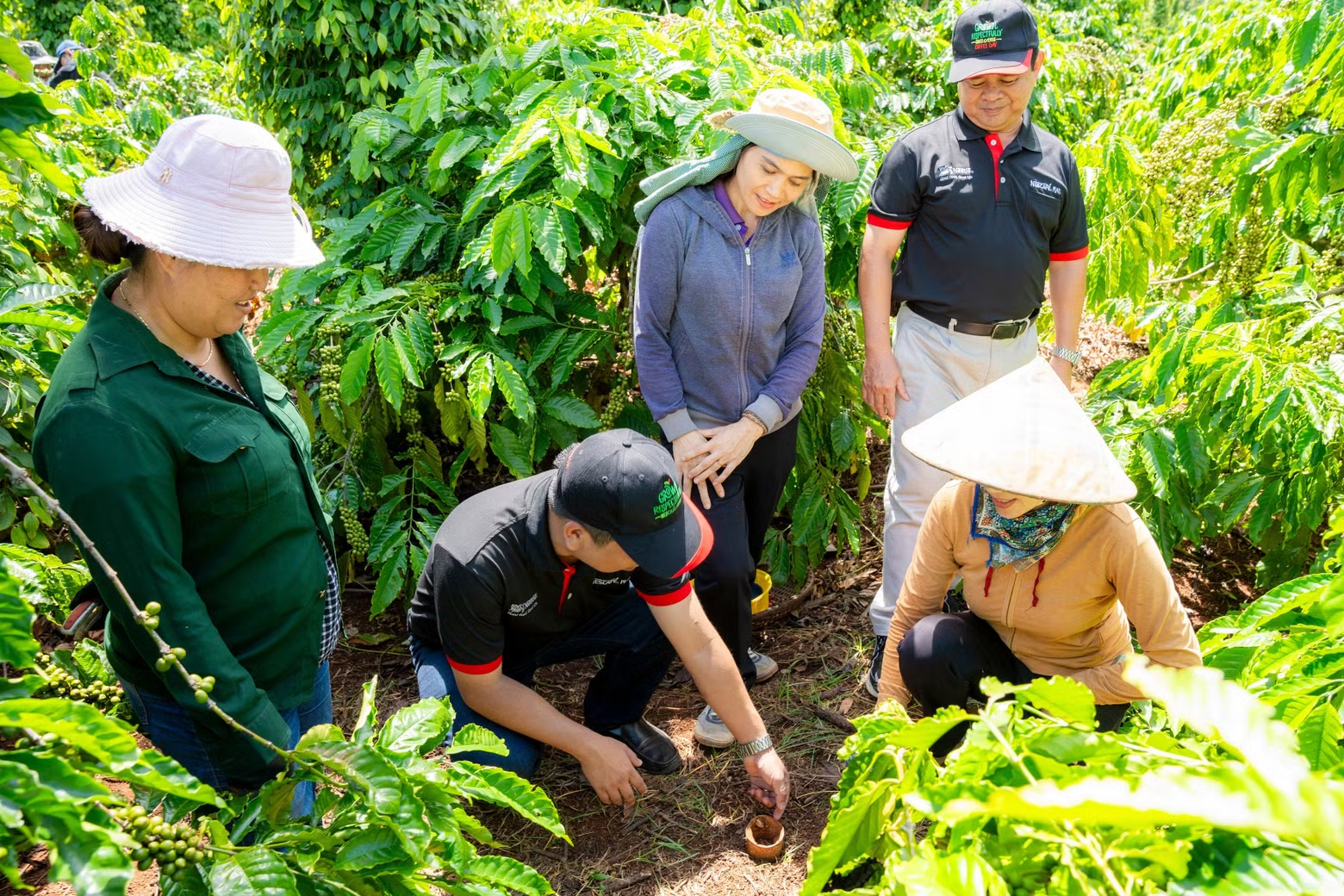
In addition, biodiversity thrives through intercropping and agroforestry systems. Growing coffee alongside pepper or fruit trees not only provides shade and improves the ecosystem but also allows farmers to multiply their revenue streams from the same area of land.
Beyond its environmental benefits, regenerative agriculture also yields striking economic dividends for producers. According to programme data, household income can surge by 30–150% compared with coffee monoculture, thanks to lower input costs and additional income from intercropped crops.
This success is perfectly encapsulated by the farming model of Mai Thi Nhung in Dak Lak Province. On her two-hectare farm, where coffee is intercropped with pepper and durian and supported by a digital farm management system, her family nets a profit of more than 1.2 billion VND per harvest.
Nguyen Van Thiet, Manager of the Rainforest Alliance Office in Viet Nam, stressed that now is the ideal time for Viet Nam's coffee industry to accelerate its transition towards sustainable development to meet the increasingly demanding requirements of international markets.
He noted that a regenerative farm achieves far more than simply yielding agricultural products — it also helps restore ecosystems, conserve biodiversity, and build a more harmonious relationship between people and nature.
"Soil should not simply be regarded as a means of production, but as a partner. In this way, farmers do not merely exploit the land; they also invest in making it healthier and more fertile for future harvests," Nguyen Van Thiet emphasised.
Experts believe that as green consumption trends and sustainable development regulations become increasingly widespread around the world, transitioning to regenerative agriculture will not only help Viet Nam's coffee industry dismantle new trade barriers but also forge a robust foundation to boost added value and building the Vietnamese coffee brand on a sustainable long-term basis.