Elevating the proportion of vegetables that satisfy safety standards
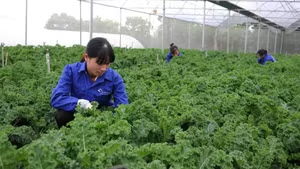
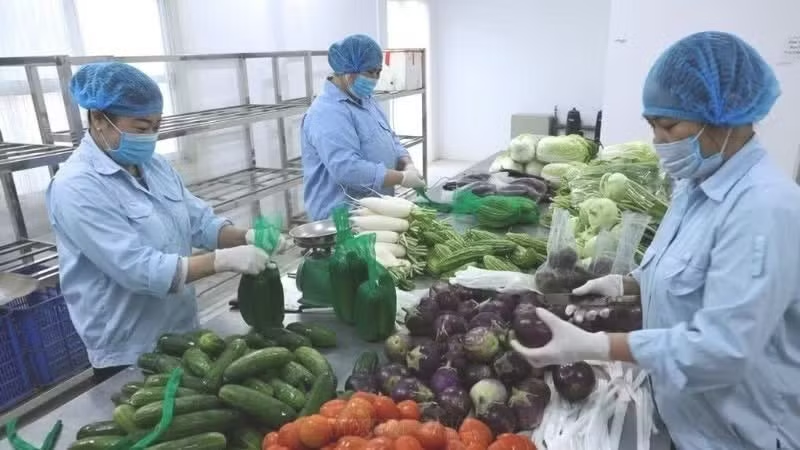
Nguyen Do Ban, Director of the Huong Ngai Agricultural Cooperative in Tay Phuong Commune, Ha Noi, highlighted that the cooperative currently cultivates 10 hectares of vegetables compliant with VietGAP standards and 45 hectares using safe farming practices. Strict control of agricultural inputs and adherence to pre-harvest safety intervals guarantee consistent product quality.
As a result, the majority of the cooperative’s products are consistently distributed to supermarkets and institutional canteens at prices 10–15% higher than those of traditionally grown produce.
Ha Noi currently has approximately 33,000 hectares of vegetable crops, with a yield of 22 tonnes per hectare and a total output of 745,000 tonnes, satisfying 60–70% of the city's demand.
Of this total, VietGAP-certified vegetables comprise about 429 hectares; certified organic vegetables encompass approximately 149 hectares; and an additional 63 hectares are currently transitioning to organic farming.
Most of the remaining vegetable-growing areas in the city employ safe farming practices. Many of Ha Noi's specialised vegetable-growing zones have forged strong market brands, such as those in Trang Viet and Yen Nhan (Me Linh Commune); Van Duc (Bat Trang Commune); Linh Nam; and Nam Hong, Bac Hong, Van Noi, Tien Duong, and Nguyen Khe (Phuc Thinh Commune).
According to the orientation of the Ministry of Agriculture and Environment, zoning areas for safe vegetable production with traceability capabilities constitutes a pivotal strategy for the sustainable development of this sector.
The Ministry has set a target for national vegetable output to achieve 23–24 million tonnes by 2030, with approximately 1–1.3 million tonnes desigearmarkednated for processing. Notably, over 95% of the vegetable samples subjected to inspection and testing satisfied rigorous safety standards.
The area dedicated to safe, concentrated vegetable production with guaranteed traceability represents approximately 30% of the country’s total vegetable cultivation area.
Luu Thi Hang, Head of the Hanoi Sub-Department of Cultivation and Plant Protection under the Ha Noi Department of Agriculture and Environment, affirmed that the city aims to sustain concentrated, specialised safe vegetable production zones by 2030, achieving an annual output of over 400,000 tonnes.
For these concentrated, specialised safe vegetable zones, the city’s goal seeks to guarantee that pesticide residues stay strictly below regulatory limits across 90% of the production area.
Regarding non-specialised vegetable production areas — characterised by small-scale, fragmented plots — farmers will be instructed to implement safe production processes. Additionally, the agricultural sector anticipates that over 30% of safe vegetable output from concentrated zones will be fully traceable.
Ho Chi Minh City aims to secure a vegetable cultivation area of 5,500 hectares (with a total planted area of 35,000 hectares) and an estimated annual output of 880,000 tonnes by 2030.
Specifically, the area dedicated to concentrated, traceable safe vegetable production is targeted to constitute 60% of the total vegetable planting area, while 100% of locally produced vegetable samples must satisfy strict safety standards.
Guaranteeing product transparency and fortifying supply chain linkages
According to Luu Thi Hang, to realise these goals, Ha Noi’s agricultural sector frequently convenes training sessions for farmers on topics such as Integrated Pest Management (IPM) and Integrated Plant Health Management (IPHM). Simultaneously, the city is advancing product information transparency through the application of modern technology.
Agricultural cooperatives have optimised collective strength by instituting cross-monitoring groups. Thanks to these inspections, community monitoring groups can promptly detect and rectify errors during the production process.
Despite significant efforts, the production of “safe vegetables” at the local level still encounters numerous challenges. Key issues stem from insufficient synchronised investment in infrastructure — such as internal farm transport, irrigation networks, preliminary processing facilities, and cold storage — as well as fragmented cultivation areas.
Technology transfer encounters barriers due to the ageing farming population. Furthermore, consumer habits still favour spontaneous or temporary street markets, with only a small volume of safe vegetables distributed through cooperatives and companies.
Consequently, authorities must urgently allocate capital to finalise infrastructure in designated safe vegetable production zones, specifically focusing on internal farm roads, irrigation canals, processing facilities, and cold storage warehouses.
Flexible mechanisms must be implemented to expedite land consolidation and stimulate business investment in high-tech agriculture, thereby establishing large-scale safe vegetable production areas.
Simultaneously, favourable conditions must be cultivated for cooperatives and cooperative groups to secure preferential loans for reinvesting in equipment, greenhouses, and net houses. Agricultural insurance pilots should also be implemented in major specialised farming zones to minimise risks for farmers arising from natural disasters and disease outbreaks.
Efforts must be intensified to forge production and consumption linkages for vegetable products among businesses, cooperatives, and farmers. This necessitates reinforcing chain integration — spanning input supply and services, production organisation, preliminary processing, and final processing — all aligned with market demand.