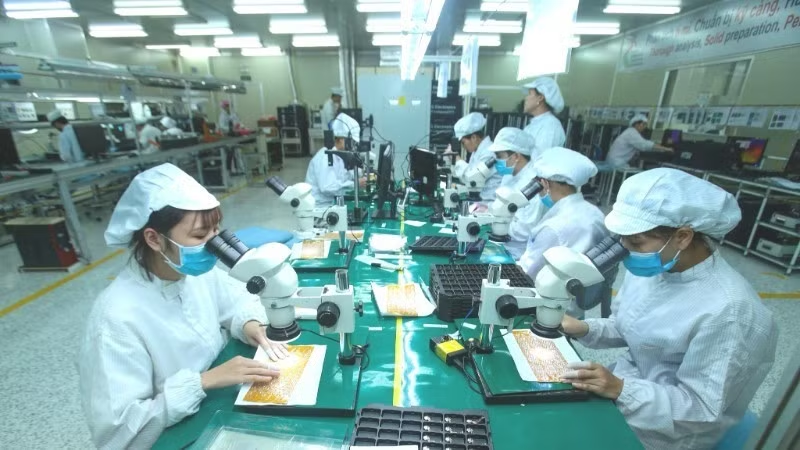
In his closing remarks at the plenum, General Secretary and State President To Lam said the Party Central Committee had decided to issue a resolution on the new development model, describing it as an unprecedented and far-reaching initiative that would shape the country’s development trajectory through to 2045 and beyond.
Building new drivers of growth
Establishing a development model centred on productivity, knowledge, technology and people is one of the four strategic transformations endorsed at the third plenum. The shift is intended to remove bottlenecks, unlock resources and create new drivers of growth, laying the foundation for the strategic objectives set out by the 14th National Party Congress.
Professor Dr Nguyen Khac Quoc Bao, Vice President of the University of Economics Ho Chi Minh City, said the decisions adopted at the plenum represented far more than an adjustment of economic targets.
According to him, they signal a fundamental shift in development thinking, moving away from a model driven by capital, natural resources, contract manufacturing and low-cost labour towards one based on productivity, data, innovation and highly skilled human resources.
This marks a decisive transition from the extensive growth model that Viet Nam has relied on for decades to one focused on intensive growth, where added value is generated through knowledge and technology rather than the volume of labour or resource extraction.
Professor Bao said the success of this transformation would depend on three key factors. The first is institutional reform and governance. Science, technology, innovation and digital transformation must be translated into tangible improvements in productivity, quality and added value through concrete mechanisms that convert knowledge into marketable products rather than remaining policy aspirations.
The second is maintaining the complementary roles of a facilitating State and an efficient market, with the private sector identified as the most important engine of growth.
The third is ensuring that foreign investment contributes to technology transfer and strengthens domestic capabilities instead of serving merely as a source of capital.
From a macroeconomic perspective, Dr Nguyen Duc Kien, former head of the Prime Minister’s Economic Advisory Group, noted that many sustainable development theories, including those adopted by developing countries and members of the Organisation for Economic Co-operation and Development (OECD), are built on three interconnected pillars: economic development, environmental protection and social security.
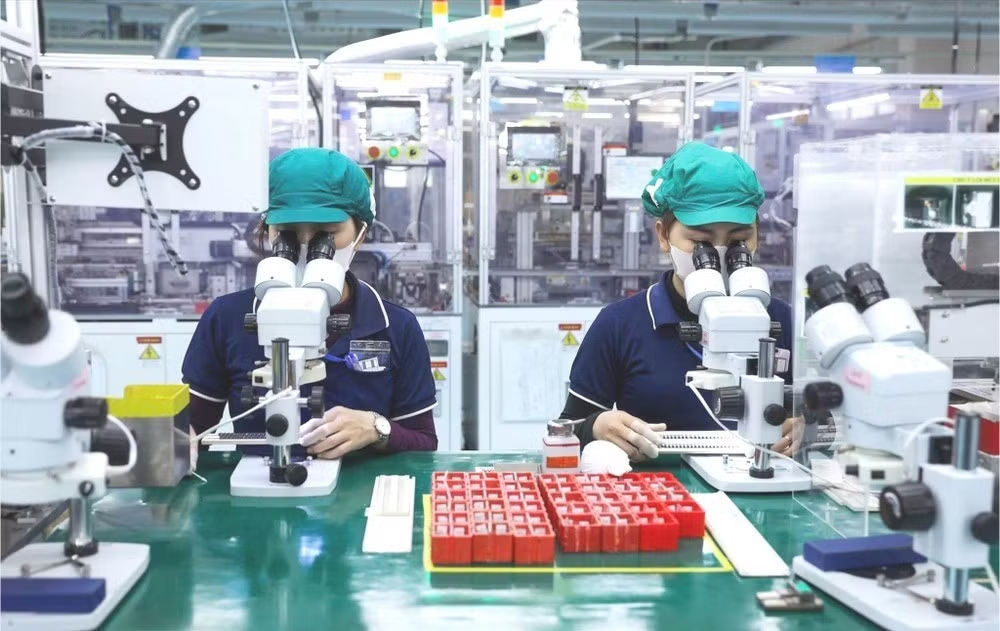
He said Viet Nam’s renewed development model through to 2045 should place rapid economic growth at the apex of this framework in order to improve living standards while fulfilling environmental commitments. Environmental protection and social welfare would form the other two pillars, creating a balanced development model with strong investment in growth, rising incomes and a gradual transition to a greener economy.
Human resources, digital infrastructure and other enabling factors, he added, would provide the means to realise the country’s long-term development goals.
Building a more resilient economy
Professor Tran Tho Dat of the National Economics University said Viet Nam had reached a critical stage of development where it must answer a fundamental question: how can the country create prosperity, competitiveness and national standing in the decades ahead?
He argued that the pursuit of double-digit economic growth was important, but that such growth could no longer be achieved through a model dependent on capital, natural resources, cheap labour and contract manufacturing. With an ageing population and intensifying technological competition, these traditional growth drivers may expand the economy in size but are no longer sufficient to improve its quality.
A development model based on productivity, knowledge, data, technology and innovation, he said, is therefore essential if Viet Nam is to avoid the slowdown that often affects economies after they reach upper-middle-income status.
Dr Nguyen Minh Thao, Head of the Department for Enterprise Development and Business Environment at the National Institute for Economics and Finance under the Ministry of Finance, noted that Viet Nam’s growth had for many years relied heavily on investment, inexpensive labour, the foreign-invested sector and exports.
As these traditional drivers gradually lose momentum, she said, shifting to a productivity-led model driven by innovation, science and technology, digital transformation, and the strength of domestic enterprises has become an urgent priority.
Such a transition, she added, is vital to building a resilient economy. The immediate challenge is to accelerate implementation, turning political commitment into tangible results by ensuring smooth government operations, removing urgent bottlenecks and delivering the highest possible socio-economic outcomes during the second half of the year.
Professor Bao identified policy implementation as the biggest obstacle to economic development and proposed four priorities to address it.
First, new policies must be both financially realistic and practical to implement.
Second, civil servants should strengthen their capacity to identify policy bottlenecks using data and evidence, while shifting from a control-oriented mindset to one that enables people, businesses and social organisations to thrive.
Third, cooperation should be enhanced among local authorities, research institutes, universities, businesses and communities.
Fourth, a robust mechanism should be established to protect officials who are willing to innovate, take responsibility and act in the public interest, while maintaining strict oversight of power.
Professor Bao concluded that 2045 is not far away given the time required to reform institutions, develop talent and build globally competitive technology companies. The most important message, he said, is that opportunities for development will not last indefinitely. National aspirations can become reality only when they are matched by effective action, a strong sense of responsibility and tangible improvements that people and businesses experience in their daily lives.