Experience from several marine economic centres shows that when seaport infrastructure, logistics, industry, and businesses are integrated effectively, they generate a strong ripple effect, driving breakthrough regional economic growth and enhancing national competitiveness.
Making a mark on the international maritime map
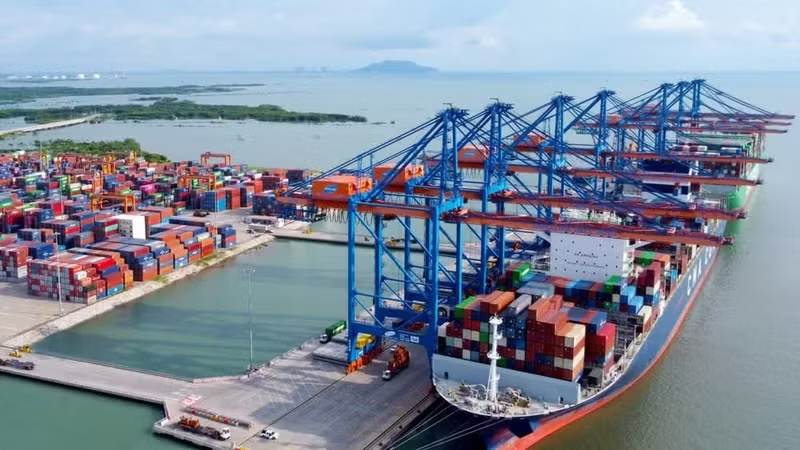
According to the 2025 Container Port Performance Index (CPPI), jointly released by the World Bank (WB) and S&P Global Market Intelligence, Cai Mep Port and Hai Phong Port have, for the second consecutive year, secured places among the world's top 20 most efficient container ports, outperforming many major ports across the region.
Cai Mep Port ranked 11th globally with 122 points, while Hai Phong Port ranked 13th, positioned just behind several of the world's leading ports, including Fuzhou, Dalian, Ningbo, Hong Kong (China), Salalah (Oman), and Kobe (Japan).
Hai Phong is one of the few localities in Viet Nam that possesses all five modes of transport. It is connected to the Ha Noi–Hai Phong–Quang Ninh Expressway; Cat Bi International Airport, which can accommodate wide-body aircraft; the planned Lao Cai–Ha Noi–Hai Phong high-speed railway; and a modern deep-water seaport system capable of receiving vessels of more than 200,000 DWT with direct connections to major ports in Europe and the Americas.
The year 2025 witnessed remarkable growth for Hai Phong's port system with the inauguration of Hateco Hai Phong International Container Terminal (HHIT), invested entirely with private capital by Hateco Group. The terminal can simultaneously accommodate two large container vessels of up to 200,000 DWT (more than 18,000 TEUs).
Hai Phong Port Joint Stock Company also inaugurated Berths No. 3 and No. 4 (HTIT) at Lach Huyen Port, capable of handling vessels of up to 165,000 DWT (14,000 TEUs) and partially loaded vessels of 200,000 DWT, with a total handling capacity of 1.3–1.5 million TEUs per year.
Lach Huyen Port is steadily affirming itself as a gateway to international waters and a symbol of Hai Phong's breakthrough in seaport infrastructure, becoming an important link in the global maritime map.
Le Do Muoi, Head of the Viet Nam Maritime and Waterway Administration under the Ministry of Construction, said that thanks to open policies and strong private-sector investment, Viet Nam's seaport system has made remarkable progress in recent years, strengthening its position on the global maritime map.
During the 2010–2015 period, major ports such as Hai Phong, Sai Gon, and Da Nang received foreign loans to upgrade their cargo handling capacity.
In the first six months of this year, the total cargo volume handled through Viet Nam's seaports and inland waterway ports was estimated at 687.5 million tonnes, an increase of 18% compared with the same period in 2025, with container throughput reaching approximately 18 million TEUs, up 12%.
According to the revised master plan for seaport groups, terminals, and wharves for the 2021–2030 period, with a vision to 2050, recently issued by the Ministry of Construction, investment demand for Viet Nam's seaport system is estimated at more than 359 trillion VND. This includes approximately 72.8 trillion VND for public maritime infrastructure and around 286.7 trillion VND for commercial cargo terminals.
The total land requirement for the seaport system by 2030 is estimated at approximately 34,000 hectares, including areas designated for port development, 17,500 hectares of which will be allocated to seaports.
Strengthening connections between transport modes
Deputy Minister of Construction Nguyen Xuan Sang noted that in recent years many of the world's leading groups, including APMT (Denmark), PSA (Singapore) and SSA Marine (the US), as well as shipping companies such as MOL and NYK, have made substantial investments in major Vietnamese ports, creating a modern port network that meets international standards from north to south.
Today, Viet Nam's seaports are capable of receiving some of the world's largest vessels, with capacities exceeding 200,000 DWT. Placing seaports at the centre of transport connectivity, establishing a national logistics database, and promoting green transition and digital transformation are regarded as key strategies for developing efficient and sustainable multimodal transport.
According to Sang, the Ministry of Construction is finalising sectoral master plans covering all five modes of transport to support the country's goal of achieving double-digit GDP growth.
At present, Viet Nam's seaport system consists of 34 ports with 320 berths. Cargo throughput exceeded 960 million tonnes in 2025, placing Viet Nam among the fastest-growing nations in the region.
The Viet Nam Maritime and Inland Waterways Code currently being drafted includes policies that prioritise the development of multimodal transport connectivity with active participation from businesses in providing logistics services.
Representatives of the Viet Nam Maritime and Waterway Administration noted that statistics from the United Nations Conference on Trade and Development (UNCTAD) show that approximately 80–90% of global merchandise trade is transported by sea. Most international logistics chains are organised around major hub seaports, which serve as key connections between maritime transport and road, rail, inland waterway, and air transport.
At present, Viet Nam's seaport system consists of 34 ports with 320 berths. Cargo throughput exceeded 960 million tonnes in 2025, placing the country among the fastest-growing economies in the region.
However, the development process of seaports and logistics in most localities continues to face challenges, including inadequate maritime infrastructure, insufficient channel depth, shortages of modern specialised equipment capable of serving vessels exceeding 200,000 DWT, incomplete multimodal transport connectivity, and limited integration between seaports and other transport modes. These shortcomings continue to result in increased logistics costs.
With seaports identified as the core of the national transport system, the maritime sector has established three major strategic priorities for the coming years: developing seaports into national transport hubs; promoting multimodal connectivity as a strategic breakthrough to reduce logistics costs; and modernising management through integrated, data-driven logistics systems.
Based on these realities, business representatives have proposed various measures to ensure the sustainable and efficient development of the seaport system. These include prioritising synchronised investment in post-port service infrastructure, accelerating railway connections to seaports, upgrading inland waterway infrastructure for container transport, and planning and developing large-scale inland container depots (ICDs), depots, and large-scale logistics centres.
Building a national logistics data platform and strengthening data connectivity and sharing among logistics businesses, major seaports, shipping lines, customs authorities, and state management agencies will provide an important foundation for the development of multimodal transport.