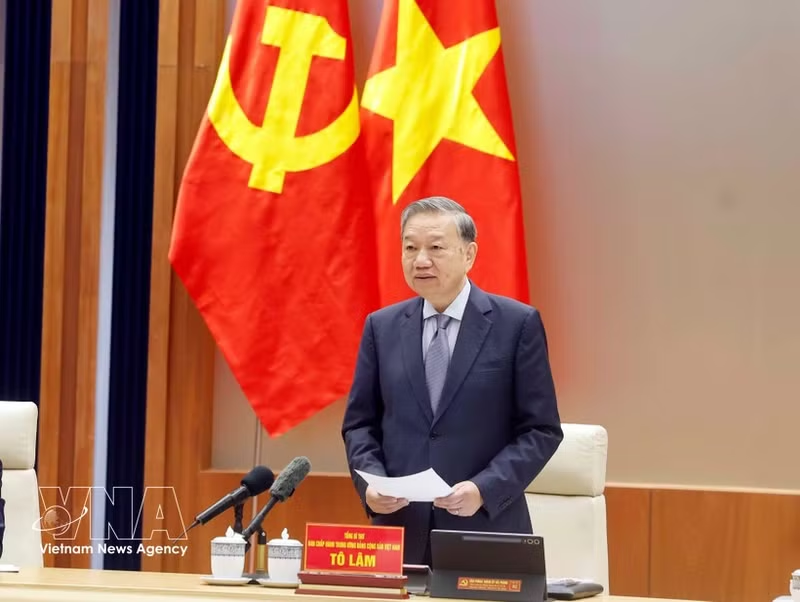
During a working session with the municipal Party Committee on March 16, General Secretary Lam urged the northern city to sustain high, long-term growth closely tied to modernisation, green transition, digitalisation, and better life quality. The city should further expand its dynamic business community and maintain its top national rankings in investment environment, administrative reform, and digital transformation.
Hai Phong should build an advanced industrial ecosystem by carefully selecting capable investors, cutting-edge technologies, and strategic supply chains, he said, adding that the city must also develop a modern maritime, port, and logistics system of global and national stature. This entails forming an international logistics centre linked with a modern seaport network, multimodal transport, e-commerce, green and smart ports. The goal is to transform Hai Phong into a coordinating hub for trade flows, logistics, and high-value services across northern Vietnam.
He suggested the city urgently and effectively follow the Politburo’s Resolution No. 57-NQ/TW on breakthroughs in science and technology development, innovation, and national digital transformation, while making full use of special policy mechanisms to develop an innovation ecosystem. This involves building startup support centres, gradually establishing a sci-tech park, and completing a smart operation centre.
The city should promote digital ports, logistics, and services to boost the digital economy's share, strengthen modern governance capacity and creat new appeal for investors and innovative enterprises. It should encourage entrepreneurship, innovation, and technology firms, gradually forming a business community capable of competing regionally and deeply embedding in global value chains.
It was asked to drastically follow special mechanisms and policies for efficient resource allocation. Priority should be given to development investment while gradually reducing recurrent spending. At the same time, the city should make effective use of public assets, resolve prolonged projects, curb wastefulness and losses, and finalise mechanisms for infrastructure utilisation within the Free Trade Zone (FTZ).
Hai Phong must aggressively reform urban governance toward a digital, service-oriented, and enabling model. The two-tier local administration system needs to operate in an integrated and effective manner with clear authority and accountability. The goal is not only to retain its leadership in administrative reform but to advance toward a modern, transparent, data-driven urban governance model. The city should elevate workforce quality, expand social housing, improve urban environment, and raise public welfare standards.
By 2030, Hai Phong must shape a modern marine economic spatial structure, with seaports and logistics at its core. The Lach Huyen and Nam Do Son port systems, alongside logistics networks, industrial parks, and the FTZ, should be planned in an integrated manner to form a cohesive value chain spanning production, transportation, trade, and services. The target is to make Hai Phong the logistics and supply chain coordination hub for northern Vietnam and the wider region.
At the same time, the city must expand and modernise regional connectivity to become a multimodal transportation hub for the north.
Looking to 2045, the Party chief stressed that Hai Phong should become a modern industrial-service port city of Asian stature and a national hub for marine economy, logistics, clean energy, and marine science and technology. Urban space should follow a multi-centre model extending seaward, with modern port cities, coastal ecological urban areas, and smart cities connected to innovation hubs. The city should also establish eco-industrial parks, hi-tech zones, and research centres focused on marine technology, materials, and new energy. Hai Phong must become a green, smart, and livable coastal city that attracts knowledge, technology, and quality workforce.
Further ahead to 2100, urban planning should target a globally competitive marine megacity serving as a hub for trade, logistics, and maritime economy in East Asia.

Hai Phong should proactively drive regional cooperation in infrastructure, logistics, tourism, workforce training, and marine environmental protection to expand economic space and boost overall regional competitiveness, he said.
Particular focus should be placed on the workforce, especially workers in industrial zones and ports, migrant labour, and vulnerable groups. Industrial growth must align with parallel development of social infrastructure for workers.
On workforce training, modern vocational training systems should meet the needs of industries, logistics, maritime economy, and hi-tech sectors to raise the rate of qualified workers in coming years.
The city should roll out effective sustainable poverty reduction schemes, create livelihoods and job opportunities, support vulnerable groups, and expand social protection coverage. At the same time, it must develop a modern, transparent, and flexible labour market.
In parallel, Hai Phong should place strong emphasis on building a green, safe, and sustainable living environment through tighter resource management, pollution control, waste classification and treatment, green urban development, and climate change adaptation to protect its residents’ long-term health and future, he added.



![[Video] Military parade and procession to mark 100th founding anniversary of the Party](https://en-cdn.nhandan.vn/images/nyM650OGFWrOVWc-xajqNz57td8idIAL_VG9puyG2UZvEoKb0gznNhZD9sqE-SMk8phfcdMoPNOPbQKdVgebGVED1MmHCcV4UHBUOhV4MHY/0923-video-tieng-anhmp4-anh-dai-dien.jpg.avif)