However, to effectively capitalise on these opportunities, exporters must ensure product traceability and comply with increasingly stringent quality requirements, towards establishing “green lane” for smooth customs clearance.
Standardising planting areas, enhancing deep processing
Nguyen Quoc Manh, Deputy Director of Plant Production and Protection Department under the Ministry of Agriculture and Environment stated that currently, China is tightening its management of growing area codes, packing houses, and phytosanitary requirements. Therefore, it is time for the fruit and vegetable industry to shift from growth models based on quantity to one driven by quality, value and low emission.
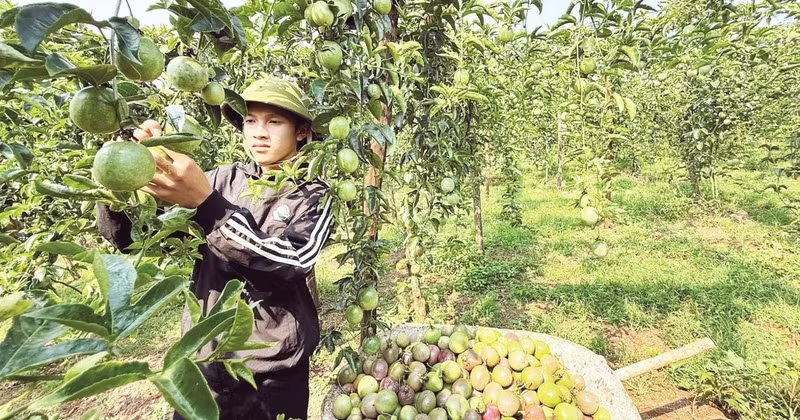
According to the Ministry of Agriculture and Environment, by May 2026, the country had launched more than 9,500 growing area codes and over 1,500 packing house codes for exports to various markets. Of these, 4,323 growing area codes and 1,332 packing house codes had been approved for export to Chinese market. However, expanding the number of growing area codes is just the initially favourable condition. More importantly, it is crucial to tighten management and maintain the quality of approved codes to meet the continuous changing requirements from the import markets. In practice, a number of codes have recently been suspended or revoked by the Chinese authorities due to non-compliance with the relevant regulations.
Besides traceability, to stably penetrate China's market, the fruit and vegetable sector needs to pay more attention to deep processing. This would not only limit the risks for fresh fruits’ export, especially during the peak harvest season, but also stay ahead of the new consumption trend of Chinese people.
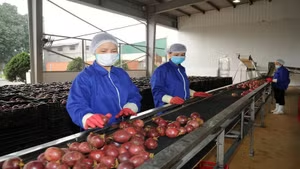
Dinh Cao Khue, Chairman of the Board of Directors of Dong Giao Export Food Joint Stock Company (DOVECO) said that the DOVECO's practical surveys of logistics centres and food processing companies in several regions of China showed strong demand for Vietnamese tropical fruit ingredients and processed products. Many food processing groups are showing increasing interest in concentrated fruit juice, fruit juice, fruit purée, frozen fruit and vegetables, and canned products,... This is a major opportunity for businesses because processed products generate more higher economic value than exports of raw materials.
Simultaneously, it also opens up a broader “groundwork” for the entire industry to increase the turnover in the context of fresh fruit and vegetable exports facing technical barriers, strict phytosanitary requirements and intense competitiveness pressure from regional countries.
Enhancing customs clearance efficiency
To help Viet Nam’s fruit and vegetable industry effectively capitalise on opportunities in the Chinese market, reducing customs clearance times and lowering logistics costs play decisive roles. According to a representative of the China Certification and Inspection Group (CCIC) Southwest Region, the group has recently introduced an artificial intelligence (AI)- enabled traceability model for Vietnamese durian exported to China. This system allows digitalisation of the entire process from growing areas and packing process to transportation and customs clearance.
The results showed that customs clearance times have been significantly reduced, with most consignments being processed within 24 hours, while some have been cleared in as little as three hours. This provides an important foundation for extending the pilot scheme to other agricultural products. However, to seize these trade opportunities and favourable conditions from logistics, it is necessary to address the current bottleneck facing Viet Nam's fruit and vegetable industry in the input stage of the assessment and issuance of growing area codes.
Nguyen Dinh Tung, Chief Executive Officer of Vina T&T Group, proposed that the Chinese side increase the frequency of online inspections for submitted applications or researching a mechanism to work with reputable inspection organisations in Viet Nam to conduct preliminary risk assessments. He also added these measures can accelerate the evaluation and approval of growing area and packing house codes.
On the other hand, companies with a strong record of compliance with regulations governing growing areas and packing facilities that adopt green production practices and standardised traceability systems, could investigate to create a "green lane" for quick customs clearance to shorten transport times as well as ensure fruit and vegetables’ quality when reaching consumers.
According to the Agency of Foreign Trade under the Ministry of Industry and Trade, China’s domestic fruit retail market is projected to reach about RMB 1.8 trillion CNY in 2026. In particular, demand for durians, bananas, dragon fruits and mangoes is expected to continue growing strongly. Therefore, the bottlenecks of procedures, logistics and technical standards need to be addressed promptly to create opportunities for Vietnamese fruits and vegetables to attain higher export milestones in the Chinese market.