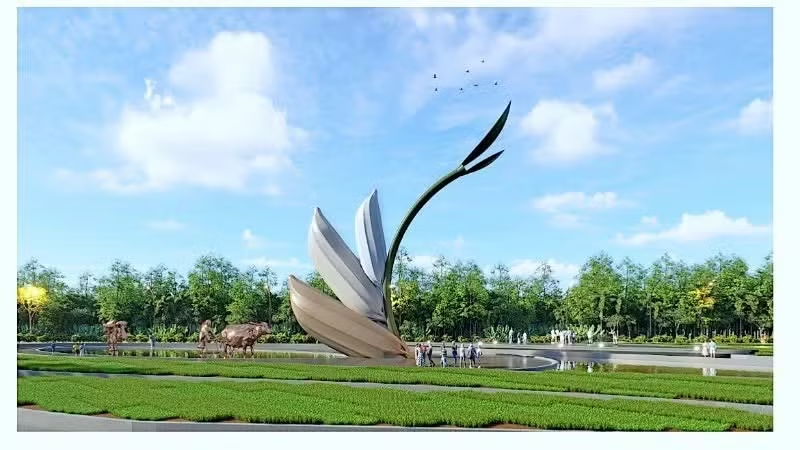
This is an architectural work that carries the mission of preserving memory, honouring the history of labour, and positioning the locality’s brand on the international stage.
In late April 2026, amid the vibrant atmosphere of a series of events marking Science–Technology and Culture–Tourism Week, in conjunction with the first “Best Rice of the Mekong Delta” contest, Ca Mau Province officially launched the Rice Museum and promoted the construction of the “rice symbol”. This marks a pivotal event of profound significance in promoting the image of the locality.

However, going against public consensus, certain online platforms have spread distorted narratives. By manipulating information, these sites have fabricated stories and used offensive language to misrepresent reality, even accusing the Ca Mau authorities of wasting more than 40 billion VND of the budget on “reinforced concrete structures”.
Materialising century-old spiritual values
To refute such short-sighted arguments, it is necessary to step back and understand the root issue: why does this southernmost land of the country need a Rice Museum and a rice symbol?
Ca Mau is not only a land enriched by fertile alluvium but also one imbued with the sweat, tears, and even blood of the countless generations of ancestors who pioneered this land. It was no miracle that turned swampland into rice granaries and aquaculture hubs.
Through diligence, intelligence, and remarkable resilience, farmers in Ca Mau transformed barren, saline, and acidic land into vast shrimp farming areas covering more than 430,000 hectares.
These efforts have helped Ca Mau emerge as the country’s “shrimp capital”, generating export turnover of around 2.6 billion USD per year. At the same time, the province’s 185,000 hectares of rice fields produce approximately 1.8 million tonnes of food each year. These figures not only demonstrate Ca Mau’s role in ensuring food security but also support exports and stabilise the livelihoods of tens of thousands of farming households across generations.
More importantly, with forward-thinking and innovation, farmers in Ca Mau have developed the ecological rice–shrimp farming model. This model adapts effectively to climate change, brings prosperity to households, and embodies local cultural values, serving as a source of pride on the international community.
Therefore, investing more than 40 billion VND in building the two cultural symbols is not about erecting lifeless concrete structures. It is about materialising invaluable spiritual values. These works preserve memory for future generations, honour rice civilisation, celebrate local products, and serve as “red addresses” for educating younger generations about cultural history.
Livelihood vision from cultural symbols
The short-sightedness of distorted narratives also lies in separating cultural works from economic value chains. In modern governance thinking, a symbolic project of regional scale not only enhances the landscape but also strongly stimulates the service economy. In essence, it is a long-term strategic investment that generates returns for people’s livelihoods.
A clear example is the giant tiger shrimp symbol embracing the globe, standing 24 metres tall at Phan Ngoc Hien Square. Since its completion, it has become the “heart” of cultural activities and firmly affirms Ca Mau’s position as the “shrimp capital”. It acts as a magnet attracting millions of visitors for check-ins each year. The growth of tourism has in turn boosted accommodation, transport, and dining services, while promoting the consumption of local OCOP products — creating real economic flows that directly benefit residents.
Similarly, the “three rice grains” symbol at the Rice Museum is a love song imbued with love for the land and its people. Coinciding with the first “Best Rice of the Mekong Delta” contest in 2026, its debut represents a highly effective communication strategy. The image of ripening rice grains conveys a strong message to international markets about Ca Mau’s organic rice brand.
The added value from enhancing this brand will help rice and shrimp achieve higher export prices, bringing sustainable prosperity. Equating such a culturally significant project with “wastefulness” is an affront to the pride of working people.
Transparent funding to dispel false accusations
To fabricate misleading narratives, certain online pages have seized upon investment figures to suggest “budget misappropriation”. In reality, the facts are entirely different.
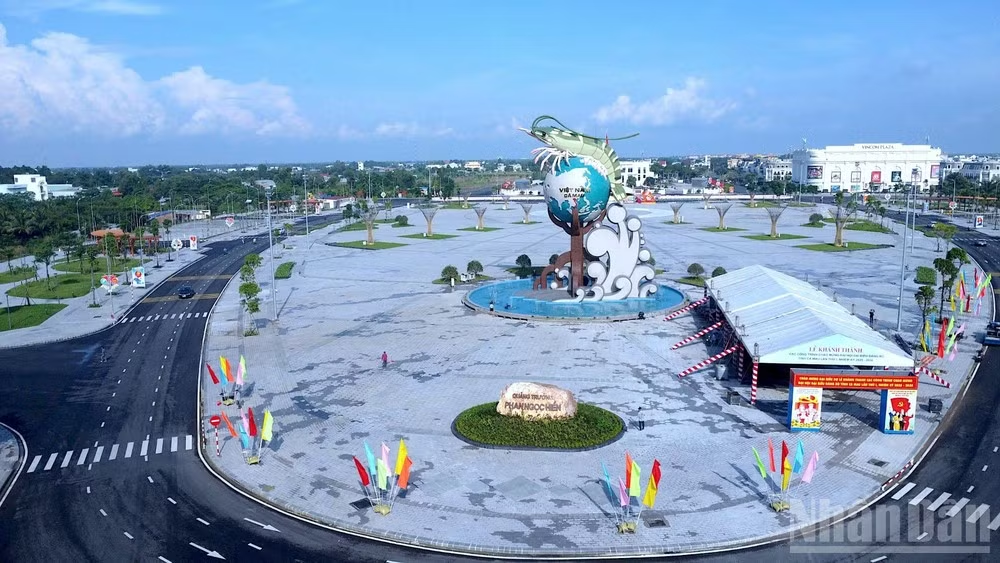
The Ca Mau shrimp symbol work attracts large numbers of visitors for check-ins.
Responding to concerns about funding, Nguyen Van Den, Deputy Director of the Department of Culture, Sports and Tourism of Ca Mau Province, affirmed that most of the funding has come from socialised sources — voluntary contributions from businesses, benefactors, and people with strong ties to their hometown.
“Mobilising social resources for cultural projects is a major policy that reduces pressure on the state budget while promoting national solidarity,” Den said. When funds are voluntarily contributed to beautify the locality, it clearly reflects public consensus.
Moreover, any project using state budget counterpart funds must strictly comply with the Law on Public Investment and the State Budget Law. From proposal and approval by People’s Councils to bidding, construction supervision and auditing, the process is closed, transparent, and subject to multi-level oversight of agencies, committees, sector, and the public. There is absolutely no way that any individual could "create" a project to profit tens of billions of VND, as falsely accused.
Building “digital immunity” to clean up online misinformation
In response, Party committees and authorities of Ca Mau have taken a firm stance. The Department of Culture, Sports and Tourism, together with cyber security forces of the provincial police, is urgently tracing the origin of the Facebook page in question to handle violations in accordance with the law. At the same time, efforts to ensure transparency in public investment projects are being strengthened to proactively provide official information, guide public opinion, and prevent misinformation.
Truth will ultimately prevail. Ca Mau’s symbolic works stand as evidence of a development vision that harmonises economic growth with cultural values. Distorted narratives will eventually dissipate like foam against the strong current of truth.