However, for private capital to truly “flow” into the urban railway sector, Ho Chi Minh City needs strong breakthroughs in mechanisms, policies and methods of benefit sharing.
Accelerating the mobilisation of social resources
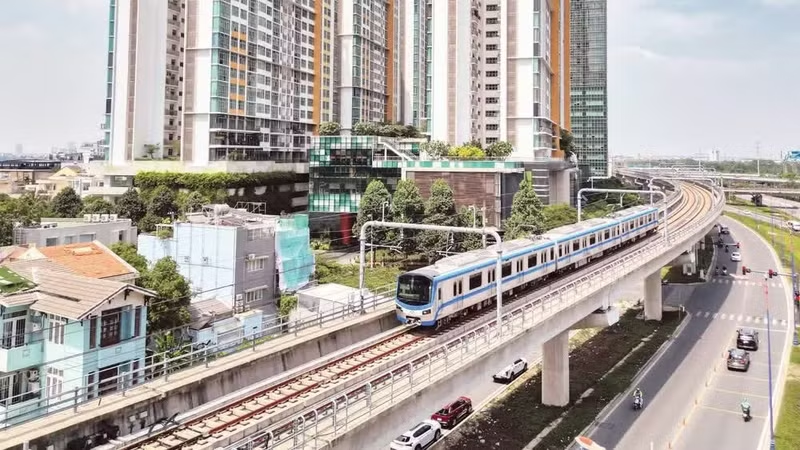
After many years of implementation, Ho Chi Minh City has so far put only Metro Line No. 1 Ben Thanh-Suoi Tien into operation. Meanwhile, under the urban transport development plan, the city aims to build a 355-km urban railway network from now to 2035 to meet people’s travel demand and restructure urban space in line with transit-oriented development (TOD).
Recently, the Politburo’s Resolution No. 09-NQ/TW on building and developing Ho Chi Minh City in the new era set the target that by 2030, the city will complete 200 km of urban railways (metro), moving towards basically completing the metro network by 2045.
Urban experts recommend that, to complete the metro system within the next 10 years, Ho Chi Minh City will need a very large amount of investment capital. If it relies only on the state budget or official development assistance (ODA) loans and aid capital, progress will find it difficult to meet development requirements. Reality shows that the traditional metro investment model is revealing many limitations. Projects dependent on foreign loans often take a long time for negotiation, disbursement and procedural adjustments. Investment costs increase while pressure from public debt repayment is growing.
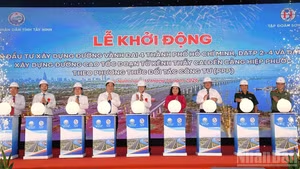
In that context, mobilising social resources through public-private partnership is considered an inevitable direction. At present, many enterprises have been implementing and studying metro projects in Ho Chi Minh City. Typically, Vingroup is investing in the Ben Thanh-Can Gio metro line, thereby forming a high-capacity transport axis to the south of the city; Thaco Group is building Metro Line No. 2 on the Ben Thanh-Thu Thiem section, which was started in April 2026, and completing the study on the Thu Thiem-Long Thanh railway line to prepare for its commencement in July this year.
Several other enterprises have proposed studying metro projects to connect new urban axes formed after mergers, aiming to develop a high-capacity public transport system. Sovico Group has proposed investing in Metro Line No. 4 (Dong Thanh-Hiep Phuoc Industrial Park) in the form of PPP or direct investment; Masterise Group has proposed studying Metro Line No. 3 (Hiep Binh Phuoc-An Ha section) in the form of PPP, under a BT contract. The Ho Chi Minh City People’s Committee has assigned Becamex Group to study an investment plan for the Bau Bang-Cai Mep national railway line.
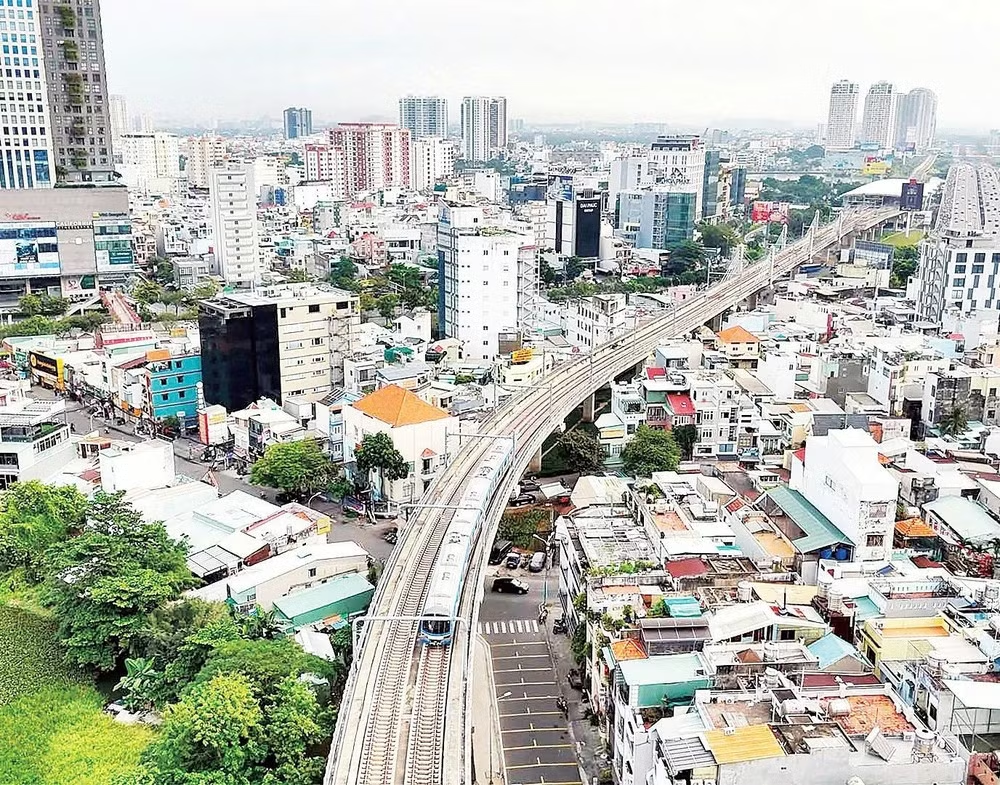
The steering committee for the development of the city’s railway network has directed departments and sectors to focus on prioritising investment in six metro projects in the 2025-2030 period, including Line No. 2 (Ben Thanh-Tham Luong section); Line No. 2 (Ben Thanh-Thu Thiem section); Thu Thiem-Long Thanh line; Binh Duong New City-Suoi Tien line; Line No. 6 in the first phase (Tan Son Nhat Airport-Phu Huu); and Ben Thanh-Can Gio line. With strong determination for implementation by 2030, the city aims to complete about 200 km of urban railways, with a preliminary total investment of more than 19 billion USD.
Increasing attractiveness and feasibility
Unlike expressway projects that can collect tolls directly, metro lines often need many years of operation to develop a sufficiently large passenger base. The difficulty is that ticket revenue can hardly cover investment, operation and maintenance costs. Another barrier is the very long payback period. An investor who once participated in studying an infrastructure project in Ho Chi Minh City said enterprises are interested in revenue from train tickets and supplementary income sources such as real estate, commerce, advertising, logistics services and the exploitation of underground space...
Dr Pham Viet Thuan, Head of the Ho Chi Minh City Institute of Natural Resources and Environmental Economics, said the city needs to thoroughly address three core bottlenecks. Only then can the PPP model for urban railways in Ho Chi Minh City become attractive and feasible.
First, the state needs a risk-sharing mechanism with investors to compensate for revenue shortfalls compared with commitments or subsidise operations in the early years. Second, revenue sources should be diversified in association with the TOD model, allowing investors to bid for the development of urban, commercial and office areas around stations, thereby tapping land value. This is the “golden key” to generating large profits to offset railway investment costs. Third, there needs to be a clear financial mechanism, identifying costs and standard profit margins in investment to control capital flows into metro projects.
Over the past period, the National Assembly’s Resolution No. 98/2023/QH15 and Resolution No. 188/2025/QH15 have opened up opportunities for Ho Chi Minh City to pilot many new mechanisms related to the exploitation of land funds and TOD development.
This is seen as an important foundation for building more attractive PPP models in the urban railway sector. Vice Chairman of the Ho Chi Minh City People’s Committee Bui Xuan Cuong affirmed: Metro projects that have been started or broken ground are all being implemented under specific mechanisms and policies, especially those on urban railway development; the sound policy of strong decentralisation and delegation of power by the central authorities, the National Assembly and the government has given the city a high degree of autonomy, associated with clear responsibility of the municipal administration in organising implementation. The city aims that by 2030, the metro system will meet 20-30% of people’s travel demand.
Dr Pham Viet Thuan proposed that the city should separate site clearance from construction and installation, as site clearance is always a “fear” for investors because it can easily delay project progress. Therefore, the city should take primary responsibility for compensation and clearance using public investment capital or municipal bonds, thereby handing over clean land to investor consortiums for immediate implementation.
At the same time, a specific legal framework is needed to allow Ho Chi Minh City to conduct conditional contractor appointment, create “seed capital” packages and optimise profits in line with investment rates.
Le Thanh Hai, director of the Center for Economic Application Consulting under the Ho Chi Minh City Institute for Development Studies, proposed the city needs a genuine breakthrough in mechanisms, namely adopting a public-private partnership model that allows enterprises to recover part of the value generated by projects through value capture. The model, which has been implemented in Singapore and Hong Kong (China), helps ease the initial financial burden on enterprises while safeguarding public transport interests.
Thus, with appropriate mechanisms, the private sector can fully become an important resource in investing in large-scale transport infrastructure, similar to the experience of many developed countries in Asia. In addition, Ho Chi Minh City is facing a historic opportunity as the National Assembly has granted it many specific mechanisms to implement the strategy of developing the largest urban railway network in the country.