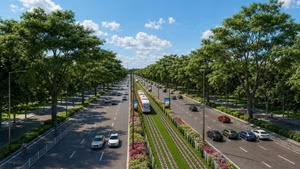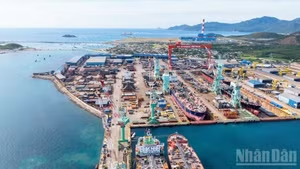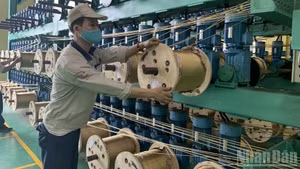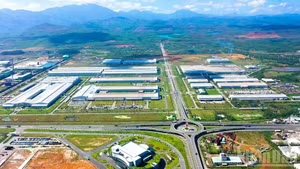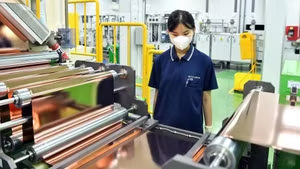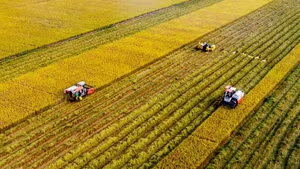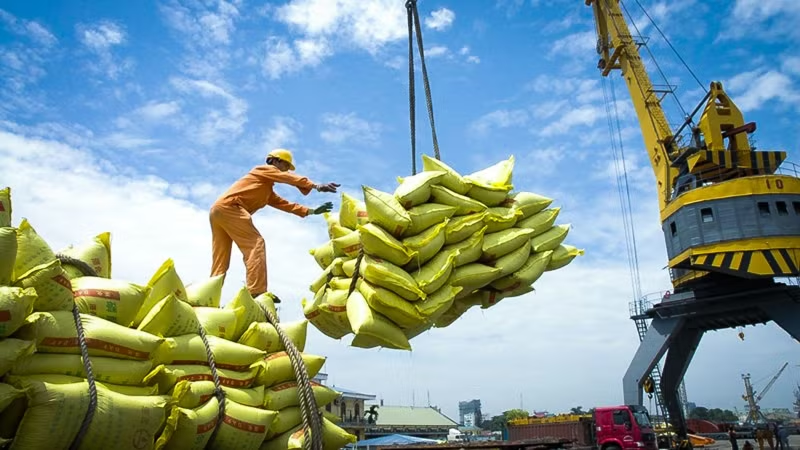
Despite persistent difficulties and challenges, with foundations laid by breakthrough resolutions, strategic infrastructure projects, and the synchronised operation of the two-tier local government system, a new position and new opportunities are opening up for Viet Nam’s economy—particularly in realising the target of double-digit growth.
Steadfast in overcoming “headwinds”
The year 2025 passed with a succession of natural disasters. In just over a month, four storms (Nos. 10, 11, 12 and 13) struck in turn. One storm had barely passed before another arrived, bringing torrential rain that blanketed the sky. Floodwaters had yet to recede when new flood peaks formed. “Storm after storm, floods upon floods” precisely describes the most severe disaster season Viet Nam has faced in many years.
Storms and floods left devastating consequences across wide areas. The series began with Storm No. 10, which claimed 67 lives and caused economic losses of more than 16.5 trillion VND (628.3 million USD). Storm No. 11 resulted in nearly 17 trillion VND (647.4 million USD) in damage and extended the list of lives lost. Storm No. 12 inundated 128,024 houses, with 173 houses collapsing or being severely damaged.
Before central Viet Nam could recover, Storm No. 13 swept through, causing additional losses of more than 7 billion VND (266.6 million USD). In Gia Lai Province alone, damage reached 5,133 billion VND (around 197.4 million USD), far exceeding initial forecasts. No sooner had the storm subsided than even more severe floods arrived, leaving 102 people dead or missing, damaging 1,154 houses and inundating more than 186,000 homes at their peak. Economic losses from this flood episode alone amounted to 13,078 billion VND (approximately 503 million USD).
Against this backdrop, closely following the Party’s leadership, the Government focused on synchronously and resolutely implementing tasks and solutions across all fields. Prioritising growth while maintaining macroeconomic stability, ensuring social welfare, strengthening national defence and security, and advancing external relations were consistent focal points. Safe and flexible adaptation, alongside effective control of pandemics and natural disasters, enabled the economy to recover more rapidly.
In particular, Viet Nam clearly identified the “dual transition: greening and digitalisation” as an objective requirement, a strategic choice and top priority—both a foundation and a driving force for fast and sustainable national and economic development. The Party, the State and the Government have paid close attention and issued numerous guidelines, mechanisms and policies to promote rapid and sustainable growth based on the principle of “neither perfectionism nor haste, but also no missed opportunities”. As a result, GDP growth in 2025 is estimated at around 8%, well above the five-year average of approximately 6.3%.
The positive socio-economic outcomes in 2025 demonstrate that Viet Nam’s economy has sufficient resilience to withstand pandemics, natural disasters and external shocks such as wars, conflicts, supply chain disruptions, monetary tightening by major economies, complex tariff policies, slowing global growth and rising global inflation.
Speaking with visible pride about a year marked by “high growth with controlled inflation” at the high-level plenary session of the Viet Nam Economic Forum 2025—under the theme “Rapid and sustainable development of Viet Nam’s economy, green transformation in the digital era”—held in mid-December, Prime Minister Pham Minh Chinh emphasised that these were the “headwinds” Viet Nam had overcome to achieve positive results.
Notably, during the 2021–2025 period, spending on social welfare reached 1.1 quadrillion VND (41.8 billion USD), the highest level ever. State budget revenue in 2025 is estimated to exceed the target by more than 25%, and in particular, 500 trillion VND (15 billion USD) from excess revenue and expenditure savings has been reinvested in development investment, national defence and security, and social welfare. This clearly demonstrates the principle of “not sacrificing social equity and progress, nor social welfare, in pursuit of mere growth”.
Viet Nam’s aspiration and responsibility
With the National Assembly considering and deciding to adopt a GDP growth target of 10% or higher for 2026 and subsequent years, Viet Nam is not merely setting a statistical figure, but embarking on a new journey in which the internal dynamism of enterprises, governance capacity, and innovative and creative thinking will determine success.
In reality, this is a highly challenging GDP growth target amid strong global economic volatility. Yet it clearly reflects Viet Nam’s aspiration and responsibility—as an open economy with still-limited growth quality, reliant on low-cost labour, natural resources and capital. Viet Nam is also among the countries most affected by natural disasters and climate change, while science, technology and innovation have not yet fully become growth drivers and still require time to demonstrate effectiveness. Institutions and policies also face bottlenecks that need continued refinement and resolution.
As the Prime Minister affirmed, “the lessons learned from overcoming difficulties over 40 years of Renewal form the foundation for Viet Nam’s steadfast and consistent focus on implementing these strategic objectives. Viet Nam always clearly identifies stability as an inviolable fortress; fast and sustainable development as an enduring engine without an endpoint; and the prosperity, well-being and happiness of the people as the supreme goal”.
At the same time, with the guiding principle of “the Party leads, the State enables, enterprises pioneer, public–private partnership advances together, the country develops and the people are happy”, and the consistent view that “resources stem from thinking and vision, momentum comes from innovation and creativity, and strength comes from the people and enterprises”, Prime Minister Pham Minh Chinh stressed that the key tasks and solutions for 2026 and beyond are to promote rapid and sustainable development, strive for double-digit growth while maintaining macroeconomic stability, controlling inflation and ensuring major economic balances. They also include enhancing resilience and competitiveness; strengthening analytical and forecasting capacity; proactively and flexibly responding in a timely and effective manner to external fluctuations; and continuing institutional reform.
On this journey, Viet Nam will continue to mature and grow stronger through challenges and hardship.
“Viet Nam remains steadfast in its goal of maintaining macroeconomic stability, controlling inflation and ensuring major economic balances in order to create a favourable environment and conditions for fast and sustainable development with double-digit growth.”
Prime Minister PHAM MINH CHINH