Accordingly, ministries, agencies and local authorities are focusing on developing quarterly growth scenarios across the three main economic sectors and 21 level-1 industries, with the aim of achieving double-digit growth.
Ample room for growth
Clarifying the prospects for double-digit growth from 2026, Nguyen Anh Tuan, Deputy Head of the Party Central Committee’s Commission for Policies and Strategies, affirmed that Viet Nam has sufficient conditions, potential and room to meet the target. This space lies in the creation and effective exploitation of new growth drivers, alongside stronger promotion and renewal of traditional ones such as investment, exports and consumption.
Although the economy recorded an impressive growth rate of 8.02% in 2025, overall efficiency remains modest. If bottlenecks are removed, resources unblocked and potential and advantages fully tapped, Viet Nam could achieve a breakthrough in growth.
Building on the positive momentum of 2025, the high determination of the entire political system, and forecasts that macroeconomic stability will be maintained in 2026—with major balances ensured and confidence among people and businesses strengthened—Viet Nam is well positioned for a growth surge in 2026.
In its assessment of Viet Nam’s economy in 2025 and outlook for 2026, Dr Can Van Luc, Chief Economist of the Bank for Investment and Development of Viet Nam (BIDV), together with the BIDV Institute of Economics and Research, shared the same view.
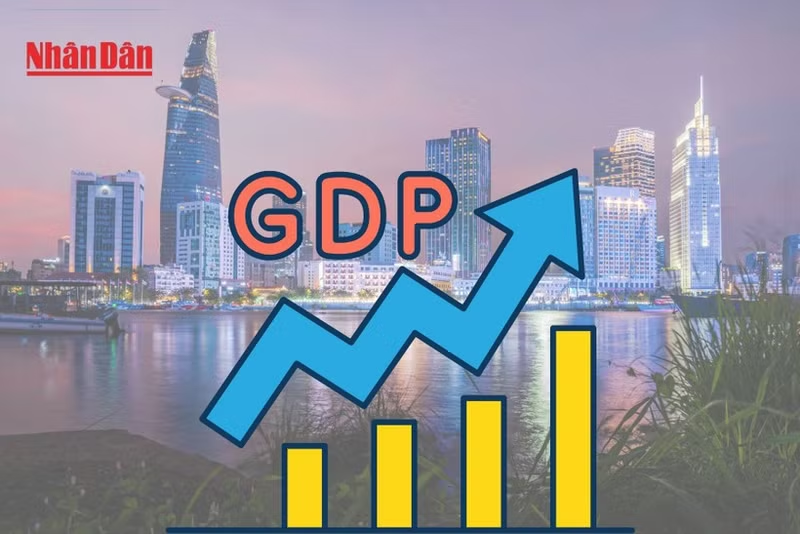
Under the baseline scenario, GDP growth in 2026 could reach 9–9.5%. Agriculture, forestry and fisheries are projected to grow by 4–4.5%, contributing 4.5–5% to overall growth; industry and construction by 10–11%, contributing 45–47%; and services by 10–11%, contributing 47–49%.
In a more optimistic scenario, GDP growth could reach 10%, with services contributing as much as 49–50% of total GDP.
This growth rate would place Viet Nam close to the breakthrough trajectory followed by East Asian economies as they overcame the middle-income trap. The report also points to remaining weaknesses, including growth quality that has improved but is not yet sustainable, and investment activity that has yet to fully take off, as disbursement rates in some ministries and localities remain below the national average.
Maintaining macroeconomic stability
According to Dr Can Van Luc, policy coordination in 2026 must strike a balance between fiscal and monetary policy and other macroeconomic instruments. Fiscal policy should play the leading role, with monetary policy acting as support to promote growth while controlling inflation. Interest rates and exchange rates should be managed flexibly; the gold market stabilised; the real estate market put on a healthier footing; and essential goods supply ensured.
Early development of a financial market reform scheme is also needed, aimed at building a balanced and synchronised financial market, improving credit allocation efficiency and expanding green credit.
Dr Luc stressed that pursuing double-digit growth while maintaining macroeconomic stability is a major challenge, but also a decisive factor in achieving Viet Nam’s medium- and long-term strategic goals. Traditional growth drivers must be strengthened by sustaining export gains and stimulating investment and consumption through substantive improvements to the business and investment environment. At the same time, a new growth model based on science and technology, innovation and digital transformation should be established, replacing growth overly reliant on capital and labour.
Economic restructuring should also be accelerated, with greater emphasis on improving growth quality by swiftly resolving stalled major projects to unlock resources and enhance investment efficiency. Public investment should be restructured in a more sustainable direction, increasing allocations for science and technology, healthcare, education, digital infrastructure and climate change adaptation.
Achieving double-digit growth while maintaining macroeconomic stability is a major challenge in the current context, but it is also a decisive factor in realising the country’s strategic objectives over the medium and long term.
Dr Can Van Luc
Sharing the same perspective, Dr Vo Tri Thanh, Director of the Institute for Brand and Competitiveness Strategy, identified three key lessons for Viet Nam’s breakthrough in the coming decade: maintaining macroeconomic stability; proactively pursuing a modern industrial policy amid intensifying global technological competition; and building a strong domestic business community with global competitiveness.
In a world marked by unpredictable geopolitical developments, a stable political environment remains a prerequisite for attracting foreign investment and strengthening business confidence. Macroeconomic stability, effective inflation control, safe public debt levels and a sound financial system form the foundation for sustained economic growth and long-term development.