Strong performance but lingering challenges
State‑owned enterprises have delivered encouraging results in production and business activities, with key financial indicators showing growth compared with the previous year. Between 2021 and 2023, based on tax data, the sector recorded slower growth in assets and equity than foreign‑direct‑investment (FDI) enterprises, yet its operational efficiency and budget contributions rose at a much faster pace.
Specifically, total assets in the state‑owned enterprise sector grew on average by 2.7% per year, while FDI and private enterprises expanded by 6.9% and 15%, respectively. Equity in the state‑owned sector increased by 2.4% annually, compared with 7.5% and 12.75% for FDI and private firms. Total revenue in the state‑owned sector rose by nearly 10% per year, with pre‑tax profit climbing by 8.5%.
By contrast, FDI and private enterprises saw revenue growth of 4.8% and 11%, respectively, but their pre‑tax profit in 2023 fell below 2022 levels. Budget contributions from state‑owned enterprises grew by an average of 18% per year, compared with 5% and 7.4% for FDI and private firms.
State‑owned enterprises, particularly corporations and groups, continue to dominate strategic and essential sectors that underpin socio‑economic development. They remain a vital instrument for maintaining macro‑economic stability, responding to market fluctuations and containing inflation.
State‑owned enterprises, particularly corporations and groups, continue to dominate strategic and essential sectors that underpin socio‑economic development. They remain a vital instrument for maintaining macro‑economic stability, responding to market fluctuations and containing inflation.
Beyond political and social responsibilities, many state‑owned enterprises also carry out economic‑development missions tied to national defence, security and sovereignty. Financial reports for 2025 from several corporations and general companies highlight positive production and business results, contributing significantly to the completion of the 2021–2025 five‑year plan targets.
Economist Le Duy Binh noted that these figures reflect a positive trend: the sector has become leaner in scale but stronger in quality and efficiency, retaining a dominant position in key industries such as telecommunications, energy and banking, and contributing more than 29% of GDP.
However, he cautioned that despite these achievements, state‑owned enterprises have yet to fully assume their role in driving other economic sectors, fostering linkages and building value chains. Operational efficiency remains below potential, and some enterprises continue to incur losses.
Reforming governance to unlock competitiveness
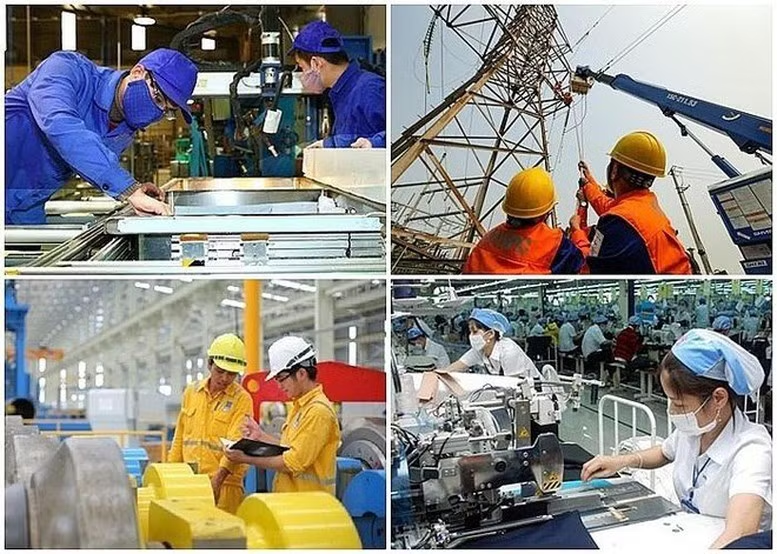
Politburo Resolution 79‑NQ/TW on the development of the state‑owned economy sets clear guiding principles. It aims to strengthen the sector’s leading role in strategic fields, support other economic components, and contribute to rapid and sustainable growth.
Targets for 2030 include placing 50 state‑owned enterprises among Southeast Asia’s top 500 and one to three among the world’s top 500, with all adopting modern, digital‑based governance aligned with OECD standards.
Dr Le Duy Binh stressed that achieving these goals requires urgent measures to enhance efficiency and competitiveness. These include separating ownership, economic management and political functions, granting greater autonomy, and reforming corporate governance with stronger accountability in line with OECD principles.
In practice, state‑owned enterprises have lacked authority to make investment decisions independently, often requiring approval from multiple levels, particularly for major or high‑risk projects. This has slowed investment between 2020 and 2024, undermining competitiveness. The new institutional framework is expected to grant boards and chairmen more autonomy, creating a more flexible legal environment, reducing administrative procedures and reinforcing the sector’s leading role.
The new institutional framework is expected to grant boards and chairmen more autonomy, creating a more flexible legal environment, reducing administrative procedures and reinforcing the sector’s leading role.
From the enterprise perspective, Le Quang Vu, a member of the Board of Members at Viet Nam Expressway Corporation (VEC), argued that decentralisation, capital mobilisation autonomy and resources commensurate with assigned tasks are essential.
Previously, VEC missed opportunities to join several expressway projects because its charter capital was just over 1 trillion VND, far below the investment levels required, making it impossible to meet debt‑to‑equity ratios under current law.
Following the National Assembly’s approval to increase its charter capital, VEC has significantly improved its resource mobilisation capacity. In early 2025, it launched projects to expand the Ho Chi Minh City–Long Thanh–Dau Giay Expressway and the Noi Bai–Lao Cai Expressway (Yen Bai–Lao Cai section).
This example illustrates that to translate the sector’s leading role into tangible outcomes, mechanisms must remove bottlenecks and create conditions for genuine competitiveness.
Dr Nguyen Dinh Cung, former Director of the Central Institute for Economic Management, emphasised the importance of investment, scientific and technological development, innovation, digital transformation and the green transition.
He explained that these are critical criteria for enterprise development today, particularly for state‑owned enterprises, which enjoy advantages in infrastructure and human resources for research and development.
To achieve a breakthrough, the state must invest not only capital but also institutions, policies, resources and human capital, while establishing mechanisms that accept risk. In this way, major corporations and general companies will be incentivised to invest in research and development, venture into new sectors and high‑technology projects, create new industries, and fulfil their pioneering role. By doing so, they will expand in scale and improve the efficiency of the state‑owned enterprise sector.