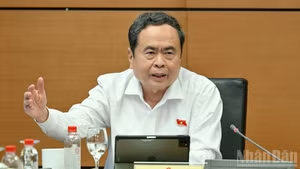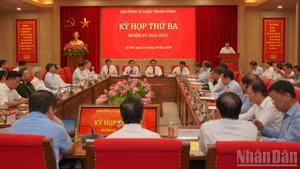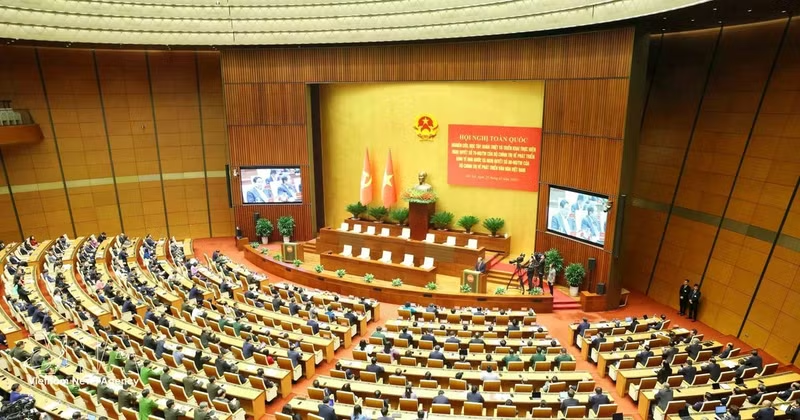
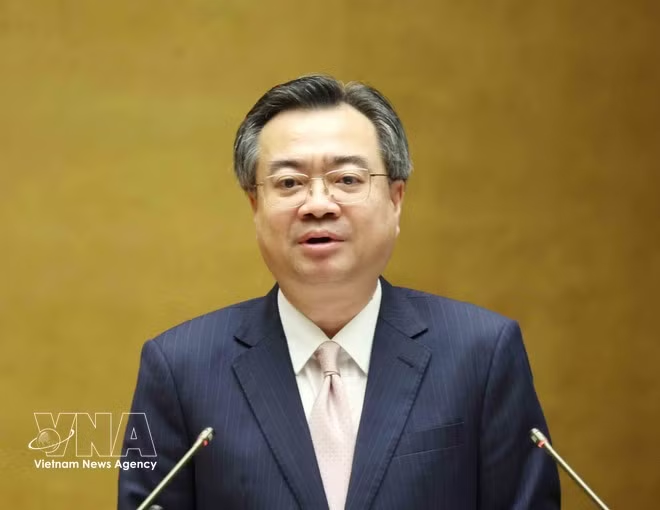
Addressing a national conference on February 25 to disseminate and implement Resolution No. 79 and Resolution No. 80-NQ/TW on cultural development, Nguyen Thanh Nghi, Politburo member, Secretary of the Party Central Committee, Chairman of the Party Central Committee's Commission for Policies and Strategies, stressed that the state economic sector remains a particularly important pillar of the socialist-oriented market economy.
The Resolution affirms that throughout more than 80 years of national construction and development, especially during 40 years of the Doi moi (Renewal) process, the state economic sector has consistently played a leading role. Beyond direct involvement in production and business, it serves as a critical material foundation and a strategic instrument enabling the State to guide and regulate the economy, promote growth, stabilise the macroeconomy, safeguard major balances, ensure defence and security, enhance autonomy and self-reliance, and drive rapid and sustainable socio-economic development along socialist orientations.
The Resolution also candidly identifies persistent shortcomings. Policies and laws governing the state economic sector have been slow to innovate and lag behind reality. The management and use of many State-owned assets and resources remain inefficient, with waste, losses and weak economic accountability.
The sector’s leading and controlling role has not been clearly demonstrated. State-owned enterprises (SOEs) have yet to operate in line with the scale of resources they hold, remain limited in competitiveness, and have not played a pioneering role in innovation or in leading key industries, while SOE reform has progressed slowly. The system of public service units are still cumbersome, with delayed reforms in operating mechanisms and financial autonomy, a low proportion of fully autonomous units, and service quality that falls short of requirements.
To strengthen the state economic sector and support the realisation of Viet Nam’s centennial development goals for 2030 and 2045, the Resolution sets out five overarching guiding viewpoints. These focus on redefining the state economic sector’s leading role; clarifying its co-development with other economic sectors; improving the efficiency of state resource management and use; aligning state-sector tasks with growth-model renewal; and reinforcing Party leadership alongside more effective State management, particularly in resource allocation and implementation.
Looking ahead to 2030, with a vision to 2045, the Resolution outlines overarching and specific development targets. The overarching goals rest on four pillars: enhancing the state sector’s leading and pioneering role in key and strategic fields; guiding and supporting other economic sectors; contributing to rapid and sustainable development while ensuring defence, security, social progress and equity, and improved living standards; and helping achieve the country’s two centennial goals.
Specific targets to 2030 are defined for six components of the state economic sector: land and natural resources; infrastructure assets; the State budget, national reserves and off-budget State financial funds; SOEs; State-owned credit institutions; and public service units. Key quantitative targets include mobilising State budget revenues equivalent to around 18% of GDP, keeping the budget deficit at about 5% of GDP, maintaining public debt below 60% of GDP, and allocating 35–40% of total budget spending to development investment and 50–55% to recurrent expenditure. For SOEs, the targets include placing 50 enterprises among Southeast Asia’s top 500 and one to three among the world’s top 500, with all SOEs adopting modern, digital-based governance.
To deliver these goals, the Politburo calls for strong and substantive implementation of tasks and solutions. The Resolution identifies seven major groups of measures, including a fundamental shift in leadership and management mindset — from administrative control to development facilitation, modern governance and decisive action; completing the legal system in line with Resolution No. 66-NQ/TW on law-making and enforcement reform; fostering a fair, transparent and favourable investment and business environment; promoting public–private partnerships; accelerating administrative reform; enhancing decentralisation with accountability; expanding autonomy and responsibility; reducing compliance costs; and shifting decisively from ex-ante to ex-post oversight.
Additional measures focus on improving human resources and leadership capacity, strengthening talent attraction and utilisation, protecting officials who dare to think and act innovatively through transparent evaluation mechanisms, building an integrated and secure data system for the state economic sector, and reinforcing inspection, supervision, auditing and enforcement.
The Resolution also provides sector-specific solutions. For infrastructure assets, it calls for long-term strategies and master plans aligned with economic trends, green transition and digital transformation, climate change adaptation and integrated development, alongside a completed legal framework to mobilise non-budgetary resources and prevent waste and losses. In fiscal management, priorities include aligning the State budget with economic restructuring and a new growth model, improving resource mobilisation and allocation efficiency, strengthening decentralisation with accountability, and concentrating public investment on breakthrough strategic infrastructure projects.
For SOEs, four key task groups are identified: maintaining SOEs as a core material force of the state economic sector; boosting investment in science, technology, innovation, digitalisation and green transition; improving corporate governance efficiency; and restructuring State capital in tandem with SOE reorganisation. State-owned credit institutions are urged to continue adopting modern governance standards, strengthen risk management, accelerate comprehensive digital transformation, and reorganise State commercial bank networks to enhance transparency and accountability.
Notably, the Resolution introduces new tasks and solutions, including restructuring public service units; shifting from direct budget allocations to direct support for beneficiaries; moving public services with high socialisation potential towards market-based mechanisms; converting eligible public service units into one-member limited liability companies; and expanding the application of digital technologies.