As a result, whenever global commodity prices fluctuate sharply, many Vietnamese businesses find themselves on the defensive, with profits squeezed and, in some cases, production and business plans having to be adjusted. This paradox highlights a regulatory gap that needs to be addressed soon, giving businesses more tools to cope with price volatility.
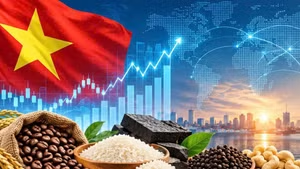
The term “commodity derivatives trading” may lead many people to associate it with financial speculation. Put simply, however, it is a tool that enables businesses to lock in future purchase or selling prices through contracts, thereby limiting risks arising from market fluctuations.
The history of global economic development shows that commodity derivatives markets were first established to support economic development and help stabilise production and business activities. As a result, most developed economies have built modern commodity derivatives markets as tools for risk management and for establishing reference prices.
In Viet Nam, the legal framework governing commodity derivatives trading is still largely based on the 2005 Law on Commerce and its implementing regulations. This legal gap is increasingly exposing shortcomings and failing to keep pace with reality as global prices for many commodities have experienced sharp and unpredictable fluctuations in recent years, limiting the market's ability to fully support businesses and the economy.
At times, prices of many raw materials have fluctuated sharply and continuously, putting significant pressure on production costs and macroeconomic management. In the absence of effective price-hedging tools, businesses have either had to bear the risks or turn to overseas exchanges, incurring high costs and facing numerous legal barriers.
This also means Viet Nam has yet to take full advantage of an important tool for strengthening the economy's resilience to increasingly unpredictable global market fluctuations. Against this backdrop, the Ministry of Industry and Trade's ongoing consultation on a draft Law on Commodity Derivatives Trading, which is expected to be submitted to the National Assembly for consideration and adoption this year, is particularly significant.
The draft law aims to establish a modern and transparent legal framework aligned with international practices, while linking financial markets more closely with production and business activities. By being able to “lock in” purchase and selling prices in advance, businesses will have greater certainty when making long-term plans, stabilising cash flows and minimising the impact of external shocks.
At the macro level, a transparently operated market would also help establish an objective pricing mechanism, strengthen supply-chain resilience and support more effective macroeconomic management.
For an economy as highly open as Viet Nam's, competitiveness is determined not only by export volumes but also by the ability to manage risks arising from global volatility. Therefore, completing the institutional framework for a commodity derivatives market is not merely about creating a new law; it is an investment in the economy's resilience and sustainable development capacity.
It would help forge closer links between financial capital and production and business activities, creating an additional “shield” to help businesses respond more effectively to price fluctuations. At the same time, it would provide an important foundation for enhancing the position of Vietnamese commodities in international markets and creating further momentum towards achieving sustainable double-digit economic growth.