According to records from the Mercantile Exchange of Viet Nam (MXV), over the past year, Viet Nam’s commodity trading market saw clear development in terms of scale, liquidity, and the level of investor participation. These developments reflect the domestic market’s increasingly deep integration process with major international commodity trading centres, while also demonstrating the clear maturity of an investment and risk management channel that remains relatively new.
Liquidity reaches peak, precious metals lead capital flows
According to MXV data, the average trading value per session in 2025 reached about 7.5 trillion VND, up nearly 46% compared with the previous year. Notably, at the close of the trading session on December 23, total market trading value surpassed 17 trillion VND – the highest level since the centralised commodity trading market officially began operating in Viet Nam.
Beyond being a milestone in scale, this figure highlights the increasingly strong linkage between the domestic and international markets. Trading orders in Viet Nam are matched in real time with leading global commodity exchanges such as CME Group (the US) and LME (the UK), helping domestic prices to closely follow global supply-demand movements, while enhancing transparency and the operational efficiency of the market.
In terms of capital flow structure, 2025 saw clear differentiation between commodity groups. Precious metals emerged as the leading group, with platinum becoming the focal point as prices surged from around 894 USD/ounce at the end of 2024 to 2,034 USD/ounce by the end of 2025, an increase of more than 127%.
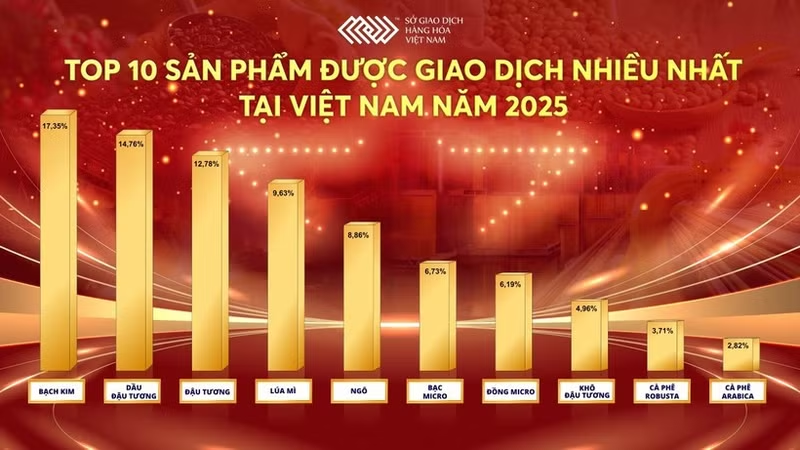
This increase comes from a confluence of factors such as declining global supply, sustained high demand for industrial and jewellery products, and a weakening US dollar following three interest rate cuts by the US Federal Reserve (FED). Concerns about trade policy and supply chain disruptions also reinforce platinum's role in value hedging strategies. Not only has its price increased sharply, but platinum has also risen to the top in terms of liquidity, accounting for over 17% of the total contract trading volume in the market in 2025.
In contrast, the agricultural product group on the CBOT experienced a challenging year, as global oversupply and ongoing US–China trade tensions continued to put pressure on prices. Soybean oil and soybeans still maintained large trading shares, accounting for 14.7% and 12.7% of total contract volume respectively, but weaker price development made market sentiment more cautious.
A maturing trading ecosystem, laying the foundation for risk management in 2026
Amid rising price volatility, the role of the commodity trading market as a hedging tool has been increasingly affirmed. Through the centralised trading channel, many agricultural producers and export-import enterprises have proactively “locked” long-term input costs, thereby protecting profit margins against ongoing fluctuations in global supply chains and prices.
One notable feature of the 2025 market lies in its account structure. With nearly 50,000 trading accounts, up about 15% year on year, individual investors accounted for up to 99.5%, while institutional and corporate accounts made up only around 0.5%. Under international practice, this is considered a “golden ratio” in commodity trading.
While individual investors play a role in providing continuous liquidity, helping the market operate smoothly and efficiently, this capital flow is also the counterparty that allows institutions and businesses to carry out hedging transactions with large volumes without causing sharp price disruptions. The synergy between flexible individual capital and corporate risk management demands has formed a relatively complete ecosystem, in which each participant group finds its own value.
At the same time, the development of Micro contracts has continued to broaden access for individual investors. With a size of just one-tenth of standard contracts, products such as Micro Silver and Micro Copper significantly reduce capital barriers. As silver prices repeatedly set new highs, Micro Silver rose to sixth place in total market trading volume at around 6.7%, while Micro Copper ranked seventh with 6.1%.
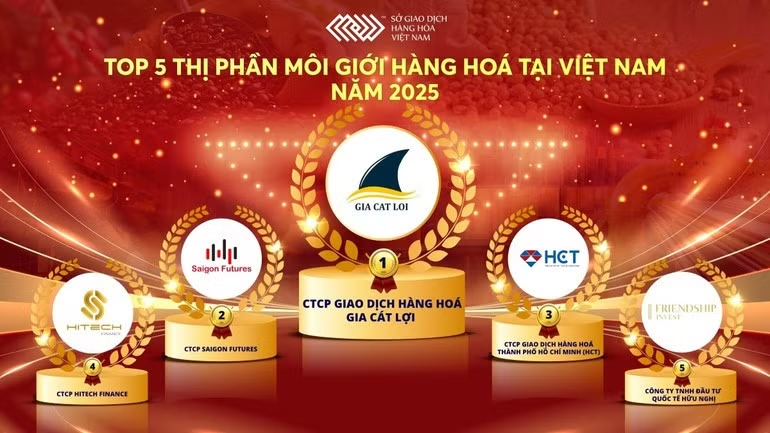
Along with market scale expansion, the brokerage market share structure remained stable in the leading group, while competition intensified in the following group. As of the end of 2025, Gia Cat Loi Commodity Trading Joint Stock Company continued to hold the top position with 32.66% market share, followed by Saigon Futures (13.07%) and Ho Chi Minh City Commodity Trading Joint Stock Company – HCT (12.98%). In the latter half of the Top 5 ranking, Hitech Finance rose to fourth place with 8.55%, while Huu Nghi International Investment Company Limited ranked fifth with 7.07%, reflecting increasingly fierce competition in a fast-growing market.

According to Nguyen Ngoc Quynh, Deputy General Director of MXV, entering 2026, the global commodity market is expected to continue facing numerous uncertainties from geopolitics and trade policies to climate change. In this context, centralised trading data, transparency, and international connectivity capacity are regarded as important foundations to help the market operate stably. Acting as a connection infrastructure between the domestic market and international exchanges, MXV is contributing to shaping an official commodity trading channel, supporting Vietnamese businesses and investors in accessing global risk management standards, thereby taking a more proactive role in stabilising production costs and optimising capital flow efficiency amid fluctuations of the global economy.
![[Infographic] VN-Index rises 0.34% on October 6](https://en-cdn.nhandan.vn/images/j0QNt7m_5iy1OXpnUKiwG61aYhTv_B140GWhfriF26IM-hJLr-YyB-igcHJ7cLRKshCXmgI3hJXGVRYJMfGPzA/chung610-8460.jpg.avif)