However, to increase export value and achieve sustainable development, the province needs to address bottlenecks in financial and credit policies, logistics, and value chain development.
Expanding export markets
For many years, Vinh Long has consistently identified agriculture as one of the main pillars of its economy. Through restructuring the sector to increase added value while promoting sustainable development, the province has focused on establishing large-scale production areas linked to the processing industry, market development, and exports.
To date, concentrated production areas have been established for high-quality rice, speciality fruit, organic coconuts, and aquaculture products. Production and marketing linkages have gradually expanded, while the adoption of VietGAP, GlobalGAP, organic production standards, and traceability systems has been accelerated, laying a solid foundation for improving the quality of agricultural products.
In particular, the project to develop high-quality, low-emission rice has been implemented across more than 8,224 hectares, exceeding its target and helping the province’s agricultural products integrate more deeply into global supply chains.
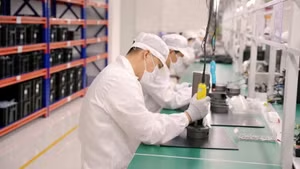
Alongside the development of production areas, the agricultural processing industry has continued to expand. The province is now home to around 450 enterprises operating in agriculture and agro-processing
The agricultural processing industry accounts for approximately 20-25% of industrial production value, while mechanisation in preservation and processing has reached 70-80%, helping to reduce post-harvest losses and increase product value.
These achievements have provided a significant boost to exports. In 2025, the province’s agricultural and aquatic exports reached 433.67 million USD, up more than 12% from the previous year. In the first six months of 2026, exports totalled nearly 234 million USD, a year-on-year increase of more than 16%. The province is aiming to achieve approximately 483 million USD for the full year.
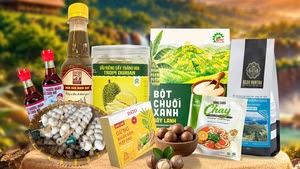
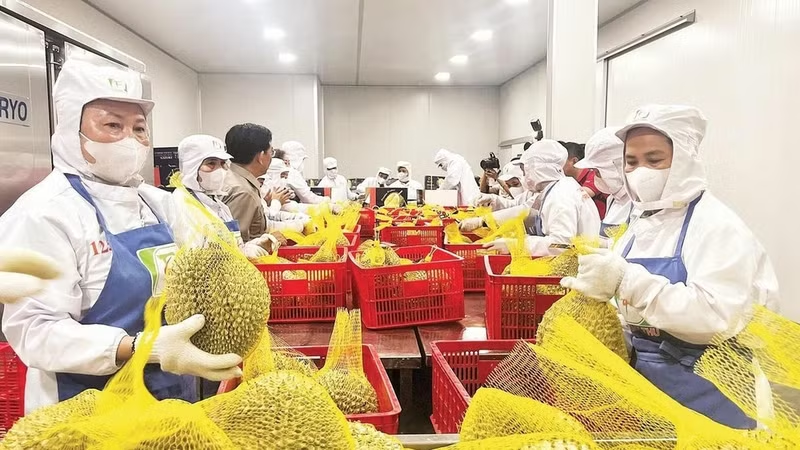
Key export products such as coconuts, durians, pomelos, and aquatic products have maintained strong growth while gradually expanding into demanding markets such as Europe and Oceania, by making effective use of new-generation free trade agreements.
Following the merger of the three provinces of Vinh Long, Ben Tre, and Tra Vinh into the new Vinh Long Province, the province’s production areas have expanded further. Coconut plantations alone now cover around 120,000 hectares, making Vinh Long the country’s largest coconut-growing region and supporting the livelihoods of tens of thousands of households.
This is regarded as an important foundation for developing a deep-processing ecosystem, promoting the circular economy, and enhancing the international standing of Viet Nam’s coconut industry.
According to Vinh Long Vice Chairman Nguyen Truc Son, the province’s GRDP grew by 6.41% in the first six months of 2026, with agriculture continuing to play an important role in the economic structure.
The province is actively mobilising credit resources and seeking support from central ministries and agencies to develop production areas, improve product quality, step up trade promotion, and expand export markets.
At the same time, the province has introduced a range of policies to support production and marketing linkages for agricultural products, promote the collective economy, provide preferential land rental rates, and encourage businesses to invest in agriculture.
It has also launched a programme to support enterprises in digital transformation through 2030. These measures are regarded as an important foundation for enhancing the competitiveness of exporting enterprises amid increasingly demanding integration requirements.
Removing bottlenecks to strengthen competitiveness
Despite these positive results, Vinh Long’s agricultural and export sectors continue to face a number of challenges.
Most agricultural processing and exporting enterprises in the province are small or medium-sized businesses with limited financial capacity, making it difficult for them to access medium- and long-term financing to invest in technology, deep processing, and market expansion.
In addition, implementing central government policies to support agricultural investment has encountered numerous obstacles due to limited funding, while logistics, cold storage, and post-harvest preservation costs remain high. Export infrastructure has yet to meet the requirements of large-scale supply chains, reducing the competitiveness of local products.
According to the Department of Quality, Processing and Market Development under the Ministry of Agriculture and Environment, agricultural production in Vinh Long remains dominated by small-scale farming households, while linkages between farmers, cooperatives, and businesses are not yet sufficiently sustainable.
The adoption of advanced production standards also remains limited, even as importing markets continue to tighten requirements on food safety, traceability, emissions reduction, and environmental responsibility. As a result, businesses are required to make substantial investments to comply with international standards.
Cao Ba Dang Khoa, Vice Chairman of the Viet Nam Coconut Association, said: “The coconut industry in Vinh Long has enormous development potential, but it still faces three major bottlenecks: a shortage of long-term investment capital for deep processing; a lack of credit mechanisms based on value chain cash flows to support cooperatives and farmers; and the high cost of maintaining international organic certification.”
Against this backdrop, many experts believe financial policies should shift from supporting individual stages of production to supporting the development of entire value chains. Priority should be given to developing standardised production areas, driving technological innovation, and advancing deep processing, logistics, digital transformation, green finance, and agricultural branding.
At the same time, mechanisms should be introduced to enable credit to be linked to production contracts, thereby reducing reliance on collateral and making it easier for businesses and cooperatives to access financing.
According to Tran Quoc Tuan, Director of the Vinh Long Department of Industry and Trade, when public investment takes the lead, bank credit supports value chains and business investment is used effectively, farmers will be the direct beneficiaries.
Close cooperation among the State, banks, businesses, and producers will provide a solid foundation for Vinh Long’s coconuts, rice, fruit, and aquatic products not only to expand their export markets but also to increase their added value, contributing to the development of a modern, efficient, and sustainable agricultural sector.