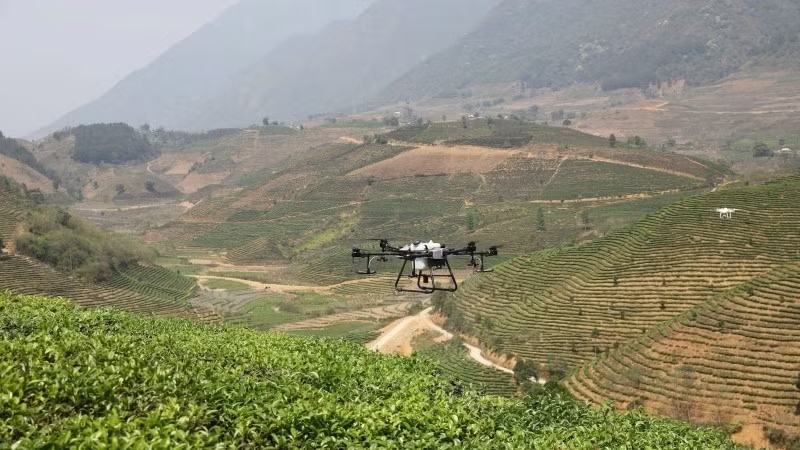
However, forecasts for the remainder of the year indicate that climate change and volatility in global trade will exert intense pressure upon growth, necessitating the rapid deployment of novel development drivers across the sector. Among them, the application of science and technology, digital transformation, and green transition will be decisive in propelling agricultural expansion.
Maintaining production momentum and boosting exports
According to Deputy Minister of Agriculture and Environment Dang Ngoc Diep, in the first six months of the year, total exports of agricultural, forestry, and fishery products reached an estimated 35.88 billion USD, up 6% year-on-year. The sector’s GDP growth was estimated at more than 3.8%, exceeding the assigned target of 3.7%. These results were primarily underpinned by stable production, particularly in key sectors.
Specifically, during the 2026 winter–spring rice crop, farmers nationwide planted more than 2.9 million hectares, representing a decline of nearly 38,000 hectares. However, thanks to an increase in yield of 1.2 quintals per hectare, output still reached around 20.5 million tonnes, up more than 88,000 tonnes year-on-year. This demonstrates that the restructuring of the rice sector is yielding profound strategic benefits: although the cultivated area has declined, output has not, while land-use efficiency and added value per unit of cultivation have gradually improved. Alongside crop production, livestock farming, and fisheries continued to make vital contributions to growth, with total fishery output reaching nearly 5 million tonnes, up 3.6%, clearly affirming its role as a key commodity sector.
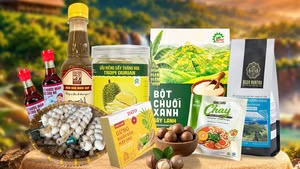
Supported by stable production, trade continued its upward trajectory. In the first half of the year, several commodity groups posted robust export turnover, with fisheries reaching 5.7 billion USD, up 11.4%; fruit and vegetables 3.6 billion USD, up 17.7%; and wood and wood products 8.5 billion USD, up 4.4%. Notably, exports of livestock products surged by 34.6% — the highest growth among all commodity groups — thanks to the wider adoption of farm-based production models and biosecurity measures, helping improve productivity, control disease, and better meet market requirements.
Although the global economy remained volatile throughout the first half of 2026, the agricultural sector successfully consolidated its primary export markets. Export value to China rose sharply by 23.1%, while exports to Japan increased by 1.6%.
Dang Phuc Nguyen, Secretary-General of the Viet Nam Fruit and Vegetable Association, noted that fruit and vegetable exports achieved exceptionally strong growth in the first half of the year, driven by stable import demand from the Chinese market and expedited customs clearance. In addition, many businesses proactively met requirements for phytosanitary measures, traceability, growing-area codes, and packing-house codes. The addition of more fruits eligible for official exports under bilateral protocols has also encouraged businesses to invest more systematically in raw-material areas and establish sustainable linkages throughout the supply chain, thereby enhancing the competitiveness of Vietnamese products.
Unlocking new drivers of growth
To achieve the target of 4% growth, the agricultural sector must rapidly harness new drivers of development in science and technology, digital transformation, and green transition during the second half of 2026. The Ministry of Agriculture and Environment is currently implementing strategic technology development tasks, ranging from the development of next-generation crop, livestock, and aquaculture varieties and mastery of veterinary vaccines and biological products to the development of digital data infrastructure for management and production. These efforts will provide an important foundation for enhancing climate resilience through the development of drought- and salt-tolerant varieties, stronger disease surveillance, and support for real-time forecasting and production management.
According to Nguyen Van Long, Director of the Department of Science and Technology under the Ministry of Agriculture and Environment, the ministry has so far proposed 15 strategic technology development tasks, identified 13 products with the potential to become strategic technology products, and promoted cooperation models involving the State, research institutions, businesses, and farmers in research and technology transfer. In digital transformation, the agricultural product traceability system officially came into operation on July 1, helping improve transparency and quality control, support exports, and enhance the competitiveness of Vietnamese agricultural products.
However, for exports to truly accelerate in the final months of the year, a renewed strategic impetus is imperative to empower businesses to expand into new markets and adapt to the global trend towards greener trade.
Do Quoc Hung, Acting Director of the Department of Foreign Market Development under the Ministry of Industry and Trade, emphasised that environmental and sustainable development standards, such as the European Union Deforestation Regulation (EUDR) and environmental, social and governance (ESG) standards, are becoming the most formidable barriers to exports in the medium and long term.
“These standards require fundamental changes to production models and entail substantial costs, from investment in technology, measurement, reporting, and auditing to maintaining management systems. For small and medium-sized enterprises, this represents a severe encumbrance that could reduce their ability to participate in international supply chains. Therefore, it is necessary to build an ecosystem to support businesses in their green transition, including carbon measurement centres, certification systems, and green finance mechanisms. In addition, green production clusters should be developed to reduce compliance costs through economies of scale,” Hung stressed.
The second half of 2026 presents many challenges but also opens up opportunities for Viet Nam’s agriculture to pivot decisively towards a growth model based on quality and sustainable value. This will ensure the achievement of the annual growth target while laying an impregnable foundation for further development.