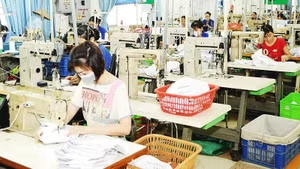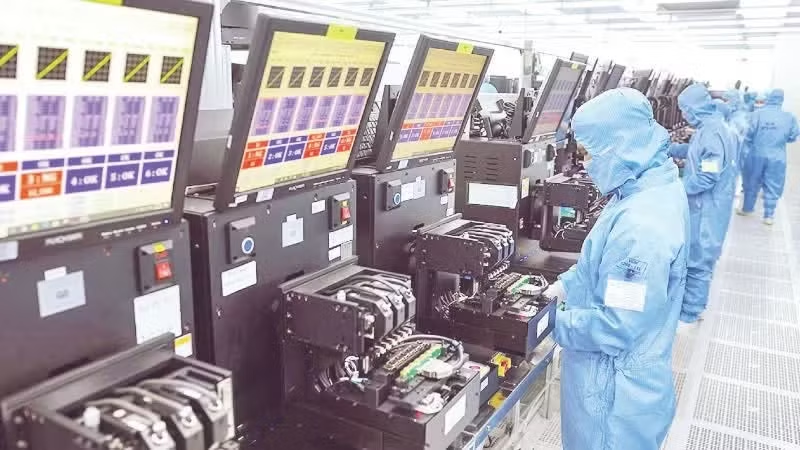
After more than 10 years of investing in Viet Nam, US technology corporation Intel found a local supplier through cooperation between Intel Products Viet Nam (IPV) and Fab 9 Viet Nam Co., Ltd. (Fab 9).
Upgrading domestic enterprises
At that time, IPV had invested 1.5 billion USD in Viet Nam, becoming Intel’s largest assembly and test facility globally, contributing more than 100 billion USD in exports and creating around 4,800 high-tech jobs. Meanwhile, Fab 9 was a small enterprise specialising in the production of semiconductor wafer testing products and had never imagined it could join Intel’s ecosystem of hundreds of thousands of global suppliers.
In a story shared at the Viet Nam Development Bridge Forum 2026, Viet Tran, General Director of Fab 9, said he had little hope of cooperation with the technology “eagle” Intel when he was proactively contacted by Kenneth Tse, Vice President and General Director of IPV. Facing a “billion-dollar” partner like Intel, Fab 9 saw itself as a small enterprise that was not yet ready in terms of workforce skills and technology. However, with Intel’s commitment to supporting the development of a supplier network in the local market to optimise its supply chain, Viet Tran decided to upgrade Fab 9 to seize the opportunity.
Since then, Intel has sent experts to Fab 9’s factory, while Fab 9 has also sent its best personnel to the US for training, increased investment in upgrading modern technological equipment, and met higher requirements for transparency and governance capacity. This cooperation has become a model for the linkage between the foreign direct investment (FDI) sector and domestic enterprises, with over nearly 40 years of opening to attract foreign investment, the linkage between the FDI sector and domestic enterprises has remained a bottleneck, despite Viet Nam’s impressive achievements in foreign investment cooperation.
Statistics show that Viet Nam currently has more than 46,500 valid FDI projects, with total registered capital of over 543 billion USD and realised capital of around 357.6 billion USD. In terms of its contribution to the economy, the FDI sector currently accounts for about 70% of export turnover, creates jobs for millions of workers, and contributes more than 20% of GDP.
However, according to Dr Le Duy Binh, Director of Economica Viet Nam, among the more than one million domestic enterprises currently in operation, only about 5,000 have direct connections with multinational corporations or global supply chains, and only around 100 enterprises have become tier-1 suppliers to multinational corporations.
Domestic enterprises are constrained by outdated technologies, low labour productivity, and limited ability to meet the stringent requirements of international partners. To address this bottleneck, Vietnamese businesses need to take the initiative in technological renewal, improve their governance capacity and workforce quality, and place greater emphasis on digital and green transformation so they can keep pace with partners’ requirements amid shifting global FDI trends.
Increasing the spillover effects of FDI on the economy
To meet the country’s development requirements in the new period, Politburo Resolution No. 10-NQ/TW on the development of the foreign-invested economy (Resolution 10) has established Viet Nam’s new-generation foreign investment model through to 2045. Accordingly, the goal of attracting foreign capital is no longer focused on quantity, but on higher technology, greater added value, and deeper contributions to the country’s industrialisation and modernisation process.
The overall objective of the foreign investment attraction strategy is to make Viet Nam a competitive destination for attracting high-quality medium- and long-term foreign capital for development investment.
Effectively managing and using foreign investment capital is aimed at enhancing production capacity, creating linkages and spillover effects with domestic economic sectors, promoting technology transfer, training human resources, and participating more deeply in global supply chains.
Phan Huu Thang, former Director of the Foreign Investment Agency, said that Resolution 10 sets out very specific targets, such as the localisation rate of key industries reaching 45-50% by 2030, with around 10,000 domestic enterprises participating in the supply chains of the FDI sector, including 500-1,000 tier-1 suppliers. These targets provide a pathway to increasing the spillover effects of FDI on the economy, turning this capital flow into capacity for domestic enterprises and overcoming the situation in which FDI attraction continues to rise while most Vietnamese enterprises remain stuck in low-value segments.
The fact that Resolution 10 sets out very specific targets, such as the localisation rate of key industries reaching 45-50% by 2030, with around 10,000 domestic enterprises participating in the supply chains of the FDI sector, including 500-1,000 tier-1 suppliers, provides a pathway to increasing the spillover effects of FDI on the economy, turning this capital flow into capacity for domestic enterprises and overcoming the situation in which FDI attraction continues to rise while most Vietnamese enterprises remain stuck in low-value segments.
Phan Huu Thang, former Director of the Foreign Investment Agency
This is also the answer to the linkage challenge between FDI enterprises and domestic enterprises. Sharing the same view, Bui Quy Thuan, Head of the General Research Department under the Viet Nam Industrial Park Finance Association, said that by closely linking the strategy for developing the foreign-invested economy with the strategy for developing domestic enterprises, Resolution 10 has broken the isolation between the two economic sectors, promoting and encouraging FDI enterprises to pull domestic enterprises forward, thereby forming a unified economic ecosystem in line with the country’s development strategy in the new period.
To encourage FDI enterprises to strengthen their sense of responsibility, enhance linkages, share knowledge, support the development of domestic enterprises, and accompany Viet Nam’s economy in the long term, as set out in Resolution 10, Bui Thu Thuy, Deputy Director of the Foreign Investment Agency, said that management agencies need to guide and publish standards, regulations, and governance and technical conditions for enterprises to implement. Domestic enterprises, for their part, need to proactively improve themselves and link up with one another to meet large orders, thereby building a domestic business ecosystem that is strong enough, capable enough and able to absorb.





![[Infographic] GRDP growth scenarios for 34 provinces and cities in fourth quarter of 2026](https://en-cdn.nhandan.vn/images/nyM650OGFWrOVWc-xajqN-rTZ68Rlmc1fiGJOhBRYHFSa4DhrHNDxEFdnz313Vk5dNJuxdkHglPA3rLeaPeiaUheNuCI723k2lNssd-YLJuKR58epWq7s21lV5WjM-HR2-Qpbi4MwAzqt9wRjL4WjGkfEz7RO9qhcwg8o8LQFK8/grdp-growth-scenarios-for-34-provinces-and-cities-in-q42026-anh-dai-dien.jpg.avif)