Breakthroughs in development
Phan Dinh Phung ward was established on the basis of merging seven wards of the former Thai Nguyen city. With an area of more than 14 km² and a population of more than 121,000 people, this is the commune-level administrative unit with the largest population scale and also the “core” urban area of Thai Nguyen.
For the 2025–2030 term, the Ward Party Committee has identified three development breakthroughs. Regarding urban management and development, the ward strengthens the goal of ensuring brightness–greenness–cleanliness–beauty; synchronously deploys solutions for urban management and development based on digital technology, gradually building a modern and synchronous technical infrastructure system; coordinates to effectively implement solutions to prevent flooding in the area; prioritizes the development of green spaces, parks, public spaces and parking areas; builds a civilized urban lifestyle and promotes the role of residents in protecting the environment, preserving landscapes and maintaining urban order.
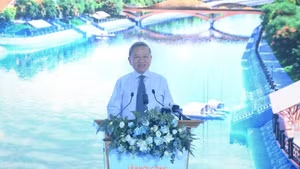
A 6.6-hectare “golden land” area in the center has been reserved by the ward for the development of a new urban area and a central pedestrian street. This is a key project of Thai Nguyen aimed at creating a new, modern appearance and a symbol for a city long known for its hospitals, universities and industrial establishments. With a total investment of nearly 900 billion VND, the project will build a modern pedestrian street more than 330 meters long and more than 52 meters wide, located entirely between two rows of high-rise integrated buildings; underneath is a basement of nearly 2 hectares for parking and commercial space.
The Party Committee of Phan Dinh Phung ward said that the Ward Party Executive Committee has directed the development and adjustment of the master plan for suitable urban development; focusing on attracting resources for urban infrastructure investment in a green and smart direction.
According to the People’s Committee of Thai Nguyen province, after the merger, Thai Nguyen province has 23 urban areas, including: one grade-I urban area, one grade-II urban area, two grade-III urban areas, one grade-IV urban area and 18 grade-V urban areas. The urbanization rate calculated by inner-city population reaches 31.28%; calculated by total urban population reaches 48.26%.
Currently, 100% of urban areas in the province have approved master plans; inner-city areas have been planned and approved at a rate of 80–90% (of which Song Cong and Pho Yen urban areas reach 100%). Detailed planning schemes have been approved in urban areas with high urbanization levels, providing the basis for implementing investments in backbone infrastructure and essential infrastructure, contributing to the formation of urban space and socio-economic development.
Turning potential into reality
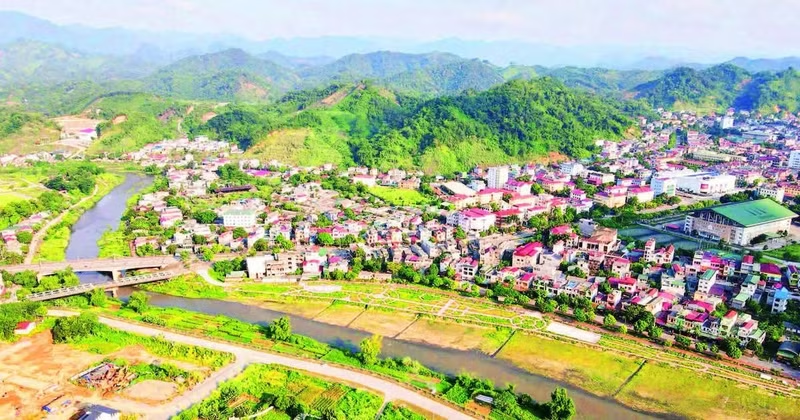
The northern area of Thai Nguyen province has a large forest coverage rate and a fresh climate suitable for the orientation of developing ecological urban areas, tourism and green urban areas. The central urban area and the southern area are currently planned and invested in building parks and green flower gardens that are clean and beautiful. With a favorable geographical position in transport infrastructure connecting with provinces in the region and Noi Bai airport, many communes in Thai Nguyen have great advantages to “rise up” to become ward-level urban areas.
Thanh Cong is a gateway commune connecting major tourism centers such as Tam Dao (Phu Tho), Nui Coc Lake, the provincial center and the Capital Ha Noi. In particular, the Bac Ninh–Thai Nguyen–Phu Tho regional connecting road passes through the commune, creating favorable conditions for attracting tourism. With an area of more than 4,300 hectares and many lakes such as Suoi Lanh, Co Phi, Bach Long Vy… located among tea hills and fruit orchards, Thanh Cong has great potential to successfully develop an urban area associated with eco-tourism. This is also one of the communes identified by Thai Nguyen province to be developed into a ward during this term.
According to Nguyen Thanh Tung, Secretary of the Party Committee of Thanh Cong commune, the locality currently has all favorable conditions of “favorable timing, advantageous location and harmony among people” to become an eco-tourism and resort center. The Commune Party Committee has identified and is focusing on leading and directing the realization of this goal by 2035. The commune is focusing on completing tourism development planning associated with land-use planning and urban planning, investing in upgrading connecting transport infrastructure: expanding regional connecting roads, building intra-commune tourism routes connecting with Suoi Lanh Lake, Glory golf course, the western Pho Yen industrial zone and historical-cultural relics…
Also included in the orientation to develop into a ward during this term, Dinh Hoa commune has proactively “gone ahead” to prepare land areas. The Commune Party Committee has issued a thematic resolution to implement site clearance to welcome investment in the construction of the inter-commune road Trung Luong–Dong Thinh–Dinh Bien–Bao Linh–Thanh Dinh–Binh Yen and the project to restore the service road of the Ho Chi Minh road. In addition, in order to call for and attract investment in building commune cluster centers, industrial clusters, residential areas and service–tourism areas, the commune has adopted the policy that once works and projects are approved, it will actively coordinate implementation, accelerate progress and plan to mobilize people to clear land and welcome investment.
To accelerate urbanization, Thai Nguyen province has issued Project No. 19-DA/TU on urban development and essential infrastructure for the 2026–2030 period. Accordingly, by 2030 the province aims to have 31 wards, including 15 existing wards and 16 wards upgraded from communes after the merger; the province’s urbanization rate will exceed 55%. It strives for at least 15% of urban areas and housing areas to meet smart urban criteria; at least three urban areas to meet technology urban criteria; the rate of civilized urban streets to exceed 60%; and the construction of three to five new urban-level parks and squares.
According to Provincial Party Secretary Trinh Xuan Truong, the province’s development orientation is for urban areas to become political, administrative, economic, cultural, social and science-technology centers that act as drivers for the economic development of urban regions, creating accumulation effects, connections and close linkages with rural areas; ensuring a high quality of life in urban areas.
In the coming time, Thai Nguyen will invest more than 32 trillion VND to prioritize the construction of 19 important key works and transport routes. At the same time, priority will be given to investing in nine clean water supply plants; four cemeteries; four wastewater treatment stations and plants; Song Cau park (Quan Trieu ward); renovation of the landscape of Gia Sang Lake (Gia Sang ward); and the development of 7,000 new 5G stations… Thai Nguyen is striving so that in the near future it will become a centrally governed city.