
Digital transformation as a new growth driver
Recently, the Prime Minister issued a directive on accelerating the implementation of science and technology, innovation and digital transformation tasks in 2026.
The directive requires ministries, agencies and localities to regard the development of science and technology, innovation and digital transformation as urgent political priorities for 2026, while also treating the accelerated disbursement of investment capital for these areas as a crucial condition for achieving stronger growth in the remaining months of the year.
According to experts, for digital transformation to truly become a lever for economic growth, the priority is not only investment in technology but also the removal of institutional, data and implementation bottlenecks.
According to Dr Ho Duc Thang, Director of the National Institute of Digital Technology and Digital Transformation, Viet Nam is facing a tremendous opportunity as artificial intelligence (AI) develops at an unprecedented pace. However, widespread AI adoption does not mean higher productivity.
“Technology only creates value when it is supported by reliable data, appropriate processes, a skilled workforce and clear accountability mechanisms,” Dr Thang said.
In his view, Viet Nam’s challenge is no longer gaining access to technology but transforming it into added value.
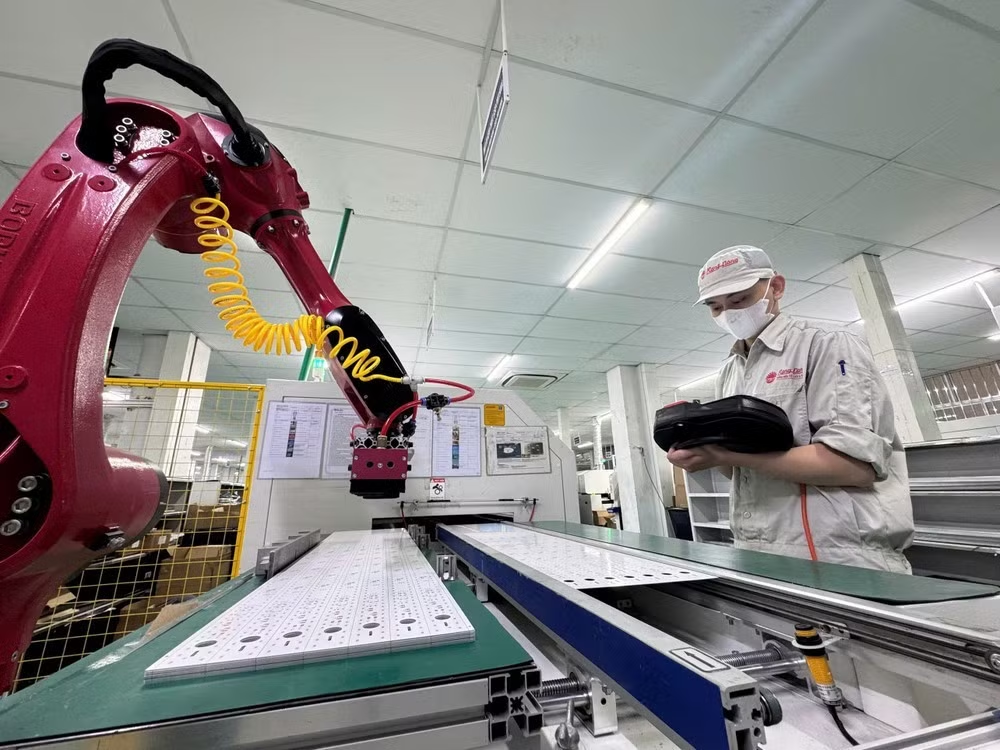
Businesses can use AI to draft documents more quickly and process data more efficiently, but this alone will not significantly improve productivity if operating procedures, management practices and decision-making processes remain unchanged.
For AI to become a genuine engine of growth, businesses must simultaneously standardise data, redesign workflows, enhance workforce capabilities and establish appropriate risk management systems.
This is also why the Prime Minister’s directive prioritises resources for the national data infrastructure, large-scale databases, shared digital platforms and digital transformation projects supporting local authorities. These are regarded as the foundations of a digital economy rather than simply the digitalisation of administrative procedures.
Removing bottlenecks to unlock growth
According to Dr Le Dang Doanh, former Director of the Central Institute for Economic Management, achieving double-digit growth is an enormous challenge amid continued global economic uncertainty.
Alongside external pressures, he believes the biggest constraints remain institutional barriers and the capacity of businesses to transform.
In his view, digital transformation will enable businesses to reduce costs significantly, improve corporate governance and simplify administrative procedures.
In particular, the rollout of electronic invoices, digital administrative procedures and digital management systems will make it easier for millions of household businesses to become formal enterprises, thereby expanding the formal economy.
“Supporting businesses in digital transformation and developing e-commerce will be a highly important driver of economic growth,” Dr Doanh stressed.
He also argued that, alongside administrative reform, greater efforts should be made to promote digital enterprises, digital citizens and e-commerce to create new growth opportunities.
From a policy perspective, Professor Dr Le Van Loi, Vice President of the Viet Nam Academy of Social Sciences, said that double-digit growth can only be achieved through a fundamental shift from a management mindset to one focused on enabling development.
In his view, microeconomic policies should directly target lowering costs, enhancing productivity, and improving access to data and innovation capacity.
“Every policy must clearly answer three questions: which bottleneck does it remove, which resources does it unlock, and by what indicators will its effectiveness be measured?” Professor Loi said.
Developing a transparent data market, establishing regulatory sandbox mechanisms for emerging technologies and expanding shared digital platforms would, he added, create a more favourable environment for business innovation.
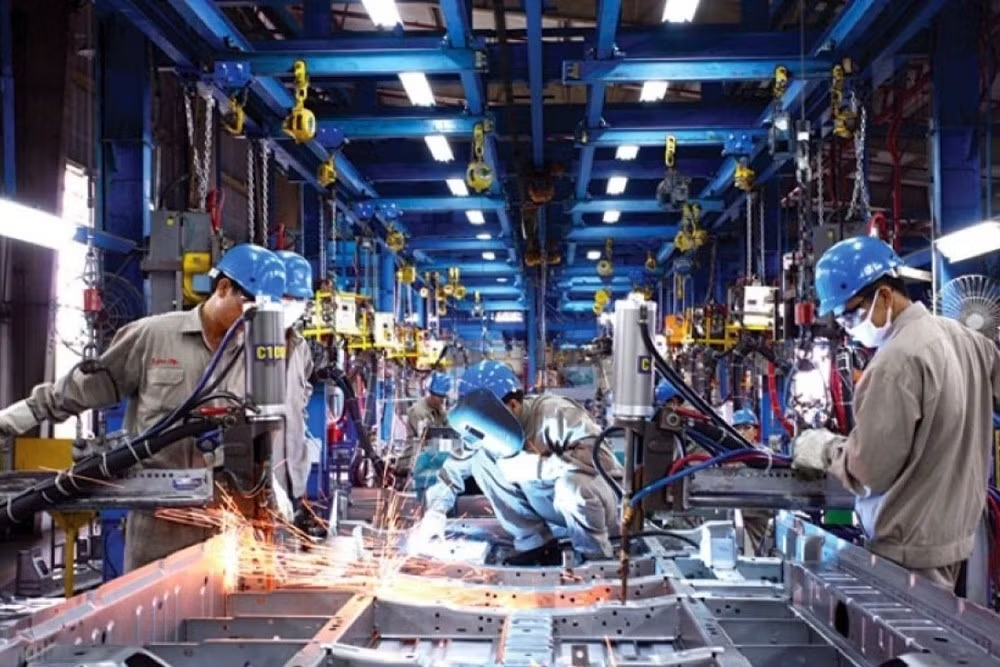
According to experts, in this new phase, digital transformation is no longer simply about investing in software or technological equipment, but about fundamentally restructuring the way the economy operates.
Dr Ho Duc Thang highlighted three major paradoxes hindering the conversion of technology into productivity.
First, while AI is becoming increasingly affordable, mastering the technology still requires substantial investment in data and computing infrastructure.
Second, although businesses possess vast amounts of data, only a limited proportion is of sufficient quality for AI because much of it has not been standardised or interconnected.
Third, while AI can help employees work more efficiently, it also creates new demands for skills training and the redesign of employment models.
According to Dr Thang, competitive advantage in the coming years will belong not to businesses with the largest volumes of data, but to those with clean, reliable, traceable and well-governed data.
Institutions must therefore both encourage innovation and manage risks, creating the confidence businesses need to invest in new technologies.
The promulgation of the Law on Artificial Intelligence, together with its implementing decrees and circulars, has established an important legal framework, enabling businesses to access computing infrastructure, shared data resources and controlled regulatory sandbox mechanisms for new business models.
Prioritising resources for projects with spillover effects
One notable aspect of the Prime Minister’s directive is its requirement that resources be allocated according to the principles of focus, priority and concentration.
Investment in science and technology, innovation and digital transformation will therefore be directed towards projects capable of generating significant spillover effects, directly boosting economic growth, raising labour productivity, strengthening national competitiveness and improving the effectiveness of state governance.
Alongside developing strategic technologies, the government is also prioritising investment in the national data infrastructure, sector-specific databases, shared digital platforms and digital transformation systems serving local governments.
According to experts, whereas previous growth was driven mainly by expanded investment, labour and natural resource exploitation, future growth must be powered by innovation, data and digital technologies.
This will require coordinated efforts to improve institutions, develop digital infrastructure, enhance human resources and implement far-reaching reforms to the business environment.
Only when digital transformation is implemented comprehensively, alongside reforms to governance models and improvements in business productivity, will technology truly become a new engine of growth, helping realise the goal of rapid and sustainable development and bringing Viet Nam closer to its aspiration of becoming a high-income country in the decades ahead.