Technology moves to the fields
Nguyen Dinh Tung, Chief Executive Officer of Vina T&T Group, noted that in agricultural digital transformation, the main challenge lies not in the technology itself but in accessibility and the ability to implement it at the farm household level.
Given the fragmented nature of production and high investment costs, deploying solutions such as AI or integrated data systems calls for a carefully tailored approach.
Vina T&T Group has adopted a model in which the company invests in the core technology platform and then transfers it to cooperatives and farmers in the form of user-friendly smartphone applications. This process is accompanied by hands-on technical guidance, with teams directly assisting farmers in recording and digitising production data.
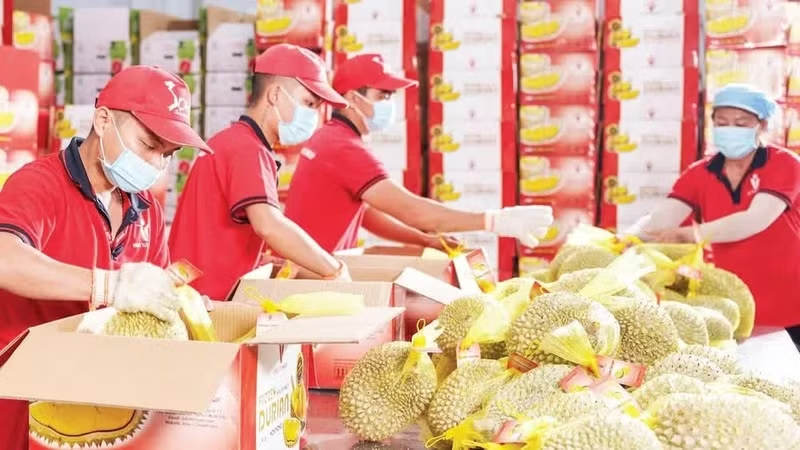
This represents a crucial step enabling the company to implement smart traceability, whereby each shipment is assigned a unique identification code. By scanning a QR code, international customers can access comprehensive information, from planting area codes and fertilisation dates to container temperatures during ocean transit, realising the vision of traceable, sustainably produced agricultural goods reaching global markets.
According to Ngo Quoc Vu, Head of Sustainable Agricultural Development at Simexco Daklak Co., Ltd, the company has partnered with coffee-farming households to install sensor systems that monitor soil moisture, temperature and nutrient levels directly in the fields. The data collected enables coffee growers to adjust irrigation and crop management more precisely, reducing input costs while improving product quality.

Tran Tuan Dan, a farmer in Ea Kao Ward, Dak Lak Province and a participant in the partnership, shared: “Instead of having to understand an entire complex technological system, farmers only need to follow specific instructions provided through smartphone applications and field sensors, which is very convenient and reassuring.”
Through the digitisation of production areas, all export coffee consignments are assigned traceability codes, enabling identification down to individual growers and their cultivation practices.
Building a comprehensive data infrastructure
According to the Ministry of Agriculture and Environment, one of the biggest bottlenecks in agricultural digital transformation today is data gaps and fragmentation. Although there are plans to develop sectoral databases covering crop production, livestock, fisheries and forestry, most data remain unstandardised, lack interoperability and are not updated in real time. Data generated by tools such as drones and field sensors have yet to be fully collected and integrated.
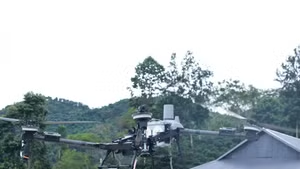
Tran Thien Phuong, Director of MiSmart Technology Joint Stock Company, observed that drones are currently still largely limited to mechanised aerial tasks, used for scheduled spraying rather than as-needed spraying, which limits their contribution to precision agriculture.
While drones can integrate multispectral or infrared cameras to detect crop stress, such applications remain scarce in Viet Nam due to a lack of training data and analytical platforms. In particular, drone-generated data are not systematically stored or utilised, causing the country to forgo valuable opportunities to build digital data assets for research and policy-making.
“Viet Nam does not lack drones, but lacks the data and digital platforms needed to turn them into intelligent decision-making tools in agriculture. We need to develop a national agricultural data platform connecting drones, IoT and satellite data; standardise and open up data from the Plant Production and Protection Department and related agencies; encourage public-private partnerships to develop a digital agriculture ecosystem; and build a national pest and disease dataset to train AI models,” Phuong emphasised.
Practical experience from pioneering enterprises such as TH Group demonstrates the effectiveness of an integrated approach combining technology and data governance. In quality control, Dr Tran Trung My, Deputy Director of Quality Assurance at TH Group, stated that beyond performing analytical functions, modern laboratory systems also act as data nodes across the entire production chain.
Samples of raw materials, water and finished products are tested, digitised and consolidated into a centralised data system, ensuring consistency, reliability and traceability throughout the production process. According to the Group’s leadership, all data – from fields, dairy herds and feed-mixing systems to laboratory test results – are synchronised into the company’s central data platform.
On this foundation, data analytics tools and AI support real-time production and business decision-making. In addition to internal use, part of the data is integrated with national data platforms, contributing to the development of an open agricultural data ecosystem.
According to the Digital Transformation Department under the Ministry of Agriculture and Environment, by the end of 2025, the Ministry had issued technical regulations for 16 major databases across key areas such as hydrometeorology, land, crop production and plant protection, fisheries, fisheries surveillance, water resources, sectoral statistics, environment, remote sensing, livestock and veterinary services, and the cooperative sector and rural development.
Le Phu Ha, Director of the Digital Transformation Department, stated that the Department has fully built out its technical infrastructure; designed, installed and deployed a shared data model at the Ministry’s data centre; ensured information security; and prepared for connectivity, integration and synchronisation with the National Data Centre. It has also coordinated with relevant units to define the data scope and methods for connecting and synchronising the various database groups.
These are essential conditions for agricultural digital transformation to move from the stage of data collection and infrastructure-building to one of data-driven governance and operations, in line with global trends in modern agriculture.