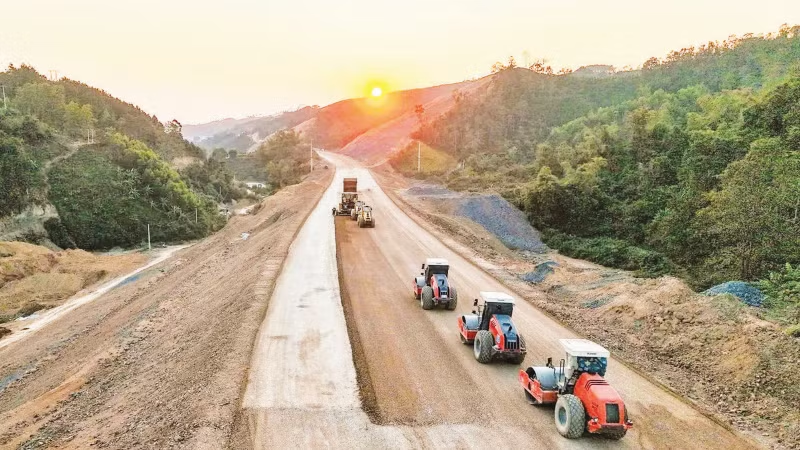
With petrol and oil prices showing no sign of easing and fuel being supplies disrupted, construction firms are scrambling to adopt emergency measures to keep sites running and limit the impact on progress.
A shock on construction sites
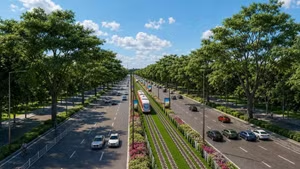
Playing a vital role in linking the northern mountainous provinces with Ha Noi, the Cho Moi-Bac Kan Expressway project has been added to the list of national key projects for the 2021-2030 period.
The project’s contractors are striving to have the entire route open to traffic by the end of the year, but the conflict in the Middle East has significantly affected the project’s construction progress.
According to Vu Duc Nhan, Deputy General Director of Phuong Thanh Tranconsin, over the past ten days, contractors have faced difficulties even greater than those experienced during the fuel price surge of 2021.
At the Cho Moi-Bac Kan Expressway project alone, Phuong Thanh Tranconsin requires up to 20,000 litres of diesel per day to operate construction machinery.
With fuel prices spiking – diesel at times rising by as much as 50% – contractors have been left in a bind: without fuel, construction grinds to a halt, yet purchasing fuel raises questions over how much to buy and when in order to minimise losses.
“Rising fuel prices have had a knock-on effect, driving up the cost of raw materials at a time when most major transport and construction projects are in their final phase, creating significant challenges for contractors”, said Le Thang, Director of the Project Management Unit 2 under the Ministry of Construction.
He added that in the first quarter of 2026 alone, the prices of key construction materials such as stone, sand, steel and cement had risen by more than 10%.
Given the nature of transport infrastructure projects, fuel costs account for 30-50% of total machinery expenses; such sharp fluctuations have seriously affected the entire cost structure.
Similarly, at the Huu Nghi-Chi Lang Expressway project in Lang Son Province, each contractor requires between 5,000 and 20,000 litres of diesel per day. At one point, diesel prices rose by 72% compared with January 2026 (excluding transport costs), while the cost of transporting materials from quarries to construction sites increased by 30-40% compared with those of early February.
At the Dong Dang-Tra Linh Expressway project in Cao Bang Province, the site requires up to 150,000 litres of diesel daily.
Calls for a direct price compensation mechanism
In the south, at the construction site of the Ho Chi Minh City-Long Thanh-Dau Giay Expressway expansion project, contractors have had to assign staff to petrol stations to secure fuel in time to keep machinery running.
At the Long Thanh International Airport construction site, the management boards of packages 4.6 and 4.7 under Cienco4 Group are facing the risk of delays due to insufficient fuel supplies, despite being in the final acceleration phase.
Tran Van Son, executive director of packages 4.6 and 4.7 at Cienco4 Group, said that actual fuel purchase prices were now 50-60% higher than the original estimates. Contractors have had to consider using stockpiled materials gathered before the Lunar New Year to maintain construction activities.
Nguyen Quoc Hiep, Chairman of the Viet Nam Association of Construction Contractors (VACC), noted that recent fuel price rises have directly affected the production and business activities of construction firms, particularly those involved in road infrastructure projects, which require large volumes of excavation, earthwork transport and fuel consumption.
With the Middle East conflict not expected to end soon, VACC has proposed several measures to the Prime Minister to ease difficulties and support contractors in maintaining progress on national key projects.
These include allowing fuel cost differentials to be factored into construction estimates, tender prices and contract values as a basis for payment between project owners and contractors. The proposed compensation period would run from March 2026 until petrol and oil prices stabilise.
At the same time, appropriate mechanisms are needed to stabilise transport costs linked to fuel prices, helping contractors manage input costs.
“We recommend that the Prime Minister instruct local authorities to strictly control prices of bulk materials and take firm action against price manipulation and unjustified increases. If fuel price volatility persists due to the Middle East conflict, we propose that force majeure provisions be considered to facilitate the adjustment of contracts,” Hiep said.
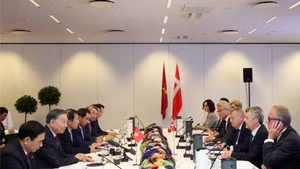
Recently, the Ministry of Construction reported to Deputy Prime Minister Bui Thanh Son on the impact of rising fuel prices and initial response measures aimed at stabilising transport and construction activities.
The ministry will continue to direct its affiliated agencies and local Departments of Construction to monitor fuel prices and their impact on transport service costs, to promptly compile data and to propose appropriate solutions to minimise adverse effects on transport operations and people’s livelihoods.
Deputy Construction Minister Nguyen Xuan Sang said that in the transport infrastructure construction sector, for adjustable-price contracts, localities need to promptly survey and publish price indices that reflect actual market movements to safeguard the lawful interests of contractors and maintain the resources needed for them to accelerate project progress.
He added that for contracts not subject to price adjustment, if price volatility persists, management authorities must study appropriate solutions to support contractors in overcoming these difficulties, avoiding a situation where they become passive, waiting for price stabilisation while construction slows.