Favourable conditions
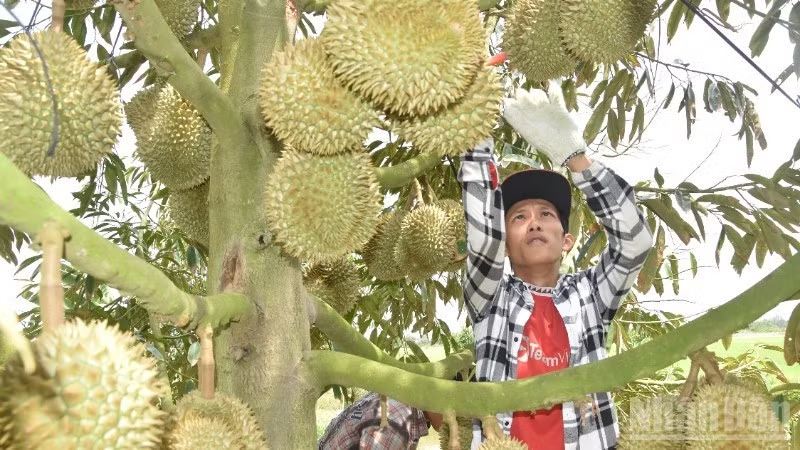
The Mekong Delta is a typical example. With favourable natural conditions, fertile land, and a dense river network, the region has long been the country’s largest agricultural production centre. Each year, millions of farmers generate large volumes of agricultural products for both domestic consumption and export. However, behind this high output lies a paradox: production has increased but value added remains low; many sectors still rely on raw or semi-processed exports; markets are unstable; and farmers frequently face price risks.
Phenomena such as “bumper harvests leading to falling prices”, “rescue campaigns for agricultural products”, or the expansion of cultivation areas followed by mass cutting when markets shift are not temporary issues. They reflect a deeper problem: agricultural production in Viet Nam still lacks organisation at the level of raw material zones.
In the context of deeper integration into global supply chains, where markets increasingly demand quality, traceability, and sustainability, the formation of organised raw material zones has become a strategic requirement for Viet Nam’s agriculture.
When large areas are not enough
In many localities, production areas for various commodities have reached significant scale: rice-growing areas of hundreds of thousands of hectares, fruit-growing zones of tens of thousands of hectares, and concentrated aquaculture areas with high output. However, large areas do not necessarily constitute true raw material zones in the modern sense. In reality, production is still largely carried out by individual households.
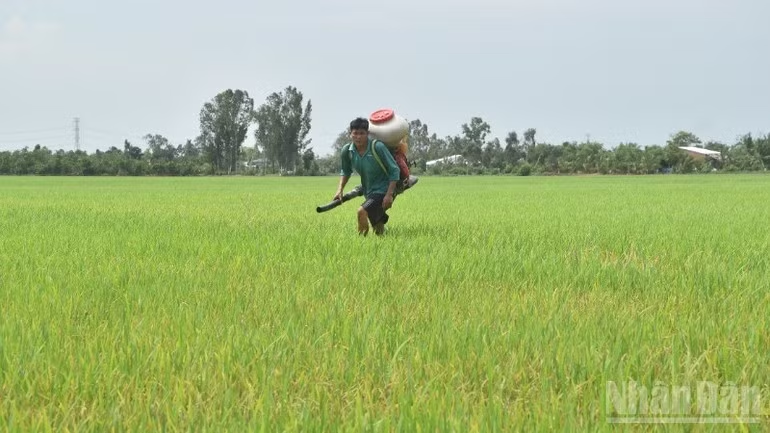
Under this model, each household selects its own varieties, decides its own cultivation processes, cropping schedules, and marketing methods. Even when producing the same product, quality, size, and technical standards vary widely among households. When enterprises require stable input supplies, they must source from multiple locations, incurring high quality control costs while still struggling to ensure consistency.
Conversely, when farmers harvest simultaneously without alignment with market demand, a sudden surge in supply drives prices sharply down. Therefore, the bottleneck in Viet Nam’s agriculture today is no longer expanding acreage, but organising production at the scale of raw material zones.
Common misconceptions about raw material zones
The concept of “raw material zones” is widely mentioned, yet in practice there remain incomplete understandings.
First, some believe that large areas growing the same crop automatically constitute a raw material zone. In fact, scale is only a necessary condition. If production remains fragmented, with non-uniform varieties, differing technical processes, and uncoordinated harvest times, the region’s output will still struggle to meet processing and export requirements.
Second, some assume that contract farming alone is sufficient to establish a raw material zone. While offtake agreements are important, without organising farmers into disciplined production communities, enterprises still find it difficult to control quality and output.
Third, raw material zones are sometimes viewed as solely an agricultural issue. In reality, they are closely linked to land-use planning, transport, irrigation, logistics, processing industries, trade, and even data infrastructure for production management.
The need for organised raw material zones
An organised raw material zone is not merely an area cultivating the same crop or raising the same species on a large scale, but a production system managed along value chains. In such a system, farmers no longer operate individually but are organised through cooperatives or production communities, enabling uniformity in varieties, technical processes, cropping schedules, and quality standards. Cooperatives play a central role in coordinating production, controlling quality, aggregating output, and linking with enterprises.
To establish true raw material zones, several synchronised conditions are required: stable planning aligned with market demand, capable cooperatives, meaningful enterprise participation from the outset, transparent standards and traceability systems, and the State’s enabling role through infrastructure, linkage mechanisms, and data systems. When these elements converge, production zones can truly become a solid foundation for modern agricultural value chains.
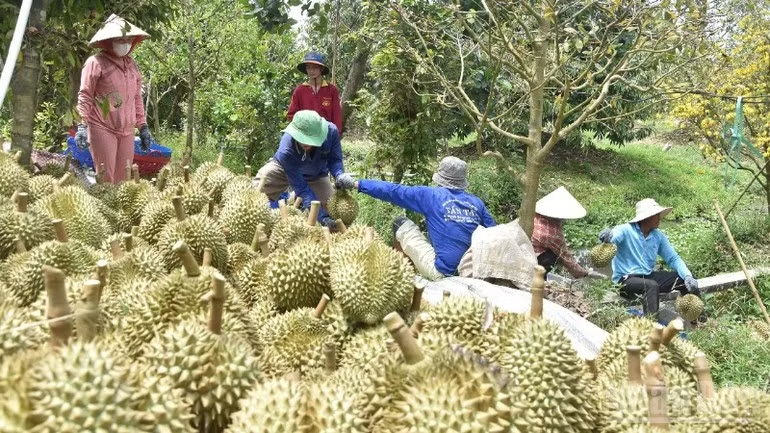
If fragmented production persists, Viet Nam’s agriculture risks losing its competitive advantage as markets impose stricter standards; agricultural products may remain stuck at the stage of low-value raw materials, and farmers will continue to bear the greatest risks. Conversely, when organised raw material zones are established, agriculture can shift from quantity to value, forming sustainable linkages between farmers and enterprises, and enhancing the position of Vietnamese agricultural products in international markets through quality, consistency, and reliability across the supply chain.
A necessary step for Viet Nam’s agriculture
In the long term, organised raw material zones are not merely a new production model but a shift in development thinking. It means moving from fragmented to organised production, from a focus on output to value creation, and from isolated practices to close linkages among farmers, cooperatives, enterprises, and the State.
When these transformations take place, Viet Nam’s agriculture will be recognised not only for its production capacity but also for its ability to supply stable, high-quality raw materials that meet increasingly stringent global standards.
At that point, fields, orchards, and aquaculture areas will not only generate output but will truly become the foundation for modern, sustainable, and highly competitive agricultural value chains.