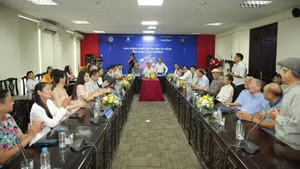
The governance challenge as scale changes
Following its merger, HCEM now has eight training campuses in different locations, nearly 600 officials, lecturers and employees, and nearly 20,000 students enrolled in more than 60 disciplines and occupations. At such a scale, the challenge for the school is no longer simply organising teaching or managing personnel. The more difficult task is how to ensure that information from campuses, functional departments and training units is connected in a timely, consistent and reliable manner for every management decision.
Reality shows that when a school’s scale expands, processes that once operated effectively begin to reach their limits. A report must go through many units for compilation. A decision has to wait for data from several departments. If just one link is delayed, the entire management process is affected. When information is not connected in a timely manner, the distance between campuses becomes a distance in governance.
This is also a problem that many vocational education institutions are having to solve as the process of restructuring and streamlining apparatuses towards forming large-scale, high-quality vocational schools is being accelerated. The larger the school, the higher the governance requirements. For the apparatus to operate effectively, experience alone is no longer enough. Every management decision needs to be based on complete, accurate and promptly updated data.
According to Dr Dong Van Ngoc, Rector of HCEM, with a multi-campus training system and nearly 20,000 students, traditional governance can no longer keep pace with development. “For HCEM, digital transformation, the application of artificial intelligence and automation in school management and governance is an imperative,” he said.
From that reality, HCEM has developed the Smart Campus ecosystem to reorganise all governance activities. Data from enrolment, training, personnel, finance and enterprise connectivity is integrated on a single platform. The board of rectors can monitor the school’s situation in real time, instead of waiting for compiled reports.
When data becomes the foundation of governance
Vocational education is entering a new stage, in which technology not only serves the digitisation of records or shortens work processing procedures, but is also gradually becoming involved in school governance.
This change is also reflected in Circular No 38/2026/TT-BGDDT. Alongside familiar criteria such as teaching staff, training programmes and facilities, the new regulation adds requirements on digital governance, databases, teaching and learning in the digital environment, enterprise connectivity and quality assurance.
As these criteria become part of quality standards, data-based governance capacity is also gradually becoming a requirement for vocational education institutions.
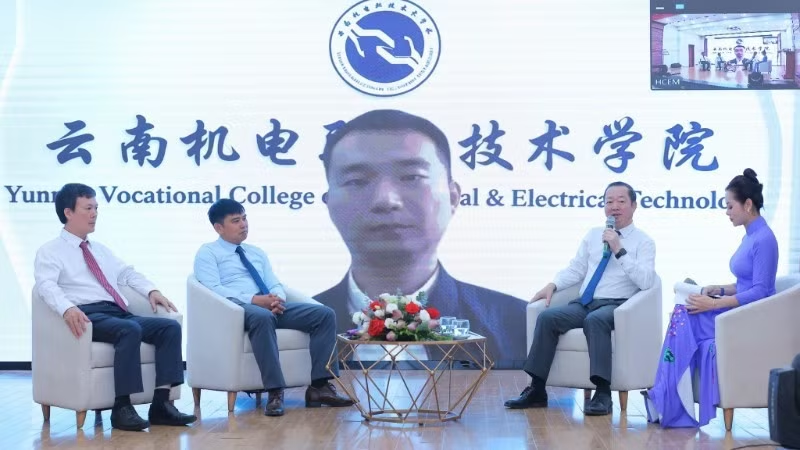
Speaking at the discussion “AI and the future of vocational education”, Dang Duy Hien, Deputy Director of the Department of Digital Transformation under the Ministry of Agriculture and Environment, said digital transformation only creates value when it is built on a centralised data foundation, operates synchronously, ensures information security and places learners at the centre. According to him, together with completing digital infrastructure, effective models need to be shared to promote digital transformation across the vocational education system.
From the perspective of management, Pham Vu Quoc Binh, Deputy Director of the Department of Vocational Education under the Ministry of Education and Training, said AI is opening up opportunities for comprehensive innovation in the operations of vocational education institutions. However, the value of technology must ultimately be measured by training quality, learners’ capacity and the extent to which it meets enterprises’ demand for human resources.
Therefore, what matters is not the number of digital platforms or AI tools a vocational school is using. The more important question is whether technology helps the school operate more effectively, deliver better training and connect more closely with enterprises.
Perhaps in the not-too-distant future, a high-quality vocational school will be assessed not only by its practice workshops, training equipment or enrolment scale. Data-driven governance capacity will also become part of that quality standard.