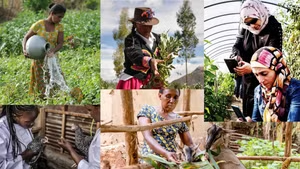
Through this, the proactive role of learners is promoted, vocational training is linked to lifelong learning, contributing to building a peasant class with aspirations to build a prosperous and happy homeland.
Taking advantage of its natural conditions, the Son La Provincial Party Committee aims to build the province into a centre for processing agricultural products in the northern midland and mountainous region. During the 2020–2025 period, agricultural production in Son La still hasn't kept pace with market developments; the productivity, quality, and competitiveness of some agricultural products are not high.
The Son La Provincial Party Committee has identified that this limitation is partly due to a lack of high-quality human resources with specialised skills. In light of this reality, the Son La Provincial Party Committee focuses on improving the quality of vocational training linked to the labour market; focus on vocational training in ethnic minority areas and particularly disadvantaged regions.
Under the direction of the Provincial Party Committee, the government at all levels is focusing on implementing a comprehensive set of solutions. Along with the rational allocation and use of state budget funds for human resource development in the province, Son La is seeking other resources to organise training for labourers, encouraging training institutions to invest in improving technical infrastructure, innovating content, programmes, and teaching methods, and enhancing the qualifications of lecturers and teachers.
According to the Son La Provincial Department of Agriculture and Environment, the training and improvement of the quality of rural labour in the province is being implemented in a way that shifts people's mindset from “doing agriculture” to “doing agricultural economics,” proactively participating in linkages, cooperation, and adapting to market demands.
Ta Hoc Commune has over 8,400 people of working age, mostly ethnic minorities such as the Mong, Thai, and Khmu. To address employment issues for rural workers, the Party Committee and People’s Committee of Phu Yen Commune have focused on improving vocational training; implementing preferential credit programmes to provide loans for job creation; and connecting businesses with employers.
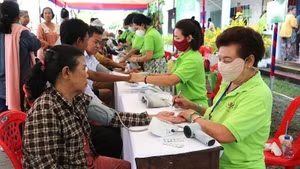
From 2024 to the present, the commune, in coordination with specialised agencies, has organised 12 vocational training classes for over 600 rural workers on techniques for planting and caring for vegetables and fruit trees; harvesting and processing coffee; and raising, preventing, and treating diseases in livestock and poultry, in accordance with the National Target Programme for New Rural Development and the National Target Programme for Socio-Economic Development of Ethnic Minority Areas in the mountainous region for the 2021–2030 period.
In recent years, the Party Committee of Phu Yen Commune has paid attention to and implemented vocational training and job creation for workers, contributing to improving product quality and production and business efficiency in the area. In 2025, Phu Yen Commune will organise training and technology transfer in crop cultivation and livestock farming for over 2,000 workers.
Phu Yen Commune is gradually planning and developing concentrated commodity production areas, such as: high-quality organic rice farming areas; goat farming areas; fruit tree cultivation areas; and agricultural product collection and processing centres.
The Standing Committee of the Commune Party Committee has recognised that trained labour is a crucial force in the plan to reorganise production towards concentration, scale, and value chain linkages; maintaining and expanding agricultural production cooperatives and cooperative groups, with cooperatives acting as intermediaries linking farmers, businesses, and the market.
To meet the requirements of labour and economic restructuring towards increasing the proportion of industry, Phu Yen Commune, in coordination with local businesses, regularly holds career guidance sessions, vocational training pathways, and job placements suitable to the capabilities and conditions of its residents. Specifically, the Ngoc Ha leather shoe factory and the tunnel brick factory have provided employment for over 2,750 rural workers in the area, with an average income of approximately 6–8 million VND per person per month.
The documents of the 14th National Congress of the Party identify the industrialisation and modernisation of agriculture and rural areas as one of the top priorities to achieve the goal of industrialisation and modernisation of the country. In this process, farmers are the main actors and the centre of the development of agriculture, rural economy, and the construction of new rural areas.
Party committees and organisations at all levels need to strengthen leadership, guidance, inspection, and supervision, while ensuring resources, improving policies, and supplementing conditions to enhance the quality and effectiveness of vocational training for rural workers, bringing the Resolution of the 14th National Congress of the Party into life.