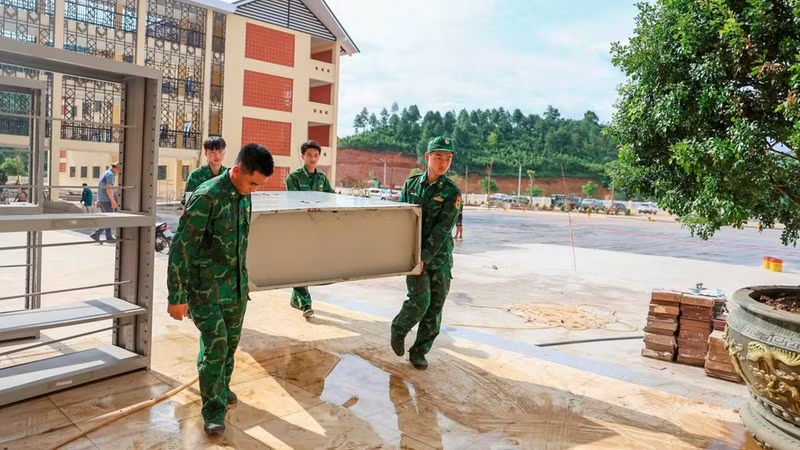
These new schools create better learning and living conditions for students in border areas, helping to improve the quality of education and laying the foundations for the long-term development of localities.
Improving the quality of education
In Lao Cai Province, despite difficulties in construction conditions, boarding school projects in the border communes of Y Ty, A Mu Sung, Muong Khuong, and Pha Long remained on schedule, and were handed over and put into use before August 30. This result was achieved thanks to the coordinated involvement of the entire political system under the “six clear” spirit: clear people, clear tasks, clear timelines, clear responsibilities, clear outcomes, and clear authority.
More than 300 workers were working to complete the final items of Pha Long Primary and Secondary Boarding School on August 26. The local authorities and the school were also preparing the necessary conditions for operation. In the 2026-2027 academic year, the school will have 28 classes with 980 students from Grade 3 to Grade 9. As of now, enrolment has been completed.
Visiting the school with her father, Lo Ngoc Thu, a Grade 8A2 student, was delighted at the prospect of studying in a spacious, modern environment. “The new school is very beautiful, and I am very happy to study here. I promise I will study hard so that I can become a useful person in the future,” Thu said.
Selected as the central venue for the nationwide opening ceremony of the 2026-2027 academic year, Muong Khuong Primary and Secondary Boarding School has now completed its main facilities.
Students gathered at the school on August 28 to officially begin operations. The commune was urgently completing the grounds and preparing the necessary conditions to ensure that the opening ceremony would be held in a solemn, careful and safe manner.
For residents of Muong Khuong Commune, the new school has long been awaited. Secretary of the Party Committee of the commune Giang Seo Van said that providing students with a better environment for learning and living would help reduce school dropouts, improve educational quality, and give parents greater peace of mind as they work and engage in production while contributing to the building and safeguarding of the border areas.
To ensure that the schools can operate smoothly from the beginning of the academic year, Lao Cai allocated nearly 48 billion VND to four border communes to purchase personal belongings, learning materials, and school supplies for students. The province also purchased and supplied all textbooks to the libraries of the four schools so that students can borrow them for their studies. More than 4,100 students have been enrolled and nearly 280 teachers, education staff, and other employees have been assigned to the schools so that they can begin operating immediately in the new academic year.
At the construction site of the multi-level boarding school in Duc Long Commune, Cao Bang Province, site manager Ngo Trong Pham said that, to address factors affecting the project’s construction progress, the site management team had simultaneously developed plans for manpower, supplies, materials, machinery, and equipment, while working day and night to meet requirements for both construction progress and quality. The contractor had actively recruited and added skilled construction workers and introduced several new construction methods to accelerate progress while ensuring that the project met the required quality standards.
Regarding enrolment, Vu Duc Thien, Chairman of the People’s Committee of Duc Long Commune, Cao Bang Province, said that Duc Long Primary and Secondary Ethnic Minority Boarding School had enrolled 784 students. Teachers and students were all excited about studying and teaching in the new, spacious, and modern school, which meets the requirements for improving the quality of teaching and learning.
Recognising that multi-level boarding school projects in border communes demonstrate the Party and State leaders’ deep concern for the education cause of children from ethnic minority communities in the country’s border areas, Cao Bang provincial leaders have regularly inspected the projects, encouraged those involved, and directed and urged each contractor not to “look for reasons to explain delays” but instead to “find solutions to reach the finish line” on schedule. As a result, by August 30, 11 multi-level boarding schools had been completed, ready to welcome students and teachers for the opening of the new academic year.
A complete and meaningful happiness
In Dak Lak, after more than ten months of construction, three multi-level primary and secondary boarding schools in border communes have been completed and are ready to welcome students in the 2026-2027 academic year.
The projects were carried out amid hot weather and rising labour and material costs. However, thanks to the province’s strong direction and the sense of responsibility of the construction units, the projects were completed as required.
Among them, the multi-level primary and secondary boarding school in Buon Don Commune was handed over first, on August 20. The project recieved a total investment of more than 158 billion VND and covers an area of more than 58,000 square metres, comprising classrooms, boarding facilities, a dining hall, a multipurpose building, and technical infrastructure.
Principal Thai Van Loc said that, in a border area that still faces many difficulties, the new spacious school was giving the locality a new appearance. Teachers of the school had visited households to raise awareness and encourage parents to send their children to school. So far, nearly 200 students have registered to board at the school. The school leaders were urgently reviewing teaching plans and completing the final preparations to provide students with a new, complete, and meaningful learning environment.
Buon Don is a border commune with a dispersed population and difficult transport conditions. Many students must travel dozens of kilometres to get to school, while some face the risk of having to abandon their education because their homes are too far away and their families face economic difficulties. The multi-level boarding school therefore provides students with the opportunity to eat, live, and study at school, giving them better access to education while allowing their parents to work and produce with peace of mind.
For Buon Don residents, the completion and opening of the boarding school at the beginning of the 2026-2027 academic year is a long-awaited event. H’Dim Bkrong, who lives near the new spacious school, said that although many local families still face financial difficulties, now that there is a well-equipped boarding school where their children receive state support for accommodation, meals, and education, residents feel more encouraged and reassured.
As people who work closely with the border area, officers and soldiers at Se-re-pok Border Guard Station, stationed in the commune, understand the significance of the school even more deeply. “Through the ‘three-sticking-to and four-sharing’ approach, the border guard force has directly witnessed the difficulties of children from local ethnic minority communities in accessing education. Building a boarding school will enable students to study with greater peace of mind, thereby helping to raise educational standards and lay the foundation for the locality’s long-term development,” said Major Ninh Cong Tan, Deputy Political Commissar of Se-re-pok Border Guard Station.
Along with Buon Don, multi-level boarding schools in the communes of Ia Rve and Ia Lop have also been completed, providing learning, accommodation and living facilities for more than 3,000 students in the border areas of Dak Lak. Projects in Ea Bung and Ea Rok are also being completed for use.
Students have begun the new academic year in spacious, modern schools. These schools are not only places where children learn but also a foundation from which children in border areas can nurture their dreams, grow, and contribute to their homeland.
More than 90 of the 108 multi-level boarding schools in border communes nationwide were handed over before August 30. However, some schools remain behind schedule due to difficulties related to terrain, geology, and implementation conditions, creating the need to accelerate construction while ensuring safety so that students can be welcomed in the new academic year.