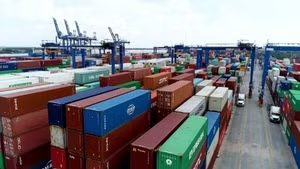
However, as the deadline for the reapplication of these regulations approaches, many businesses and industry associations remain concerned and have put forward recommendations regarding the implementation of the relevant provisions to ensure the stability of the food supply chain.
Recently, the Ministry of Health also urged enterprises and organisations operating in the food sector to proactively and urgently prepare documentation and the necessary conditions to implement the new regulations.
Concerns over the risk of renewed congestion
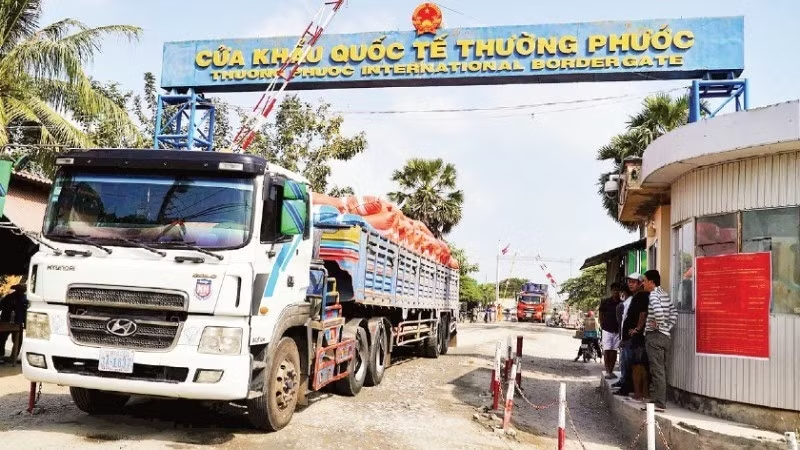
Huynh Quoc Kiet, a representative of Cam Hoa Company Limited in Dinh Ba Hamlet, Tan Ho Co Commune, Dong Thap Province, said that during the period when the implementation of Decree No. 46/2026/ND-CP was suspended and its enforcement timeline adjusted, import and export activities at Dinh Ba International Border Gate (Dong Thap Province) proceeded smoothly, ensuring timely transportation of goods. However, the company has begun to worry about possible difficulties that may arise after April 15.
As the company regularly imports fresh agricultural products such as lotus, mangoes, and palm fruit from Cambodia, the requirement to fully comply with the new food safety inspection procedures could significantly extend customs clearance times.
Given the perishable nature of fresh produce, delays in customs clearance of just three days or more can lead to additional costs, including storage and handling fees, while also increasing the risk of product deterioration.
In addition, many other agricultural importers are concerned that procedures related to product declaration and registration may prolong the import process compared with previous regulations, as Decree No. 46/2026/ND-CP stipulates that food products — including additives, processing aids, packaging, and utensils that come into direct contact with food — must undergo conformity declaration registration procedures.
On the same issue, the European Chamber of Commerce in Viet Nam (EuroCham) believes that Decree No. 46/2026/ND-CP will significantly increase the level and layers of control. As a result, customs clearance times could be extended, with a high risk of renewed congestion, particularly for fresh foods that cannot wait nine to ten days for testing.
Accordingly, administrative procedures should be reformed so that new requirements are introduced only when their effectiveness in improving food safety can be clearly demonstrated and when they do not disrupt production and business supply chains.
Food safety management should follow international practices by adopting a system-based approach with clear standards from farm to table; establishing specific regulations for the cultivation and supply of fresh foods; strengthening the application of international standards such as HACCP, ISO, and GMP for processed foods; and digitalising and integrating data among management agencies to improve inspection efficiency and traceability.
Shifting strongly towards risk-based management and stronger post-market inspection
For specific sectors such as spices, Hoang Thi Lien, Chairwoman of the Viet Nam Pepper and Spice Association, said that the sector mainly comprises dried plant products with low food safety risks and has long been globally traded. These products are often traded through merchants, transit warehouses, and re-export channels, while many countries do not issue food safety certificates or health certificates for dried spices even though the products still comply with international standards.
Therefore, applying across-the-board regulatory mechanisms designed for high-risk food products to pepper and dried spices may not align with international practices or actual trading conditions.
Regarding the regulation requiring all food production and business establishments to possess a certificate of eligibility for food safety when operating, Nguyen Hoai Nam, Secretary-General of the Viet Nam Association of Seafood Exporters and Producers (VASEP), said this requirement could create a risk of congestion for imported food products. If foreign manufacturers are unable to obtain such certificates issued by Viet Nam, as they typically only hold internationally recognised certifications such as ISO, HACCP, and GMP, it could prevent them from exporting goods to Viet Nam.
At the same time, this requirement may also create difficulties for domestic enterprises that have already applied internationally recognised standards but would still have to obtain an additional certificate of eligibility for food safety.
According to Ly Kim Chi, Chairwoman of the Ho Chi Minh City Food and Foodstuff Association, both Decree No. 46/2026/ND-CP and Resolution No. 66.13/2026/NQ-CP assign a substantial additional workload to specialised agencies at provincial and municipal levels.
This not only increases the number of administrative procedures but also significantly raises requirements for specialised expertise, certified personnel, accredited testing laboratories, and inter-agency coordination mechanisms.
If enforcement agencies become overstretched, businesses will ultimately bear the consequences in the form of prolonged processing times, disruptions to production and business activities, and higher compliance costs.
Therefore, it is necessary to urgently review and fundamentally revise Decree No. 46/2026/ND-CP and Resolution No. 66.13/2026/NQ-CP. The key focus of the revision should be a strong shift towards risk-based management, strengthened substantive post-market inspection, and a reduction in formalistic pre-inspection procedures.
In the long term, priority should be given to accelerating the drafting of the amended Food Safety Law and establishing a synchronised and stable system of guiding decrees.
In light of the aforementioned difficulties, the Viet Nam Chamber of Commerce and Industry (VCCI) has proposed that the government consider extending the suspension of Decree No. 46/2026/ND-CP and Resolution No. 66.13/2026/NQ-CP until the amended Food Safety Law is passed by the National Assembly and comes into force, while continuing to apply Decree No. 15/2018/ND-CP as the legal basis during the transitional period.
Decree No. 46/2026/ND-CP and Resolution No. 66.13/2026/NQ-CP will subsequently be replaced by detailed regulations guiding the implementation of the new Food Safety Law, ensuring coherence, consistency, and effectiveness.
According to the VCCI, this option has received broad support from most businesses and industry associations, as it aligns with practical realities and avoids creating unnecessary legal uncertainty.