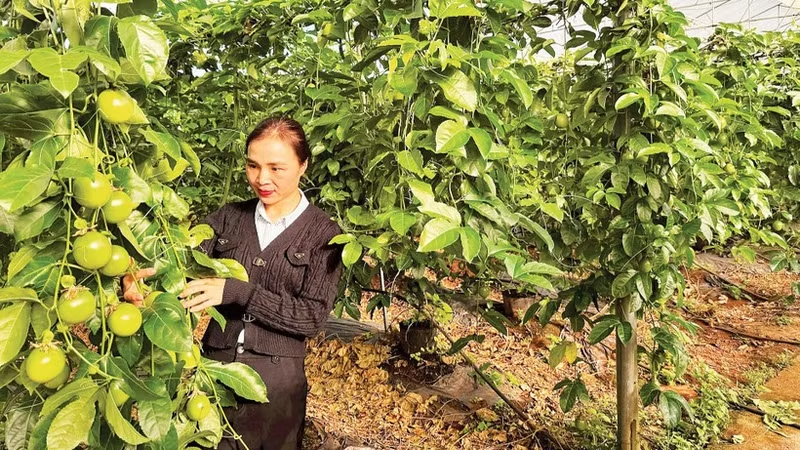
Within the first 11 months of the year, export turnover of agro-forestry-fishery products exceeded 64 billion USD, with a trade surplus estimated at 19.55 billion USD. This outcome was driven by abundant domestic supply and the steadily improving ability of farmers and enterprises to meet market requirements.
Steady production, sustained growth
Since the beginning of the year, damages caused by natural disasters and flooding are estimated to have reached more than 99.469 trillion VND. Agriculture suffered the heaviest losses, with over 541,000 ha of rice and crops inundated; 73,300 heads of livestock and more than 5 million poultry lost or swept away; and nearly 172,000 aquaculture cages damaged.
Statistics from the General Statistics Office show that the losses spread across crop cultivation, livestock, and fisheries reflect the deep vulnerability of farmers’ livelihoods, raw material zones, and production chains.
Against this backdrop, agriculture proved its resilience. By the end of November, the nationwide rice output reached 42.56 million tonnes, with full-year production expected to exceed 43 million tonnes. Although disasters reduced the planting area of most vegetables, many localities actively restored and expanded cultivation after floods, ensuring local supply and nationwide distribution.
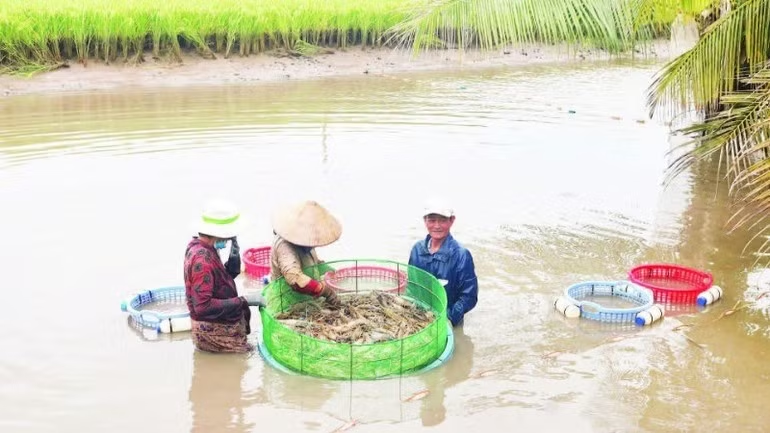
Despite heavy losses caused by natural disasters, the fisheries sector still recorded growth thanks to strong performance in aquaculture, with total output in the first 11 months estimated at over 9 million tonnes, up 2.9% year on year.
According to Phung Duc Tien, Deputy Minister of Agriculture and Environment, stable production and rapid post-disaster recovery provided a springboard for export growth, contributing significantly to the agro-forestry-fishery export turnover of 64.01 billion USD in the first 11 months of 2025, up 12.6% year on year and exceeding the full-year figure for 2024. The trade surplus was estimated at 19.55 billion USD, up 19% compared with the same period in 2024.
Several commodities set new export records, including coffee, which reached 7.88 billion USD, up 59.7%; and fruit and vegetables, which reached 7.91 billion USD, up 19.5%.
With current momentum in production recovery and export growth, the agricultural sector remains committed to a growth target of around 4% and aims to achieve a total agro-forestry-fishery export turnover of 70 billion USD for the full year.
In reality, the achievement of these impressive export figures in 2025 required a comprehensive “upgrade” in quality, standards, and supply chains. Whereas agricultural products previously relied mainly on volume advantages, the focus has now shifted strongly towards quality, with deep processing becoming increasingly prioritised.
A notable example is the coffee sector. As the world’s largest exporter of Robusta coffee, Viet Nam has moved from selling raw beans towards increasing the share of roasted, instant and specialty coffee. The application of Rainforest Alliance and Fairtrade certifications, along with early compliance with the EU Deforestation Regulation (EUDR), has enabled Vietnamese coffee not only to maintain a large market share in the EU but also to better access high-quality, higher-value markets.
Ngo Xuan Nam, Deputy Director of the Viet Nam Sanitary and Phytosanitary Notification Authority and Enquiry Point, noted that agricultural enterprises are becoming increasingly responsive to the requirements of export markets, especially those with high standards such as the US, Japan, and the EU. As a result, supply chains are also better able to meet requirements on traceability and sanitary and phytosanitary measures.
This is an inevitable condition for boosting exports, as markets regularly introduce new regulations on food safety and Sanitary and Phytosanitary (SPS) standards, as well as technical barriers to trade, requiring producers and enterprises to stay continuously updated.
Repositioning strategic growth
In 2025, Vietnamese agriculture demonstrated resilience and achieved many notable results, yet two strategic bottlenecks remain to be addressed: the scientific and technological foundation is not yet strong enough to create a breakthrough or lead growth, and production thinking has not been fully renewed to align with supply-demand signals and value chains.
Identifying science and technology as the foundation for growth, immediately after the Politburo issued Resolution No. 57-NQ/TW, the agricultural sector organised a conference to implement an action plan.
By November 2025, the Politburo issued Conclusion No. 219-KL/TW on continuing the implementation of the 13th Party Central Committee’s Resolution No. 19-NQ/TW (dated June 16, 2022) on agriculture, farmers, and rural areas through 2030, with a vision to 2045, emphasising science and technology as the key driving force for agricultural development in the new phase.
According to Minister of Agriculture and Environment Tran Duc Thang, science and technology will expand new development space for agriculture across all fields by generating new crop and livestock varieties with higher productivity and quality and applying modern processes to improve production efficiency.
In addition, environmental protection, climate change response, monitoring, surveillance, and meteorological and hydrological data systems, supported by valuable research results, are being effectively applied in practice, making important contributions to weather and climate forecasting and safeguarding production.
In the time ahead, the Ministry of Agriculture and Environment will focus on synchronously implementing tasks and solutions under programmes and action plans to implement Resolution No. 57-NQ/TW. These include comprehensive digital transformation; strong application of artificial intelligence and big data in management, training, and research; building a digital training ecosystem for the agricultural sector; and prioritising applied science and technology, innovation, and digital transformation tasks in agriculture.
If technological innovation is a necessary condition, then innovation in mindset and production organisation is the sufficient condition for Vietnamese agriculture to achieve substantive, sustainable breakthroughs and long-term competitiveness.
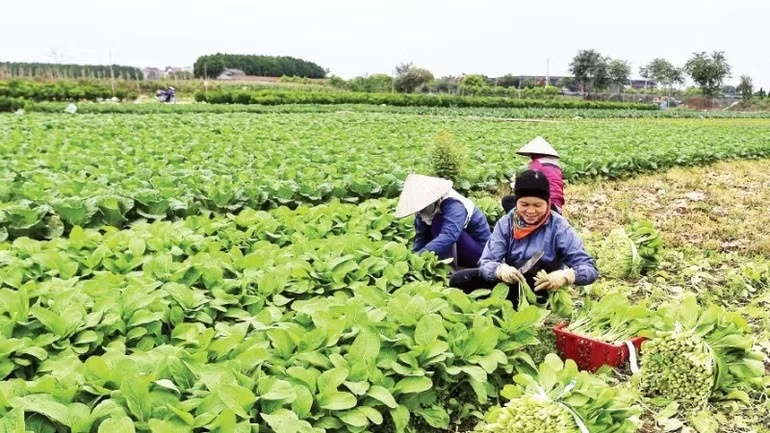
Therefore, raising awareness and action among farmers, cooperatives and enterprises in production, processing and export, and forming effective value-chain linkages, plays a crucial role in fundamentally transforming agricultural production towards a green, circular and ecological model, in line with global production and consumption trends.
Ngo Tuong Vy, General Director of Chanh Thu Fruit Import-Export Group Joint Stock Company, stated: “Value-chain development is the key to opening wide doors for Vietnamese agricultural products to reach global markets. Our company continues to invest in expanding standard-compliant raw material areas, applying post-harvest technology, and developing high-end product lines to build the Vietnamese fruit brand, including whole frozen durian under the DuriVy brand that meets export standards for high-quality markets such as the US, China, and Thailand.”
Amid increasingly unpredictable weather and climate conditions and complex developments in global markets, the agricultural sector continues to prove its role as a pillar of the national economy through persistent adaptation, proactive innovation, and gradual value upgrading.
In the new development phase, to sustain growth momentum, agriculture needs to focus on standardising green production processes, promoting digital transformation in market forecasting and disaster early warning, and diversifying processed products to participate more deeply in global supply chains.