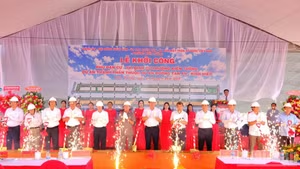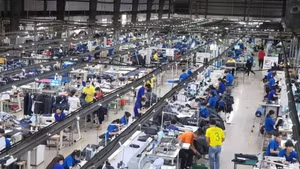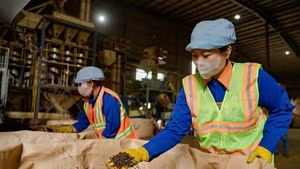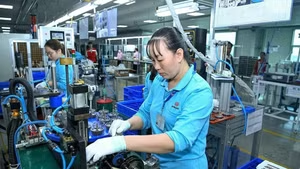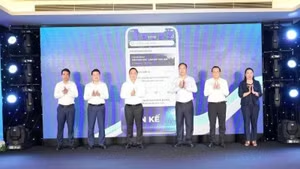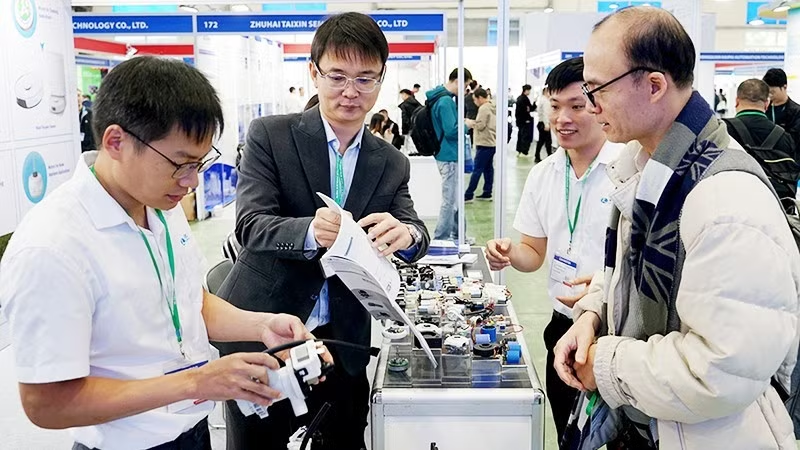
From the very beginning of 2026, Thai Nguyen Province granted investment policy approval decisions and investment registration certificates to 11 projects with a total capital of approximately 1.1 billion USD, of which FDI accounted for the majority at around 790 million USD. This outcome demonstrates that Thai Nguyen continues to maintain its attractiveness to foreign investors amid increasingly fierce competition among countries.
A prominent position in the global investment network
The story of Thai Nguyen also reflects a broader trend in FDI investors’ assessments of Viet Nam’s production and business environment. According to the survey on the business conditions of Japanese companies operating overseas in fiscal year 2025 conducted by the Japan External Trade Organisation (JETRO), 56.9% of Japanese enterprises said they plan to expand their operations in Viet Nam within the next one to two years. The proportion of both manufacturing and non-manufacturing firms intending to expand is high, mainly due to the continued expansion of the domestic market and positive export prospects.
The three most attractive factors of Viet Nam’s business environment in the eyes of Japanese enterprises are market size and growth potential (68.4%), competitive labour costs (55.2%) and a stable socio-political environment (53.2%).
Similarly, the latest Business Confidence Index (BCI) report by the European Chamber of Commerce in Viet Nam (EuroCham) shows that Viet Nam’s attractiveness continues to be reinforced by strong support from the business community. As many as 87% of surveyed enterprises said they are willing to recommend Viet Nam as an investment destination to other foreign businesses, with the highest level of confidence coming from large-scale enterprises.
Dr Joel Hassan, lecturer in International Business at the School of Business, RMIT University Viet Nam, believes that the strong growth of FDI inflows into Viet Nam can be explained by several key factors, including a well-developed manufacturing base, a skilled workforce, a stable economic and political environment, a strategic geographical location and participation in major trade blocs. These factors combine harmoniously to create an attractive investment destination, particularly amid rising global geopolitical and economic uncertainty.
Amid US–China geo-economic tensions, Viet Nam has adopted a strategic approach to optimise national interests by proactively strengthening cooperation with both sides. This has enabled Viet Nam to serve as an effective bridge, given that both China and the US are major markets. In addition, with US strengths in technology design and China’s advantages in technology manufacturing, Viet Nam offers a favourable investment environment as a connecting hub.
From a broader perspective, Viet Nam is holding a prominent position within the global investment network. A strong manufacturing foundation, cooperation with the US and China, a strategic geographical location, and a growing number of free trade agreements enable businesses investing in Viet Nam to leverage domestic advantages while accessing extensive production networks and markets.
“Viet Nam’s stability and the strength of the networks it participates in are highly attractive to companies seeking to diversify operations and reduce dependence on volatile markets,” Dr Joel Hassan affirmed.
Entering a new growth cycle
However, according to the expert, Viet Nam should prioritise attracting investment into higher-value manufacturing industries. In reality, several other Southeast Asian countries have begun offering tax incentives and investing in industrial parks in the hope of attracting high-tech industries. This creates competitive pressure, requiring Viet Nam to accelerate similar strategies to draw investment into these sectors.
Developing domestic enterprises in these industries is also critically important. FDI enterprises that can source materials locally in Viet Nam can achieve higher operational efficiency, especially during periods of heightened tension. Domestic suppliers, in turn, can benefit from positive spillovers such as technical assistance, training and financial support through their relationships with foreign enterprises.
From a long-term perspective, Dr Joel Hassan noted that while Viet Nam’s strategy of optimising benefits from cooperation with the US and China has helped secure a favourable position, the country still needs to continue strengthening and expanding economic relations with other nations. The US is currently exerting pressure on partners to support its strategy towards China. Viet Nam has made significant efforts to broaden and deepen its international economic relationships. Continuing to develop these ties will help Viet Nam attract FDI from a wider range of countries, thereby enhancing economic resilience and flexibility.
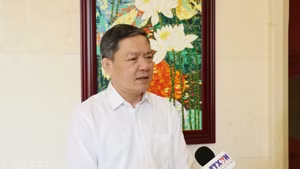
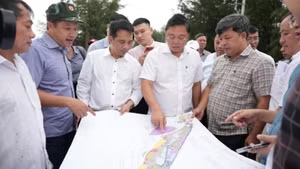
At the local level, according to Vuong Quoc Tuan, Chairman of the Thai Nguyen Provincial People’s Committee, the province has identified the expansion of industrial development space as one of the key solutions to welcome a new wave of investment. Industrial zone planning has been adjusted towards strong expansion, with the number of industrial zones increasing from 19 to 33 and total area doubling, creating sufficient capacity to attract large-scale FDI projects.
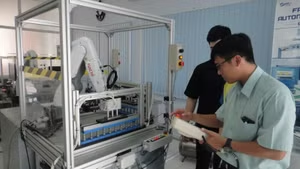
Alongside industrial land planning, Thai Nguyen is synchronously implementing solutions related to infrastructure and human resources. Transport infrastructure is being prioritised to enhance inter-regional connectivity, while a systematic human resource development strategy is being rolled out, with Thai Nguyen University and the network of vocational colleges and intermediate schools at its core, to meet the demand for skilled labour in industrial and high-tech projects.
For key FDI projects, the provincial authorities proactively apply the best possible support mechanisms within the legal framework, from land allocation and site selection to the full implementation of incentive policies, with the aim of shortening investment preparation time and accelerating project implementation. The province focuses on improving the investment and business environment through dialogue and timely resolution of difficulties faced by enterprises, committing to accompany investors throughout the entire project lifecycle.
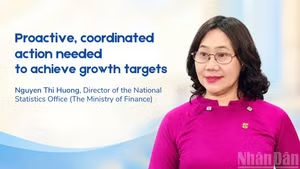
Beyond the local level, policies to support and accompany the FDI sector are also embedded within a comprehensive national framework. Recently, the Prime Minister signed an official dispatch on accelerating key tasks and solutions to achieve the 2026 economic growth target.
The State continues to identify the FDI sector as one of the key growth drivers of the economy. This policy not only aims to attract new projects but also clearly reflects a mindset of “retaining” and upgrading existing investors. Viet Nam aims to participate more deeply in global value chains, reduce reliance on processing and assembly, and gradually enhance its position on the regional and global production map.
In the official dispatch, the Prime Minister called for stronger promotion and attraction of large-scale, high-tech FDI projects, and for the urgent completion and submission to the Politburo of a Resolution on the development of the foreign-invested economic sector. The focus is on on-the-spot investment promotion, attracting and supporting multinational corporations and strategic investors to implement projects in semiconductors, artificial intelligence and digital technology in Viet Nam.