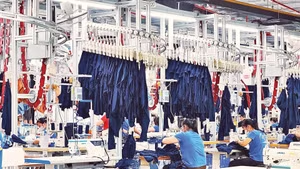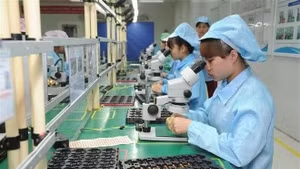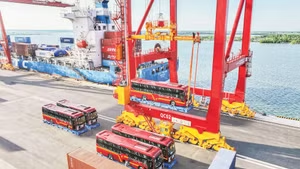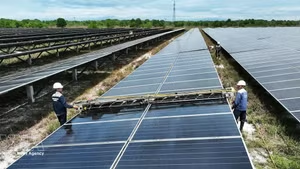
According to Hoang Quang Phong, Vice President of the Viet Nam Chamber of Commerce and Industry (VCCI), new-generation FDI is not solely profit-oriented; it also emphasises high technology, knowledge transfer, green development, corporate governance, social responsibility and sustainable labour practices.
‘Green-lane’ mechanisms
In this context, the current policy framework for new-generation FDI has been shaped consistently through a series of resolutions. Among them, a resolution issued by the Politburo in 2019 laid an important foundation for the orientation for foreign investment attraction through to 2030, opening the door to a new era of foreign investment cooperation in Viet Nam.
This capital inflow is expected to be of higher quality and to focus on high-tech and foundational technologies with spillover effects for Viet Nam’s socio-economic development, particularly from Europe and the US.
This was followed by the 2021-2030 strategy for international investment cooperation, special investment-incentive mechanisms, “green-lane” mechanisms for strategic projects, and the Investment Support Fund.
Most recently, policies to develop semiconductor human resources, now a focal point of global geopolitical and technological competition, have been introduced.
Thanks to these policies, disbursed FDI from 2021 to 2025 reached more than 158 billion USD, surpassing the 100-150 billion USD target set by the Politburo.
Furthermore, the Ministry of Finance is currently seeking feedback on a draft decree governing the management of industrial parks (IPs) and economic zones (EZs), which proposes significant revisions to investment incentive regulations.
A key highlight of the draft is the inclusion of provisions relating to expenditure on greenhouse-gas reduction activities and the development of industrial symbiosis models. This mechanism creates strong financial incentives for enterprises to transition to clean technologies, conserve energy and adopt environmentally friendly solutions.
Viet Nam is facing a major opportunity to transform itself into a regional manufacturing hub linked with innovation and sustainable development.
Nguyen Duc Hien, Deputy Head of the Central Commission for Policy and Strategy
According to Nguyen Duc Hien, Deputy Head of the Central Commission for Policy and Strategy, Viet Nam already has many favourable conditions to attract FDI, particularly high-quality capital into IPs. These include a stable and safe political, economic and social environment; a sizeable market of around 100 million people; and a young, abundant labour force.
“Viet Nam is facing a major opportunity to transform itself into a regional manufacturing hub linked with innovation and sustainable development. Fine-tuning policies to attract a wave of new-generation FDI into industrial parks will play a crucial role in realising this goal,” Hien affirmed.
Areas needing improvement
With recent legal developments, particularly the scheme for developing Viet Nam’s carbon market and the decree on greenhouse-gas reduction and ozone-layer protection, Seck Yee Chung, Vice President of the Singapore Chamber of Commerce in Viet Nam, expects greater opportunities for green investment.
However, as Viet Nam moves from policymaking to execution, several areas still require improvement to accelerate progress.
One urgent challenge is streamlining the licensing process, especially in sustainable sectors such as rooftop solar power. The current procedures remain lengthy and complicated, often requiring multiple supplementary documents and explanations.
In some cases, licensing authorities classify equipment-leasing models as electricity-generation activities, leading to unnecessary requirements regarding business lines. Such inconsistencies delay project implementation and dampen the interest of foreign investors.
Meanwhile, although a government decree has provided a legal framework for strategic projects, it remains focused mainly on initial registration rather than the entire project lifecycle. Establishing a clear roadmap covering all stages, from investment preparation to operation, would enable investors to plan effectively and ensure consistent oversight.
This would not only reduce uncertainty but also reinforce Viet Nam’s commitment to creating a stable, business-friendly investment environment for the next generation of industrial parks.
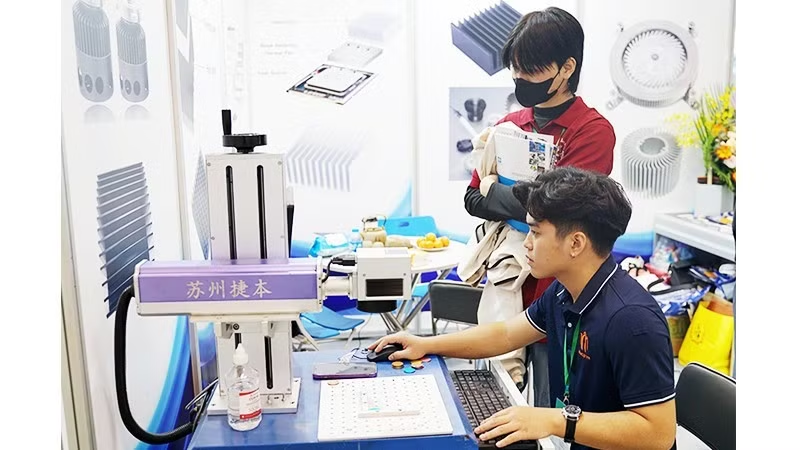
From the perspective of domestic enterprises, Nguyen Phuong Nga, Deputy CEO of CNCTech Group, emphasised that new-generation FDI investors, particularly those in high-tech, electronics and precision engineering, demand a comprehensive manufacturing ecosystem, including internationally standardised infrastructure, modern logistics and adequate business-support services.
They also require capacity for technology integration, as well as green standards and ESG (environmental, social and governance) compliance. This places substantial demands on IP infrastructure in host countries such as Viet Nam, where developing ecological industrial parks with comprehensive infrastructure requires considerable cost, resources and time.
There must be supportive policies for developers during the creation of ecological industrial parks based on industrial symbiosis.
Nguyen Phuong Nga, Deputy CEO of CNCTech Group
She said “There must be supportive policies for developers during the creation of ecological industrial parks based on industrial symbiosis. In addition, policies to attract value chains in high-tech industries are crucial so that FDI enterprises investing in Viet Nam have a suitable supporting ecosystem for production, particularly in the semiconductor field.”
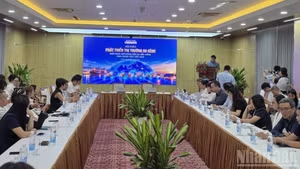
According to Pham Thanh Binh, Director of the Northern Investment Promotion and Support Centre under the Ministry of Finance’s Foreign Investment Agency (FIA), sweeping reforms are needed across institutions, infrastructure and IP development planning.
He said the top priority is to improve investment institutions and policies to make them transparent, stable and predictable. This must go hand in hand with strong administrative reforms, digitalisation of investment management and streamlined licensing procedures.
Infrastructure must also advance rapidly, especially logistics, energy, and green smart industrial-park infrastructure, integrated with global supply chains. This not only reduces production costs but also meets core criteria for multinational corporations when making investment decisions.
Another essential requirement is the development of a high-quality workforce. Industrial parks seeking to attract high-tech FDI need an aligned human-resources ecosystem, from technical vocational training and technology engineers to specialists in digital transformation and renewable energy.
More specifically, there must be clear regulations on emission-reduction expenditure, green-production standards and industrial-symbiosis models. These are vital tools to generate financial incentives for enterprises to invest in clean technology.
Furthermore, strengthening the capacity of Vietnamese enterprises requires promoting linkages between domestic firms and FDI companies, developing supporting industries, increasing localisation rates and reducing reliance on intermediate imports. In doing so, FDI becomes not just capital, but a catalyst for transforming and upgrading the national industry.
“If policy and investment-environment reforms move at the right pace and trajectory, Viet Nam can fully emerge as the region’s new manufacturing hub, underpinned by green technology and innovation,” the FIA official affirmed.