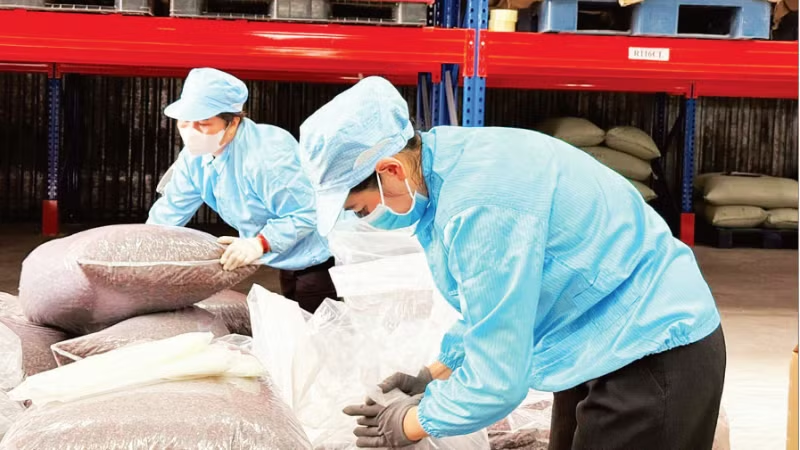
In late November, the Viet Nam Trade Office in Belgium reported that a Belgian importer specialising in supplying coconut milk to supermarkets and the food-processing industry is seeking to cooperate with a Vietnamese coconut milk producer. The requirements are that the Vietnamese manufacturer must be sufficiently large to meet industrial-scale demands, provide coconut milk products with various fat contents, and offer packaging in small retail cartons for supermarkets as well as large 10–20kg bags for industrial food production.
Products must comply with European Union (EU) regulations and possess the necessary certifications to access the Belgian and EU markets under the preferential framework of the Viet Nam–EU Free Trade Agreement (EVFTA). Notably, the Belgian company plans to visit Viet Nam in January 2026 to directly work on approved orders.
Nguyen Thi Kim Thanh, Chairwoman of the Viet Nam Coconut Association, noted that although demand for cooperation in processed agricultural products from foreign partners is considerable, many Vietnamese enterprises are unable to meet such requirements because much of their output remains in raw export form.
To support deep-processing businesses in building the national brand “Vietnam Coconut” towards international standards such as “Philippines Coconut” or “Indonesia Coconut”, appropriate credit policies are needed, along with coordination with scientific research institutions to transfer modern processing technologies to enterprises and cooperatives.
Overall, in the fruit and vegetable sector, opportunities for deep-processed products are expanding, especially as Vietnamese enterprises aim to boost exports to high-quality markets. For example, in the EU market, revenue from dried vegetable products is projected to rise from 16.2 billion USD in 2025 to around 35.5 billion USD in 2035. This growth is driven by increasing consumer demand for convenience, reduced food waste, and the functional benefits of dried vegetables.
To support deep-processing businesses in building the national brand “Vietnam Coconut” towards international standards such as “Philippines Coconut” or “Indonesia Coconut”, appropriate credit policies are needed, along with coordination with scientific research institutions to transfer modern processing technologies to enterprises and cooperatives.
Nguyen Thi Kim Thanh, Chairwoman of the Viet Nam Coconut Association
Nguyen Tien Dung, Deputy General Director of Simexco DakLak (Dak Lak 2-9 Import-Export Company Limited), stated that, as one of Viet Nam’s largest exporters of green coffee beans, the company is accelerating deep processing to diversify its product portfolio and enhance the value of Vietnamese coffee.
Simexco DakLak is also a successful exporter of speciality coffee husk (cascara tea) to the Republic of Korea, with a commercial value of nearly 1 million VND per kilogram. Normally, coffee husks are discarded after bean extraction, but they are now repurposed into cascara tea — a beverage suitable for caffeine-sensitive consumers seeking an alternative energy source.
According to the Agency of Foreign Trade under the Ministry of Industry and Trade, processed coffee has become a new growth driver for the entire sector, with export value reaching 1.46 billion USD in the first 10 months of 2025 — an increase of 58% year-on-year. This is a strategy aimed at deepening value-chain development and enhancing international competitiveness, while also enabling Viet Nam to consolidate its position as one of the world’s key coffee-supplying centres.
Germany, the largest coffee-consuming market in Europe, reports an average consumption of more than 6.5kg per capita per year. Notably, the segment for high-quality coffee, deeply processed coffee, and speciality coffee is growing at an “astonishing” pace, creating opportunities for Vietnamese enterprises to transform production and capture market share.
Processed products are not merely a market trend, but also a solution for many export commodities in recent years. A notable example is the sharp growth in squid and octopus exports. Despite ongoing shortages in domestic raw material supply, by the end of October 2025, Viet Nam’s squid and octopus export value reached 627 million USD, up 19% compared with the same period in 2024, with the majority comprising processed items such as ready-to-eat dried squid, semi-dried squid, pre-processed octopus, and frozen boiled octopus. These products are both convenient to use and meet consumer demand for food safety.
Many agricultural experts believe that the future of agriculture does not lie in producing more, but in producing smarter — maximising added value from each unit of agricultural raw material. As such, the shift towards deep processing is the pathway that will enable Vietnamese agricultural products to enter global markets more firmly and achieve higher profits.






![[Infographic] VN-Index rises 0.34% on October 6](https://en-cdn.nhandan.vn/images/j0QNt7m_5iy1OXpnUKiwG61aYhTv_B140GWhfriF26IM-hJLr-YyB-igcHJ7cLRKshCXmgI3hJXGVRYJMfGPzA/chung610-8460.jpg.avif)