The Ministry of Construction has recently issued Decision No. 1922/QD-BXD approving the detailed development plan for the land and water areas of the former Ba Ria–Vung Tau seaport for the 2021–2030 period, with a vision to 2050, affirming the area’s strategic role in Viet Nam’s national port network and across Southeast Asia.
Under the plan, the Ba Ria–Vung Tau seaport comprises eight main port zones: Thi Vai, Cai Mep, Long Son, Dinh River, Sao Mai–Ben Dinh, the Vung Tau international passenger terminal, Con Dao port, and the offshore oil and gas terminal system alongside buoy berths, transshipment areas, and anchorage zones for waiting, shelter, and storm avoidance.
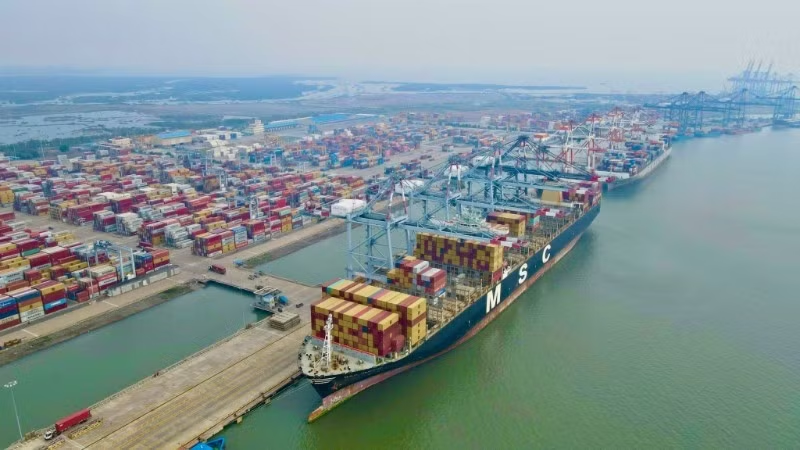
The Cai Mep–Thi Vai zone will continue to be planned for major container terminals such as CMIT, SSIT, Gemadept–Terminal Link, and Cai Mep Ha. These terminals are designed to receive ultra-large container vessels operating on international shipping routes.
The Long Son area is oriented towards specialised ports serving petrochemicals and LNG energy, while Con Dao will see expanded passenger and cargo facilities, with the aim of becoming a hub for marine tourism services.
In Vung Tau, the plan includes an international cruise terminal comprising one berth with two quays, with a combined length of 840 metres, capable of handling up to 1.50 million passengers.
By 2030, total cargo throughput is targeted at 215–236.9 million tonnes (including up to 18.25 million TEU), with passenger volumes of 2.67–2.89 million. The port system is expected to have 60 berths and 117–123 quays, with a combined length of more than 30 km, including many berths able to accommodate ships of up to 250,000 tonnes.
By 2050, port cargo growth is projected at 3.5–3.8% per year, with further expansion planned for Cai Mep Ha (17 quays) and the downstream Cai Mep Ha area (33 quays).
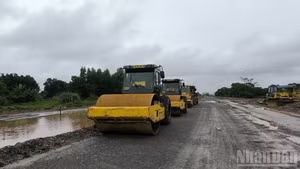
Total investment across the system to 2030 is estimated at about 81.841 trillion VND, including 5.131 trillion VND for public maritime infrastructure, with the remainder earmarked for terminal investment. Priority projects include expanding the Cai Mep–Thi Vai navigation channel, building service berths, storm shelter anchorages, a Vessel Traffic Services (VTS) system, and the Vung Tau international passenger terminal.
The plan also sets orientations for developing green ports and smart ports, accelerating digital transformation, using clean energy, and strengthening seamless connectivity between seaports and road, rail, and inland waterway networks, as well as post-port logistics centres.