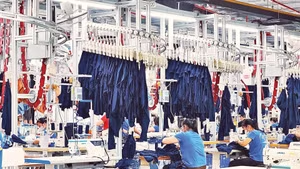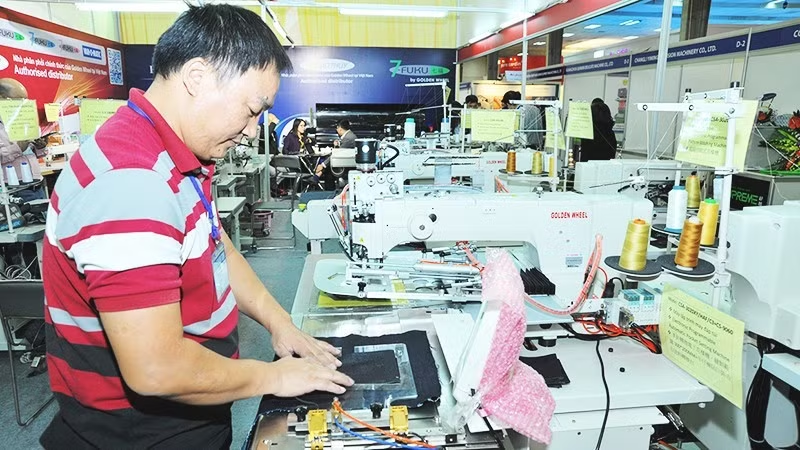
Nguyen Thi Lan, a garment worker at a company in Ha Noi, said that her family’s income mainly comes from the wages earned by her and her husband. After paying rent, her children’s school fees, utility bills and monthly living expenses, the family has almost nothing left to save. News of a proposed regional minimum wage increase from 2027 has raised hopes for her and her colleagues.
A foundation for a high-quality workforce
The National Wage Council has agreed to propose an average 7.8% increase in the regional minimum wage from January 1, 2027, equivalent to an increase of between 310,000 VND and 390,000 VND per month, depending on the region.
“An increase of a few hundred thousand dong a month may not be much, but it will help ease our financial burden. More importantly, wages need to keep pace with the cost of living so that workers can feel secure in their jobs and remain with their employers for the long term,” Lan said.
Sharing the same expectations, Tran Van Minh, an electronics worker at a company in Bac Ninh Province, said his current income basically meets his living needs. An increase in the minimum wage would give workers additional income to improve their living standards and ease financial pressures as living costs continue to rise.
“I also hope that businesses will continue to provide welfare benefits, such as housing allowances, shift meals and performance-based bonuses, so that workers can lead more stable lives, feel secure at work and stay with their employers for the long term,” Minh said.
According to Mac Quoc Anh, Vice Chairman and Secretary General of the Ha Noi Association of Small and Medium-sized Enterprises, adjusting the minimum wage is necessary to ensure that workers share in the benefits of economic growth and feel secure enough to remain with their employers. For businesses with long-term development strategies, the adjustment can also provide an incentive to restructure operations for greater efficiency.
Instead of relying on cheap labour, businesses will be encouraged to invest in machinery, adopt technology and automation, and improve the quality of their workforce. As labour productivity improves, the additional costs arising from wage adjustments can be offset while businesses’ competitiveness is enhanced.
In practice, improving productivity does not simply mean purchasing more machinery. Many businesses can boost labour productivity by optimising production processes, reducing waiting times between stages, training workers in multiple skills and applying management technologies. At a higher level, shifting from simple contract manufacturing to producing higher value-added goods can also help businesses better absorb rising labour costs.
As Viet Nam pursues its goal of double-digit economic growth, raising labour productivity will be a key factor. A reasonable wage policy will help motivate businesses to innovate their production models, invest in technology and increase value added rather than competing primarily on the basis of low costs.
The National Wage Council has agreed to propose that the regional minimum wage in Region I rise from 5.31 million VND to 5.7 million VND, an increase of 390,000 VND; in Region II, from 4.73 million VND to 5.08 million VND, an increase of 350,000 VND; in Region III, from 4.14 million VND to 4.45 million VND, an increase of 310,000 VND; and in Region IV, from 3.7 million VND to 4.04 million VND, an increase of 340,000 VND.
Comprehensive support measures needed
On the other hand, adjusting the minimum wage also presents considerable challenges for many businesses, particularly small and medium-sized enterprises facing pressure from capital constraints, input costs and market volatility.
According to the National Statistics Office, more than 169,800 businesses were newly established or resumed operations nationwide in the first six months of 2026, up 11.2% year on year. However, during the same period, more than 151,000 businesses withdrew from the market, up 18.8%, equivalent to around 25,200 businesses ceasing operations each month.
The 2025 Provincial Competitiveness Index (PCI) survey conducted by the Viet Nam Federation of Commerce and Industry (VCCI) also identified a number of “bottlenecks” hampering production and business activities. The biggest pressure came from the market, with finding customers becoming the top difficulty for businesses. Access to capital remained another major challenge. As many as 75.5% of businesses said they could not obtain loans without collateral.
In addition, access to policy information remains limited. Some 51.9% of businesses said they primarily learn about legal regulations through social media, while tax, land and administrative procedures continue to impose significant compliance costs. Market entry also remains subject to numerous barriers, increasing costs and reducing incentives for the private sector.
Household businesses are also under considerable pressure, with 73.7% reporting only “small profits”, 12.9% breaking even and 11.5% making losses, while just 1.9% achieving their “expected profits”. These figures show that most household businesses operate on thin profit margins and have limited resilience to cost shocks.
From a business perspective, Phi Ngoc Trinh, General Director of Ho Guom Group JSC, said businesses must proactively restructure production, invest in technology, accelerate automation, streamline management processes and improve workers’ skills in order to raise productivity and offset higher labour costs.
However, the decisive factor determining whether businesses have sufficient resources to raise wages remains the availability of markets and orders. Therefore, Trinh called on the government to continue promoting trade promotion programmes, support businesses in expanding domestic and overseas markets, connect them with importers and make effective use of free trade agreements (FTAs) to generate more orders.
Mac Quoc Anh said that for the minimum wage adjustment policy to deliver its intended effect, businesses need the government’s support through a comprehensive range of measures, including continued and stronger administrative reform and improved access to credit at reasonable interest rates. The government should also step up programmes supporting digital transformation, technological innovation and training to help businesses improve labour productivity and management capacity.
In the long term, the adjustment of the minimum wage also reflects Viet Nam’s transition towards a new growth model. As living standards improve and the labour supply is no longer as abundant as before, the competitive advantage based on low labour costs will gradually diminish. This will force businesses to shift towards development models based on productivity, technology and higher value added if they are to maintain their competitiveness.