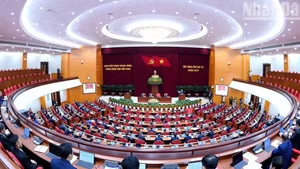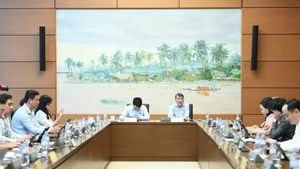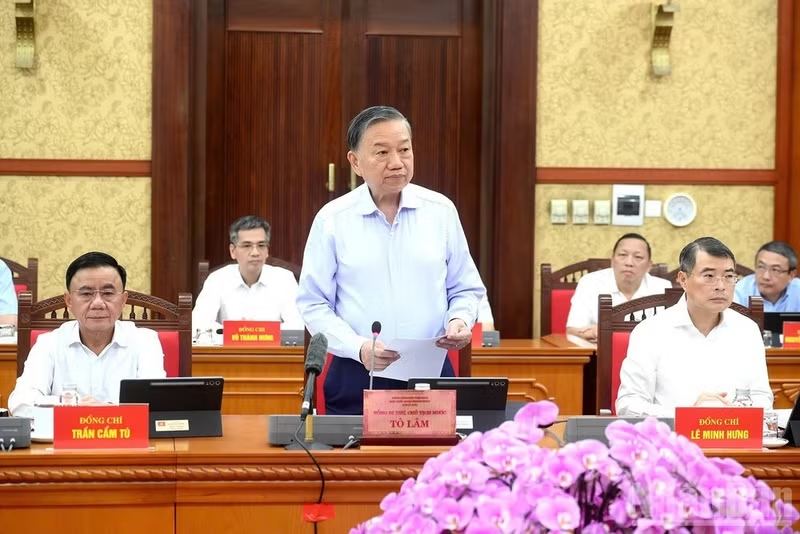
Chairing a meeting of the Central Steering Committee for Science, Technology, Innovation Development and Digital Transformation on July 30 to review work completed so far and set key tasks for the coming period, General Secretary and President Lam, who is also head of the committee, called for a continued shift from managing progress to managing outcomes. He said each task must clearly define the problem to be addressed, the final product, target users, responsible agencies and individuals, implementation conditions and evaluation criteria.
The top leader noted that farmers should gradually become digital farmers capable of mastering modern agricultural technologies; workers should master advanced technologies and equipment; entrepreneurs should become the leading force in innovation; and officials should move from a management mindset to one focused on creating and enabling development. Creative labour must become the nation’s most important resource in the future, he stressed.
The General Secretary and President said resources must be concentrated on creating competitive products, markets and enterprises. All research tasks must be oriented towards practical application, commercialisation and improving the competitiveness of the economy and society as a whole, he emphasised.
According to the leader, resources should be prioritised for foundational and strategic tasks with high potential for widespread impact and clearly identified users, while overcoming the situation of fragmented investment and the division of tasks that fails to create sufficiently strong products and capabilities.
Businesses must participate from the stage of identifying challenges and conducting research and testing through to product commercialisation. The State should focus on building institutions, commissioning research, sharing risks and creating initial markets for technology products that meet development needs. Research institutes and universities must become more closely connected with the development needs of the country and businesses, with their performance evaluated through technologies, products and tangible value created.
A strong transition must be made from innovation in selected fields to innovation across society as a whole. Every citizen can become an actor in innovation. Every enterprise must consider innovation a vital condition for development. Every official must adopt a development-oriented mindset. Every ministry, sector and locality must become an innovation hub in its respective field, contributing to the building of a learning society, a creative society and an innovation culture that spreads widely throughout society.
The top leader requested that necessary conditions must be urgently completed so that the Central Steering Committee, after its restructuring, could begin work immediately and focus resources on implementing the key strategic tasks agreed upon at the meeting.
He asked the Central Steering Committee, Party committees, Party organisations, agencies and localities to continue working with the highest sense of responsibility, building on and fully promoting existing achievements while shifting decisively towards implementation, ensuring that each task delivers concrete products and final results. At the same time, he called for accelerating the transition from simple labour to creative labour increasingly based on knowledge and technology throughout society.
The guiding principle is that commitments must be followed by action, promises must deliver results, and strategic priorities must be pursued to completion, the General Secretary and President noted.
At the meeting, Member of the Party Central Committee and Chief of the Party Central Committee’s Office Nguyen Hai Ninh announced the Politburo’s decision on the assignment and restructuring of personnel for the Central Steering Committee. Accordingly, the committee, which operates under the Politburo, consists of 31 members and is headed by Politburo member, Secretary of the Government's Party Committee and Prime Minister Le Minh Hung.