Whereas during the 2019–2021 period, rooftop solar was largely discussed in terms of feed-in tariff (FIT) mechanisms and short-term investment opportunities, the narrative has now shifted towards market fundamentals, energy governance and the international integration capacity of manufacturing enterprises.
The energy challenge of the economy’s largest consumer
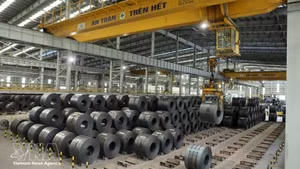
According to Viet Nam Electricity (EVN), in 2024 total national commercial electricity consumption was estimated at nearly 277 billion kWh, with the industrial sector alone accounting for more than half, equivalent to over 140 billion kWh.
With 381 industrial parks, more than 700 industrial clusters and around 40,000 operating enterprises, this sector continues to be a major energy consumption hotspot of the economy.
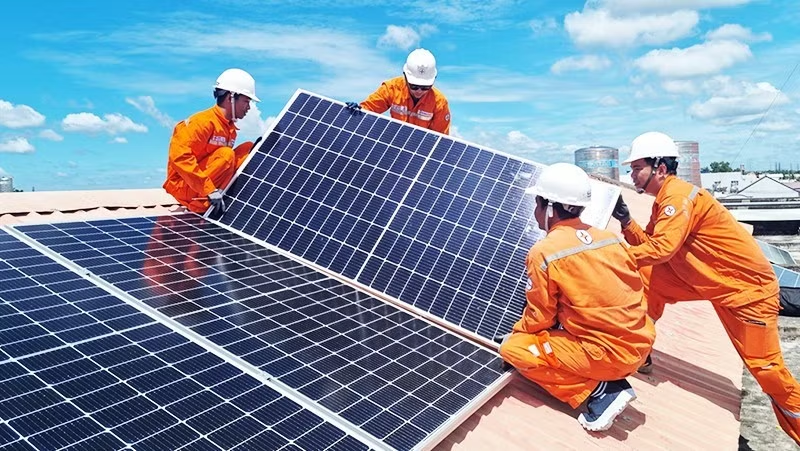
According to surveys by the Ministry of Industry and Trade, the industrial sector still has the potential to save 20–30% of electricity consumption if efficiency solutions are applied. In this context, rooftop solar power has emerged as a suitable option thanks to large factory roof areas, concentrated loads and stable daytime demand.
Experts note that rooftop solar is no longer a symbolic “green dream” representing sustainability imagery, but has become a concrete economic calculation. Enterprises will only decide to invest if the solution helps reduce production costs, manage energy risks and meet emissions requirements set by international partners.
In reality, the issue has moved beyond electricity bill savings and is increasingly becoming part of strategies to maintain export competitiveness. Research by McKinsey & Company indicates that by 2030, around 80% of manufacturing industries in Asia will be subject to emissions control standards across supply chains. As a major manufacturing hub in the region, Viet Nam is facing growing pressure from the EU, the US and the G7.
As a result, rooftop solar is viewed as a “two-in-one” solution: reducing emissions while stabilising long-term energy costs. According to estimates by Do Quang Thinh, Chief Executive Officer of The Sunergy, if just 15% of electricity demand in industrial parks were replaced by this source, the economy could save approximately 2.5 billion USD per year.
This potential is attracting a growing number of providers, expanding from installation into comprehensive services such as legal consultancy, design, operation and power purchase agreements (PPAs), helping to reduce upfront capital burdens for customers. However, the proportion of factory rooftops currently equipped remains only 5–7%, indicating that the market is still constrained by multiple barriers.
The first challenge is an inconsistent policy framework. Following the end of the FIT mechanism, regulations on electricity pricing and direct power trading remain incomplete, making it difficult for businesses to build viable financial plans.
Next is the issue of contracts and payback periods. Most enterprises lease factory space on a short-term basis, while rooftop solar projects typically require seven to ten years to recover capital, complicating negotiations among stakeholders. Finally, infrastructure and safety standards pose challenges, ranging from grid overload risks and fire prevention requirements to inconsistent connection and construction procedures across localities, all of which increase costs and prolong project timelines.
Opening pathways through business models and policy
To unlock this billion-dollar market, many companies are shifting towards more flexible models such as PPAs or Energy Service Companies (ESCOs), combining solar system leasing with intelligent energy management systems (EMS). Under these models, manufacturing enterprises do not need to invest upfront capital, but instead pay for electricity at prices lower than EVN’s, while also meeting green standards required for exports.
At the same time, digitalisation is becoming a key factor enabling enterprises to adapt more effectively. Specifically, the application of smart contracts, IoT and AI helps monitor output, optimise performance and meet carbon traceability requirements—standards that are increasingly common in the EU and the US.
On the policy front, Do Quang Thinh has proposed allowing electricity distribution units within industrial parks to purchase and use surplus internal power, while simplifying implementation procedures. In particular, removing the requirement for SCADA connections for projects that do not sell electricity to the EVN grid is expected to significantly reduce unnecessary costs.
In addition, many experts have suggested encouraging the integration of battery energy storage systems (BESS) to ease pressure on the grid and enhance the efficiency of solar power utilisation. Phan Cong Tien, an expert at the Institute for Smart Energy Application Research (iSEAR), noted that for projects under 30 MW, direct bilateral power trading should be permitted without mandatory participation in the spot electricity market.
“If these policies are approved, rooftop solar capacity in industrial parks could increase five to seven times within the next five years,” Thinh predicted.
According to the International Energy Agency (IEA), by 2030 G7 countries will require emissions transparency across entire supply chains, including Scope 3—indirect emissions from suppliers. This means that Vietnamese enterprises seeking to retain orders from major corporations must be able to demonstrate the proportion of renewable energy used in production.
In this context, rooftop solar in industrial parks is not merely an energy solution, but a component of an integration strategy. If Viet Nam can promptly remove policy bottlenecks during the 2025–2030 period, this market will not only generate multi-billion-dollar value, but also help maintain the country’s position in global supply chains in a green and sustainable direction.
At the system-wide level, rooftop solar is no longer a niche segment. According to statistics, Viet Nam currently has around 103,000 rooftop solar projects with a total capacity exceeding 9,500 MW. Under national power planning and long-term orientations, the target by 2030 is for approximately 50% of public buildings, offices, factories and enterprises, as well as 50% of households, to use solar power, thereby enhancing self-sufficiency and reducing pressure on the grid.
Looking further ahead, by 2050 rooftop solar capacity is expected to reach 39,500 MW, becoming an important component of the national power mix. To achieve the goal of covering around 50% of rooftops in major urban areas by 2030, experts argue that stronger government involvement is needed, particularly in finalising institutions, technical standards and investment incentive mechanisms.
According to system operators, the market is entering a phase of “slowing down” to self-adjust. Rooftop solar is no longer viewed as a short-term investment, but as infrastructure assets requiring systematic management throughout a 20–25 year lifecycle.