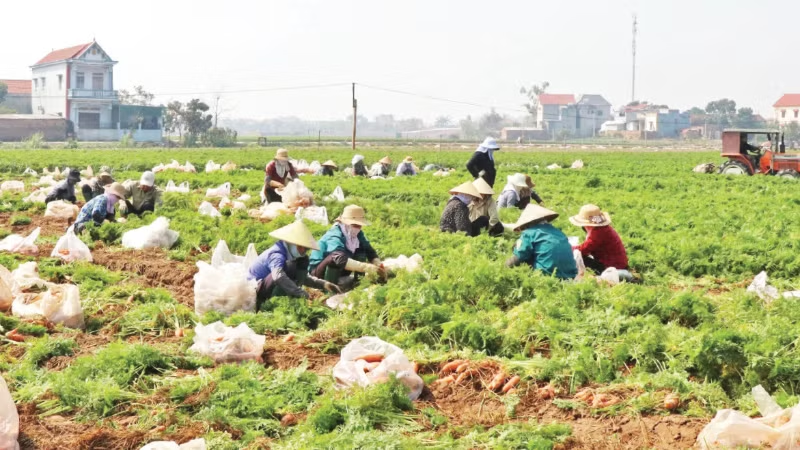
Abundant supply, stable prices
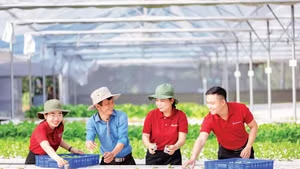
In mid-December 2025, the family of Nguyen Thi Hong in Viet Yen Commune, Hung Yen Province, planted more than 20,000 cauliflower plants, one mau (3,600 m2) of tomatoes and five sao (1,800 m2) of cabbage, kohlrabi and assorted leafy vegetables for sale during the Lunar New Year period. At present, her vegetable fields have entered the harvest season for Tet. Hong said that although weather conditions were unfavourable, careful cultivation ensured high quality and yields.
Compared with early lunar December, vegetable prices have shown a sharp decline. Despite the low prices, farmers are not overly concerned. According to Nguyen Huu Hung, Director of the Yen Phu Agricultural Services Cooperative in Viet Yen Commune (Hung Yen Province), this situation will not last long. He forecasts that after the 20th day of the last lunar month, when consumer demand rises sharply, prices of green vegetables—especially fresh salad greens and herbs—will rebound. However, given the abundant supply, prices are unlikely to surge dramatically.
In the 2025 winter crop season, northern provinces cultivated more than 400,000 hectares of winter crops, with estimated output of 4.8–5 million tonnes. As the Lunar New Year coincides with the main harvest period of many vegetables, agricultural supply is plentiful and sufficient to meet market demand. Localities are actively intensifying cultivation, staggering planting schedules and growing cold-tolerant, short-cycle vegetables to ensure adequate supply before, during and after Tet.
In central provinces, improved supply has led to a marked cooling of vegetable prices. At several traditional markets in Da Nang, lettuce prices have dropped sharply from around 30,000 VND/kg previously to just 10,000–15,000 VND/kg (0.38–0.58 USD/kg). Other leafy vegetables such as mustard greens, water spinach, amaranth and malabar spinach have also recorded significant price declines. Given current conditions, shortages and price spikes are considered unlikely.
In Lam Dong, the country’s major vegetable hub, production activity is in full swing. With approximately 22,800 hectares planted for the Tet crop, the province is expected to supply around 790,000 tonnes of agricultural produce. Farmers are accelerating harvesting and transportation to ensure timely supply for the Lunar New Year market.
Demand in the capital during the three peak months—before, during and after Tet—is expected to be very high. Ha Noi residents are projected to require around 301,000 tonnes of rice; more than 334,000 tonnes of vegetables and fruit; and over 400 million poultry eggs. Demand for fresh food is forecast at around 60,000 tonnes of pork, along with tens of thousands of tonnes of beef, poultry and seafood. At present, production units and distribution systems have completed their stockpiling plans. Compared with the same period last year, food supply has increased by between 5% and 30%, depending on the key commodity group.
Ta Van Tuong, Deputy Director of the Ha Noi Department of Agriculture and Environment
According to Ta Van Tuong, Deputy Director of the Ha Noi Department of Agriculture and Environment, the capital’s food supply capacity is sufficient to meet demand throughout the Tet peak period. Stockpiles have been strengthened, ensuring stable supply and market balance.
Pham Kim Dang, Deputy Director of the Department of Livestock Production and Animal Health under the Ministry of Agriculture and Environment, said that with approximately 8.66 million tonnes of live meat, 21.4 billion poultry eggs and 1.3 million tonnes of milk, the agricultural sector is fully prepared to meet consumer demand during Tet. Based on current production and reserve capacity, food supply is sufficient, and prices of livestock products are expected to remain broadly stable during the Lunar New Year.
Establishing a food safety “barrier”
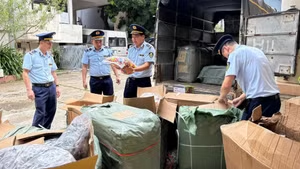
To ensure food safety during the Lunar New Year, the Ministry of Agriculture and Environment has issued directives requiring localities to strengthen supervision of slaughtering and food hygiene, particularly in major urban areas. In parallel, to prevent smuggling and the sale of products of unknown origin, the agricultural sector is coordinating closely with relevant agencies to intensify inspections and enforcement.
Food safety assurance has been raised to the highest level. For pork products, the Ministry has activated a multi-layered monitoring plan covering the entire chain—from livestock selection and slaughtering processes to market circulation. In major cities, inter-agency inspection teams have conducted on-site checks to assess conditions and promptly rectify violations.
A notable new feature this year is the mobilisation of grassroots authorities and police forces to jointly participate in supervision. This coordinated approach is expected to form a robust “protective barrier” against substandard food and enhance the effectiveness of State management of food safety during this critical period.
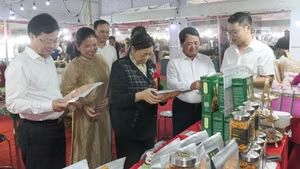
For vegetables, Nguyen Quoc Manh, Deputy Director of the Department of Crop Production and Plant Protection, noted that localities have stepped up safe vegetable production while strengthening quality control and food safety inspections. At the same time, authorities have intensified oversight of agricultural input suppliers, from seeds to fertilisers and plant protection chemicals, resolutely preventing substandard products from affecting agricultural quality and the sustainable development of crop production.
Localities have stepped up safe vegetable production while strengthening quality control and food safety inspections. At the same time, authorities have intensified oversight of agricultural input suppliers, from seeds to fertilisers and plant protection chemicals, resolutely preventing substandard products from affecting agricultural quality and the sustainable development of crop production.
Nguyen Quoc Manh, Deputy Director of the Department of Crop Production and Plant Protection
As Tet approaches, ministries, sectors and localities are urged to further strengthen inter-agency coordination and intensify inspections to ensure food safety and promptly prevent the production and trading of counterfeit or low-quality food. Localities are also required to strictly implement Plan No. 1941/KH-BCDTUATTP of the Central Inter-sectoral Steering Committee on Food Safety on ensuring food safety during the Lunar New Year and the spring festival season 2026.