As global trade shows signs of slowing, international capital flows are being forced to restructure and seek out new destinations that are stable and safe while still offering strong growth potential. In this context, Viet Nam is emerging as a rising economy, maintaining macroeconomic stability, deepening integration, and setting ambitious growth targets for the coming period.
The advantage of a latecomer
Viet Nam is standing before a rare opportunity to make a breakthrough, shifting from the position of a “manufacturing destination” to the role of a regional hub connecting capital flow, technology, and innovation.
According to Dr. Ho Quoc Tuan, senior lecturer at the University of Bristol (the UK), Viet Nam has chosen the right moment to build an international financial centre (IFC). This is not simply a functional zone or an infrastructure project, but a policy declaration on the level of openness, integration, and determination to enable Viet Nam to participate more deeply in global financial flows.
Dr. Ho Quoc Tuan noted that compared with leading financial centres such as London or Singapore, Viet Nam lacks the advantage of a long development history. However, its position as a “latecomer” allows Viet Nam to learn, select, and avoid the mistakes experienced by earlier centres.
Viet Nam can draw on the models of Singapore, Malaysia, and China, such as Hong Kong (China) or Shanghai (China), while adjusting them to suit its institutional conditions, level of development and strategic objectives.
Specifically, as finance is increasingly intertwined with technology, the gap between centres is no longer determined entirely by time. The capacity to absorb technology and the speed of adaptation are becoming decisive factors. A young workforce, the rapid development of fintech, AI, green finance, and digital assets are creating favourable conditions for Viet Nam to build a financial centre “born in the digital age” that is flexible and modern from the outset.
At the first meeting of the Steering Committee for the IFC in Viet Nam, Prime Minister Pham Minh Chinh affirmed that building an IFC is a new and difficult task with no precedent, but one that must be implemented. The guiding principle is: “not seeking perfection, not rushing, not missing opportunities”, and “doing while drawing lessons, expanding step by step.”
In recent times, the Government, ministries, sectors, and localities have achieved important initial results: submitting conclusions and directions to the Politburo; submitting Resolution No. 222/2025/QH15 for adoption at the National Assembly; drafting and submitting eight guiding decrees for issuance; consulting international experience; and gradually forming the IFC operating council at the central level as well as management apparatuses in the two cities.
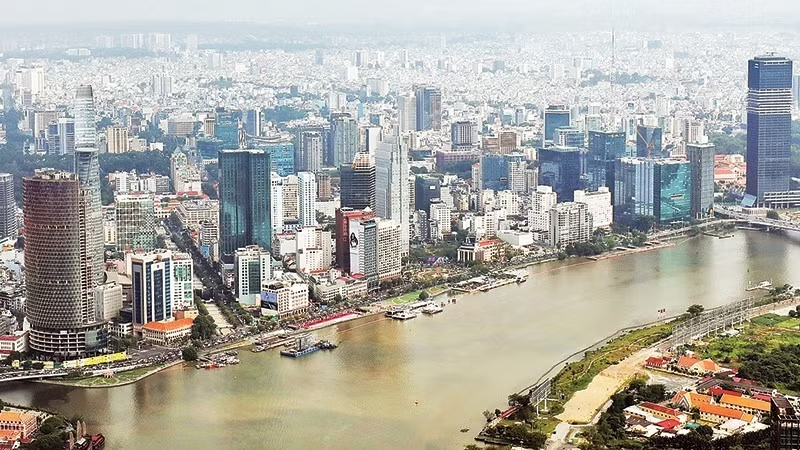
Ho Chi Minh City and Da Nang City have also proactively prepared personnel, facilities, headquarters, and other operating conditions for the IFC.
According to Dr. Ho Quoc Tuan, the reforms that the Government of Viet Nam has been promoting recently are moving in the right direction in terms of building initial confidence among international financial institutions.
“We are in a race for speed,” Dr. Ho Quoc Tuan observed. In the context that countries across the region all want to secure positions in the financial value chain, opportunities will not wait if Viet Nam falls behind.
Building an IFC is therefore not only an economic equation, but also a matter of institutional reform, development thinking and the capacity for decisive and consistent action. If the opportunity is well seized, Viet Nam will not only attract international capital flow but also gradually assert its role as a dynamic and reliable link in the reshaping Asian financial system.
Dr. Ho Quoc Tuan, senior lecturer at the University of Bristol (the UK), commented: “A commitment to high growth is an important foundation for the development of international finance. Financial institutions always base their capital decisions on the outlook of the host economy.”
Joining the Asian financial “supply chain”
If institutions are a necessary condition, enterprises are the decisive force determining the success or failure of the IFC. The fact that the first enterprises have officially been selected to participate in the IFC shows that the “preparation” phase has moved into the action phase.
In Da Nang, one of the first ten selected enterprises is the only payment intermediary on the list, underscoring the increasingly important role of fintech in the structure of the future financial centre.
Le Tuan Anh, business director of 9PAY (a provider of digital payment solutions), said the company has prepared on three fronts: the legal framework for cross-border payments, a digital payment product ecosystem, and human resources and technological infrastructure. The establishment of an IFC project board and the opening of an office in Da Nang demonstrate the company’s long-term commitment to accompanying the IFC.
According to experts, it is precisely these pioneering enterprises that will serve as “living laboratories”, testing the feasibility of new financial models in practice.
Beyond being a location for the headquarters of financial institutions, the IFC is expected to become a policy sandbox (a controlled testing mechanism), where new models such as cross-border payments, digital finance, green finance, and digital assets can be piloted within a tightly supervised framework.
Assoc.Prof.Dr. Nguyen Huu Huan, a member of the advisory group for establishing the IFC in Ho Chi Minh City, said the city has signed important cooperation agreements with major international partners such as Nasdaq and Binance (a global cryptocurrency exchange), gradually building an ecosystem of innovative financial products.
According to economist Tran Hoang Ngan, the IFC will be a tool for Viet Nam to mobilise international venture capital funds, promote innovative start-ups, and at the same time open the possibility of organising commodity exchanges and modern financial instruments.
Looking to the medium and long term, Dr. Ho Quoc Tuan believes that finance, like manufacturing, has a supply chain with specialised segments. Viet Nam does not necessarily need to become a “super centre” but can participate deeply in advantageous links such as payments, digital finance, capital mobilisation for new technologies, or green finance.
To achieve this, the two key pillars are people and infrastructure, together with a legal framework that is flexible yet sufficiently rigorous to both encourage innovation and ensure system safety.
As emphasised by Prime Minister Pham Minh Chinh, building an IFC is a new task, but one to be carried out with the principle of “not seeking perfection, not rushing, not missing opportunities”, and “doing while drawing lessons, expanding step by step.”
To succeed, the IFC must have credibility, trust, stability and high predictability. Therefore, all policies must be transparent and consistent, procedures must be standardised, individual responsibilities must be clearly defined, work must be handled swiftly but correctly, open yet controlled, encouraging innovation without trading off system safety.
Viet Nam’s IFC is entering a real race. It is a race in terms of speed, the quality of reforms and implementation capacity. If the opportunity is well seized, the IFC will not only be a symbolic project, but also a strategic turning point, helping Viet Nam assert its position, credibility, and increasingly important role in the Asian and global financial networks.