Across many localities, cooperatives have signed product offtake contracts with businesses, enabling them to proactively secure supply sources for the year-end period.
Proactive production planning
These days, Yen Duong Cooperative in Thuong Minh Commune, Thai Nguyen Province, is mobilising manpower and resources to intensify the care of fragrant wax gourd, glutinous rice, and the processing of arrowroot glass noodles to meet consumer demand during the year-end period and Tet (Lunar New Year).
Its director, Ma Thi Ninh, said with enthusiasm that the cooperative has already signed a contract with partners to supply 50 tonnes of glutinous rice for the Tet holiday. In addition, demand for arrowroot glass noodles is forecast to increase by 1.5–2 times compared with the same period in 2024. As a result, the cooperative decided as early as mid-year to expand its cultivation area from 20 to 30 hectares.
Thanks to proactive production planning and close monitoring of market demand, the cooperative has continued to grow in scale. From an initial 12 members linked with 230 farming households, it now has 25 members cooperating with 560 households. Notable among its models is the linkage in cultivating 40 hectares of fragrant wax gourd, including 10 hectares certified under the Participatory Guarantee System (PGS) organic standard — an OCOP four-star product — yielding an average output of 500–700 tonnes per year. The cooperative also operates a 30-hectare arrowroot growing area. Meanwhile, 30 hectares of Tai glutinous rice have achieved PGS organic certification as well as Japan’s Agricultural Standard (JAS) for organic cultivation.
To give its products a “new look”, Yen Duong Cooperative has introduced Tet gift baskets featuring a variety of items for consumers. This initiative has helped create additional jobs for cooperative-linked members, with an average monthly income of around 7 million VND per person.
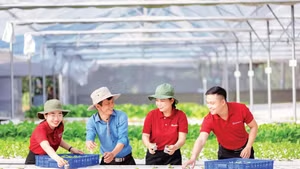
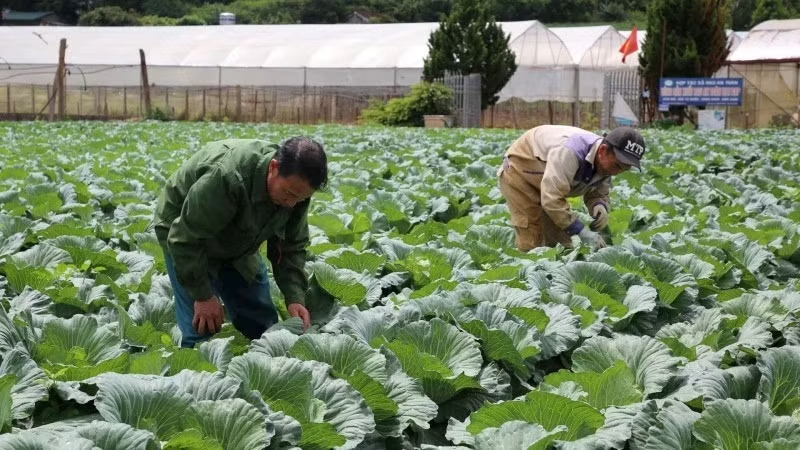
Proactive production planning and stronger linkages to increase output for year-end demand are also the chosen approach of the Tu Nhien Safe Vegetable Cooperative, Moc Son Ward, Son La. Nguyen Thi Luyen, its director, said the cooperative has 35 member households farming 25 hectares and growing 32 varieties of vegetables and fruits. To meet consumer demand during the year-end period and Tet, the cooperative has leased an additional 10 hectares to grow more vegetables, adjusted sowing schedules, and implemented staggered cropping to secure supply. It also produces vegetables according to orders from supermarkets and retail outlets, with annual output exceeding 1,000 tonnes of assorted produce.
In Son La, not only vegetables but also fruit are being ramped up by co-ops for the Tet season. Nguyen Van Nam, Director of Xuan Que Strawberry Cooperative in Mai Son Commune, said the cooperative has 11 members cultivating more than 50 hectares of strawberries, cucumbers, cabbage, aubergines, and other crops. Each year, the cooperative guarantees the purchase of around 300 tonnes of raw materials from local farmers, in addition to members’ output. It is currently linked with five enterprises to secure outlets for products with an annual volume of 800–1,000 tonnes.
Ensuring quality to meet market demand
As the Lunar New Year approaches, agricultural co-ops are continuing to expand production linkages, broaden consumption markets, and place particular emphasis on product quality. To support cooperatives, Son La Province has prioritised maintaining and expanding agricultural supply linkages with Hanoi, Hai Phong, Thanh Hoa, Hung Yen, and northern industrial zones, helping to stabilise outlets and reduce price volatility.
According to Phung Kim Son, Director of the provincial Department of Agriculture and Environment, the department is continuing to work with other agencies and localities to support cooperatives through policies encouraging investment in agriculture and rural areas. These include interest-rate subsidies, plant propagation using tissue culture technology, investment in coffee pre-processing facilities, concentrated beef cattle farming, agricultural processing, and the OCOP programme.
At the same time, the department is supporting cooperatives in developing value-chain-based production models, such as establishing planting area codes; granting VietGAP, GlobalGAP, and OCOP certifications; promoting community-based agricultural extension; preventing disease outbreaks and natural disasters; and boosting trade promotion and market expansion. Producers are advised to closely follow market forecasts issued by the Department of Industry and Trade in order to proactively plan production and supply.
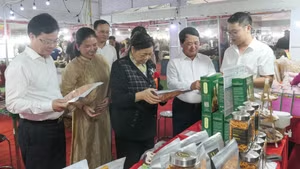
In Thai Nguyen, alongside agricultural cooperatives, the provincial Department of Industry and Trade has forecast a sharp increase in consumer demand for goods, particularly essential items such as food, beverages, and garments. Numerous trade promotion activities have been organised, including the Thai Nguyen 2025 Agricultural Products, OCOP and Craft Village Festival linked with tourism; the 7th Exhibition Week for showcasing and promoting outstanding products from provinces and cities, combined with the second Viet Nam–Republic of Korea economic and cultural exchange; and exhibitions promoting tea brands.
In addition to providing market information, Thai Nguyen Province has organised more than 40 e-commerce training courses, supported nearly 400 online storefronts, and enabled over 500 cooperative participants in domestic and international trade fairs. New models such as livestream meeting rooms, e-marketplaces for ethnic minority regions, and digital communications have been effectively implemented, helping cooperatives expand their distribution channels.
According to the Department of Economic Cooperation and Rural Development under the Ministry of Agriculture and Environment, to ensure the Tet season becomes the most economically valuable crop season of the year, cooperatives need to closely monitor the market and develop production schedules aligned with consumer demand. At the same time, they should develop concentrated raw material zones, apply high technology, mechanisation, and smart agriculture to improve product quality and value. In the long term, cooperative managers need training in operational skills, financial management, business administration, and digital transformation, including the use of accounting software and electronic production logs.