To achieve its growth target and attract major investors, the city has pledged to continue improving its investment and business environment while working closely with investors.
In recent years, Ha Noi has remained an attractive destination for both domestic and foreign investors, with numerous large-scale projects in high technology, infrastructure, innovation, logistics, healthcare, education and high-quality services.
In the first six months of 2026, the city approved investment for 138 domestic projects with total registered capital of approximately 3.5 quadrillion VND (133.2 billion USD). Foreign direct investment (FDI) inflows are estimated at 3.24 billion USD, equivalent to 72% of the full-year target and exceeding the first-half target by 16%, keeping Ha Noi among the country’s leading FDI recipients.
According to the Ha Noi Department of Finance, the city’s investment and business environment has continued to improve, with nearly 19,000 newly established enterprises in the first half of the year, up 21% year-on-year. Their combined registered capital reached 397.9 trillion VND (15.1 billion USD), a 2.5-fold increase compared with the same period last year.
Ha Noi’s improved investment climate has not only attracted new projects but also encouraged long-term investors to deepen their commitments.
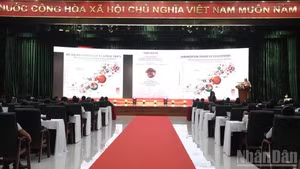
At the recent conference announcing the Ha Noi Capital Master Plan with a 100-year vision and promoting investment for 2026, Samsung Viet Nam General Director Na Ki Hong said that after many years of investing in Ha Noi across manufacturing and research and development (R&D), Samsung hoped to expand its cooperation with the city further.
He added that this would help attract higher-quality investment and accelerate the capital’s transformation to a new growth model.
Manabu Hamamoto, General Manager for Global Urban Development Strategic Business at Sumitomo Corporation, likewise affirmed that after nearly 30 years of investment in Ha Noi through the Thang Long Industrial Park and the North Ha Noi Smart City Project, Sumitomo would continue to support the capital’s efforts to build a green, smart and sustainable city.
At the same conference, the Ha Noi government unveiled a portfolio of 276 projects calling for investment across infrastructure, industry, urban development, education, healthcare, culture and environmental protection.
It also launched the Ha Noi Investment Map, a digital platform enabling investors to access planning information, assess potential sites and explore investment opportunities visually, transparently and conveniently.
Before and during the event, Ha Noi granted investment policy approvals for several key projects and signed 50 memoranda of understanding with domestic and international enterprises and investors in priority sectors. City leaders reaffirmed their commitment to building a secure, competitive investment environment and working closely with businesses to realise the century-long vision set out in the capital's master plan.
Whereas Ha Noi's investment appeal once rested largely on its market size, geographical location and infrastructure, investor confidence is now increasingly built on institutional reform, a long-term development vision and the city's capacity for innovation.
Truong Gia Binh, Chairman of FPT Corporation, emphasised that, as a technology company founded in Ha Noi, FPT remained committed to supporting the capital in developing its innovation ecosystem. The company has pledged to invest in developing the Tay Tuu Digital Technology Park into a leading centre for research, training and innovation.
According to city statistics, however, while the number of new investors has increased, the average investment per project remains modest at around 1.24 million USD.
This indicates that most new investments are medium- and small-scale projects in the trade and services sectors, while relatively few large-scale projects have been launched in industry, science and high technology.
In addition, capital contributions and share acquisitions account for around 78% of total cumulative registered investment capital.
Ha Noi aims to attract major investors as it pursues its goal of achieving double-digit economic growth. Between now and 2035, the city plans to mobilise 14.5 quadrillion VND in total investment across the economy, including approximately 2.68 quadrillion VND in private-sector investment for infrastructure. Total investment is projected to rise to 50.3 quadrillion VND during the 2036-2045 period.
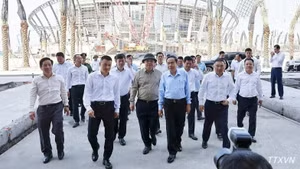
To achieve these ambitions, Ha Noi Party Secretary Tran Duc Thang said the city would focus on four key priorities: continuing wide-ranging administrative reform and building a service-oriented public administration; prioritising investment in strategic infrastructure to mobilise resources from across society; developing a highly skilled workforce and a vibrant innovation ecosystem; and ensuring that all policies and projects contribute to improving residents’ quality of life while preserving the cultural identity of Ha Noi.
The city also pledged to foster a transparent and equitable investment environment that safeguards investors’ legitimate rights and interests.