Removing obstacles to export growth
Speaking at the Trade Promotion Conference with Viet Nam's overseas trade offices in the second quarter of 2026, held both in person and online on July 7 by the Trade Promotion Agency under the Ministry of Industry and Trade, Nguyen Anh Son, Director General of the Agency of Foreign Trade, stated that Viet Nam's growing trade deficit with the United States poses a major challenge to efforts to rebalance the country's trade account in the second half of the year.
Regarding the Japanese market, representatives of the Viet Nam Business Association in Japan noted that Viet Nam has become Japan's second-largest supplier of coffee. However, the export value remains modest because most shipments consist of unprocessed coffee beans.
"The value of our coffee exports is five to six times lower than those of Brazil or Colombia," the association's representative noted, explaining that many Vietnamese processing plants have yet to obtain the stringent international certifications required by the Japanese market.
In addition to pressures in key markets such as the US and Japan, major export industries including timber and textiles are also encountering difficulties.
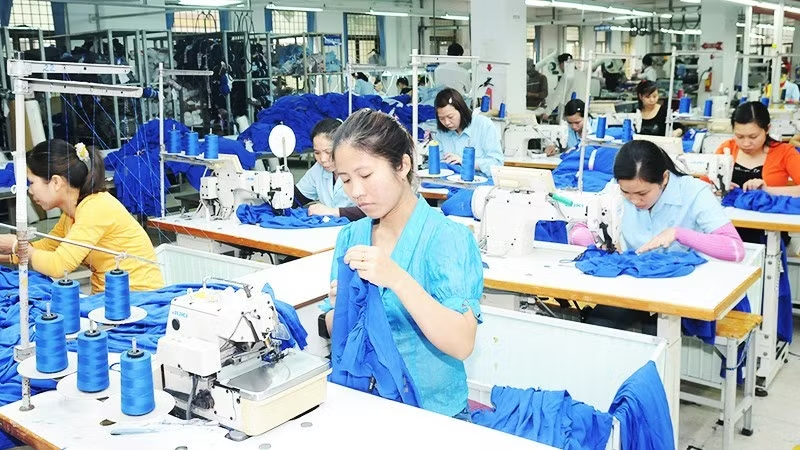
According to Truong Van Cam, Secretary General of the Vietnam Textile and Apparel Association (VITAS), although the industry maintained a trade surplus of 9.2 billion USD, export turnover grew by only 1.7%, well below the country's overall export growth rate. The sector's most pressing challenges are labour shortages and the need to transform its growth model to elevate competitiveness.
In this context, industrial restructuring and technological innovation have become essential for businesses. Vu Ba Phu, Director General of the Trade Promotion Agency, emphasised that enterprises should develop distinctive, value-added products under Vietnamese brands to create new competitive advantages.
Representatives of the Viet Nam Logistics Business Association (VLA) also underscored the importance of technological solutions such as green logistics and digital supply chains, which can help address data shortages that often hinder businesses from making timely and informed decisions in a rapidly changing market.
Held under the theme "Proactively adapting to global market changes – promoting trade to boost exports, contribute to trade balance, and achieve double-digit economic growth", the conference provided updates on international market developments and explored measures to help businesses seize export opportunities amid continued global economic uncertainty.
Results from the National Trade Promotion Programme showed that 22 trade promotion projects were completed during the first half of the year. These included national pavilions at major international trade fairs such as Biofach, Hannover Messe, Fruit Logistica (Germany), Gulfood (United Arab Emirates), and Foodex Japan, as well as business missions to Canada, Japan, and the Republic of Korea, alongside regional trade fairs and promotional campaigns for Vietnamese products.
Decisive and coordinated action
To achieve export growth targets, representatives of the Trade Promotion Agency emphasised the need for close monitoring of market developments, regular updates to provide early warnings of potential risks, and stronger trade promotion efforts, particularly in following up business connections established at trade fairs.
Vu Ba Phu stated: "Trade promotion should not end when an exhibition closes. Overseas trade offices need to help businesses send product samples, organise specialised business-to-business sales activities, and bring international buyers and trade delegations directly to production areas and raw material regions in Viet Nam so they can assess production capacity firsthand."
He added that the responsibility extends beyond industry associations. Viet Nam's overseas trade offices should continue diversifying export markets, maximise existing free trade agreements (FTAs), promote negotiations on new agreements such as the ASEAN–Canada Free Trade Agreement, and expand into promising markets in the Middle East and Africa.
The overseas trade office network was also urged to fortify early warning systems and provide businesses with timely support in responding to technical trade barriers and anti-dumping investigations launched by foreign markets.
In addition to providing market intelligence, representatives from Viet Nam's overseas trade offices shared a range of recommendations for exporters. They emphasised the need to elevate product quality, comply with traceability requirements, and adopt greener and more sustainable production practices.
Businesses were also encouraged to deepen cooperation with multinational corporations to establish comprehensive product traceability systems covering the entire supply chain — from raw materials to finished products — in order to meet the increasingly stringent customs and regulatory requirements of importing countries.
These measures are expected to play a pivotal role in enhancing the competitiveness of Vietnamese goods and expanding their market share in international markets.