In the complicated context of global trade, the Ministry of Industry and Trade is determined to maintain the export growth target of 15-16%, while maintaining a trade surplus of approximately 23 billion USD or more, making a significant contribution to the double-digit GDP growth target in 2026 and subsequent years.
Numerous difficulties and challenges
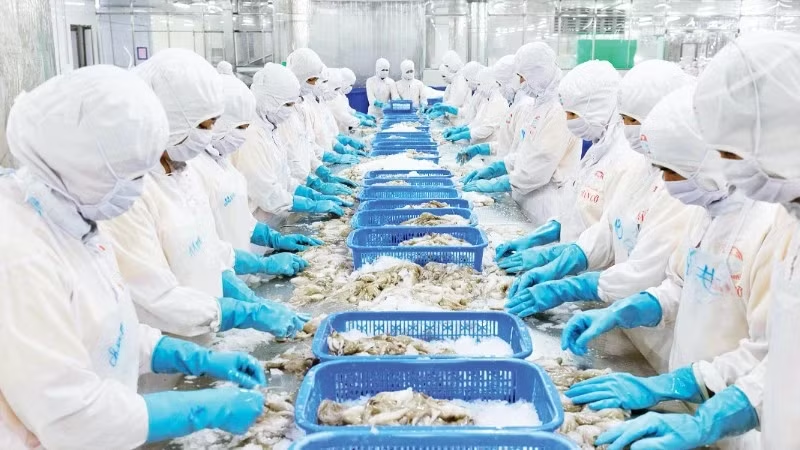
Seafood exports in 2025 reached a record figure of 11.3 billion USD, and in the first two months of 2026, continued to grow by 20% compared to the same period in 2025, reaching 1.7 billion USD. However, seafood exports are facing a series of major challenges.
According to Le Hang, Deputy Secretary General of the Viet Nam Association of Seafood Processing and Export (VASEP), logistics costs have increased due to the impact of the Middle East conflict, which strongly affects the industry's operations because seafood exports are heavily dependent on sea transport.
Currently, businesses are being informed that many ships have to be diverted to Africa, extending the time it takes to transport seafood to Europe or the East Coast of the US by about 1-2 weeks, thus increasing costs. Insurance companies will not cover insurance for routes through the high-risk Middle East region. Furthermore, the cost of packaging and some auxiliary materials for seafood processing is also skyrocketing.
Logistics costs have increased due to the impact of the Middle East conflict, which has severely affected the industry’s operations, as seafood exports are heavily dependent on sea transport.
Le Hang, Deputy Secretary General of the Viet Nam Association of Seafood Processing and Export (VASEP)
In addition, seafood exports also face challenges from trade protection measures and tariff policies on many key products such as shrimp and pangasius. Since January, the US has begun banning seafood products from 12 fisheries not recognised as equivalent under the Marine Mammal Protection Act.
In February, the US announced the final results of the 19th administrative review (POR19) of the anti-dumping duty order on shrimp. Accordingly, two Vietnamese companies, STAPIMEX and Thong Thuan, were subject to anti-dumping duties of nearly 26%, while the group of companies not subject to mandatory inspection were subject to a rate of over 4.5%. This result caused shrimp exports to the US to decrease by up to 60% in February alone.
In 2025, trade turnover between Viet Nam and the UAE is expected to reach over 6.5 billion USD, with Viet Nam having a trade surplus of nearly 5 billion USD. Notably, the UAE government’s announcement that the Viet Nam-UAE Comprehensive Economic Partnership Agreement (CEPA) came into effect on February 3 immediately impacted Viet Nam's exports to this market, with export turnover in the first two months of the year reaching nearly 1 billion USD, an increase of about 10% compared to the same period last year.
However, according to Truong Xuan Trung, Head of the Vietnamese Trade Office in the UAE, after the Middle East conflict, exports to this market may face many risks such as logistics disruptions; fluctuations in fuel prices leading to increased transportation and production costs, reducing the competitiveness of Vietnamese goods in the Middle East market in the future. On the other hand, because the UAE is currently focusing on maintaining stability in essential goods, some Vietnamese agricultural export products such as spices and fresh fruits may be affected.
Trung noted that Vietnamese export businesses may face payment risks for signed import contracts or shipments already transported to the UAE but unable to enter the country due to the conflict. In discussions with the Trade Office, many businesses reported having to “sell off” shipments stranded at sea because they were unable to enter the UAE.
Expanding markets, reducing dependence
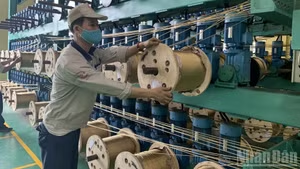
As one of the key export sectors, Vietnamese textiles and garments are currently exported to approximately 130 countries and territories, but mainly concentrated in a few major markets such as the US, the EU, Japan, the Republic of Korea, and China (accounting for nearly 90%), while the remaining markets account for just over 10%.
Therefore, Truong Van Cam, Vice President and General Secretary of the Viet Nam Textile and Garment Association (VITAS), suggested that the Ministry of Industry and Trade continue to support businesses in promoting activities in new, high-potential markets, especially in some markets where businesses have already conducted exploratory export activities.
In addition, the biggest bottleneck for the textile and garment industry is the shortage of raw materials and components. If Viet Nam cannot be self-sufficient in this supply, it will not be able to benefit from free trade agreements, or will benefit very little.
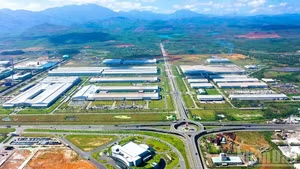
The Viet Nam Textile, Garment and Footwear Industry Development Strategy to 2030, with a vision to 2035, also clearly states that the solution is to develop large textile and garment industrial parks for the production of raw materials and components to serve domestic production.
Cam suggested that the Government direct ministries, sectors, and localities to focus on implementing the proposed Strategy, especially localities needing to quickly review the planning of industrial parks that have changed after mergers. Vietnamese trade offices abroad are proactively seeking and introducing reputable investors in the textile and dyeing finishing sector to invest in Viet Nam.
According to Le Hang, in the current challenging context, diversifying markets and enhancing product value are key factors for the seafood industry to maintain growth. Therefore, VASEP recommends that the Ministry of Industry and Trade, in addition to key markets, expand the promotion programme to other potential markets such as Brazil, South America, or South Asia, reducing dependence on traditional markets such as the US and the EU, and creating more room for growth in the seafood industry.
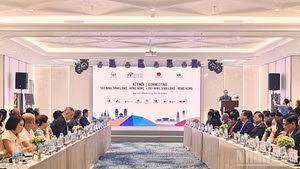
Vietnamese trade offices abroad need to strengthen the promotion of information about domestic export businesses to foreign partners, creating conditions for export businesses to access more partners and sign more new contracts; at the same time, continue to support businesses in removing barriers and difficulties in export markets, especially in responding to trade defense cases.
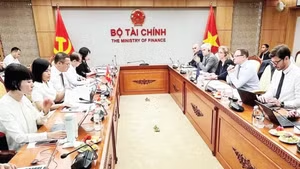
Furthermore, in the current uncertain market environment, providing market information and early warnings is of great significance, helping businesses proactively plan production and respond to emerging situations. According to Nguyen Anh Son, Director of the Import-Export Department under the Ministry of Industry and Trade, the Ministry will continue to closely monitor developments in the markets to propose to the Government directives for coordinated management among relevant ministries and agencies regarding import and export activities. The Trade Offices system is also required to closely monitor markets to provide timely information and warnings to the Ministry and businesses.