Data from the Agency of Foreign Trade under the Ministry of Industry and Trade show that import demand for agro-forestry-fishery products within ASEAN has maintained a steady upward trend in recent years. In Malaysia, fruit and vegetable imports recorded an average annual growth of 6.03% during the 2021–2025 period, reaching a peak of 2.95 billion USD in 2025.
Malaysia’s import structure reflects its strong reliance on external supply sources, with essential vegetables such as onions, garlic, and potatoes accounting for around 40–45% of total vegetable imports. Meanwhile, carrots, cabbage, and cauliflower make up about 30%. Imports of high-end fruits and vegetables serving the restaurant and hotel segments have also increased significantly.
Viet Nam is currently the seventh-largest supplier of fruits and vegetables to Malaysia, accounting for 3.52% of market share. Products such as dragon fruit, frozen durian, mango, and longan continue to hold clear competitive advantages. Notably, Viet Nam’s Ri6 durian is increasingly imported by Malaysia as a raw material for Halal food processing.
In addition to fruits and vegetables, several other sectors have recorded positive signals from ASEAN markets. According to the Viet Nam Trade Office in Singapore, Viet Nam became the third-largest seafood supplier to Singapore in 2025, with export turnover reaching 125.5 million SGD, accounting for a 10.3% market share. Of this, fish fillets and chilled or frozen fish products reached 63 million SGD, representing 29.7% of the market and remaining key export items.
In Indonesia, rubber imports averaged 492,521 tonnes per year during the 2021–2025 period, up 21.3% compared to the previous period. Viet Nam ranked fourth among rubber suppliers to Indonesia in 2025, with export volume reaching 48,710 tonnes, up 125.1% year-on-year, while market share increased from 4.2% to 10.5%. This upward trend is expected to continue as Indonesia’s domestic rubber output gradually declines.
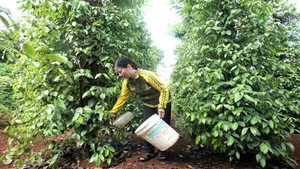
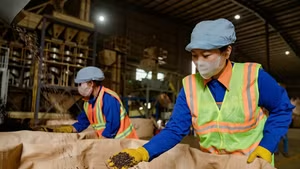
Demand for pepper imports in ASEAN has also risen sharply. In Thailand, imports increased from 5,990 tonnes in 2020 to 9,652 tonnes in 2025. Impoera reached 978 tonnes in January 2026 alone, up 121.2% year-on-year, with Viet Nam accounting for 99.63% of total import volume.
Regarding rice exports, Chairman of the Viet Nam Food Association (VFA) Do Ha Nam stated that ASEAN will remain a key export market for Viet Nam in the coming period. Rice exports to the Philippines in January 2026 reached 331,770 tonnes, valued at 147.4 million USD, accounting for 50.93% of total export volume and 47.7% of total export value. This marked the first time the Philippines has accounted for more than 50% of Viet Nam’s total rice export volume. In addition to the Philippines, Viet Nam also exports rice to Malaysia, Indonesia, and Singapore.
However, alongside opportunities, competition within ASEAN markets is becoming increasingly intense, requiring Vietnamese enterprises to adjust their strategies to maintain and expand market share. According to Le Phu Cuong, Trade Counsellor at the Viet Nam Trade Office in the Philippines, despite strong purchasing power and consumer preferences relatively aligned with Vietnamese products, challenges remain as key exports such as rice are subject to regulatory policies and trade defence measures, requiring businesses to stay regularly updated on market developments.
On the other hand, Vietnamese agricultural products are facing growing competition from other exporting countries such as China, Thailand, and Indonesia, particularly as the Philippine market remains relatively open to imports.
Meanwhile, Vietnamese enterprises have yet to prioritise the development of distribution systems. Limitations remain in sending product samples, participating in trade fairs, and establishing direct connections with customers. They have not sufficiently invested in product innovation to suit consumer preferences.
In addition, high costs associated with accessing retail distribution systems, building brand presence in local markets, and lengthy and costly food safety registration procedures continue to pose significant barriers for Vietnamese businesses.
“To address these challenges, the Viet Nam Trade Office in the Philippines has been strengthening connections between domestic enterprises and local importers and distributors, supporting product displays at showrooms, and facilitating participation in trade fairs such as Worldbex in Manila in March 2026,” Cuong noted.
From the perspective of the Thai market, Le Huu Phuc, Trade Counsellor at the Viet Nam Trade Office in Thailand, said that disruptions in energy supply chains and restrictions on flights through the Middle East have been having certain impacts on consumption and tourism in Thailand, thereby affecting Viet Nam’s exports to this market in the short term. He stressed that Vietnamese exporters need to closely monitor market developments and flexibly adjust their business plans and product structures to respond in a timely manner.