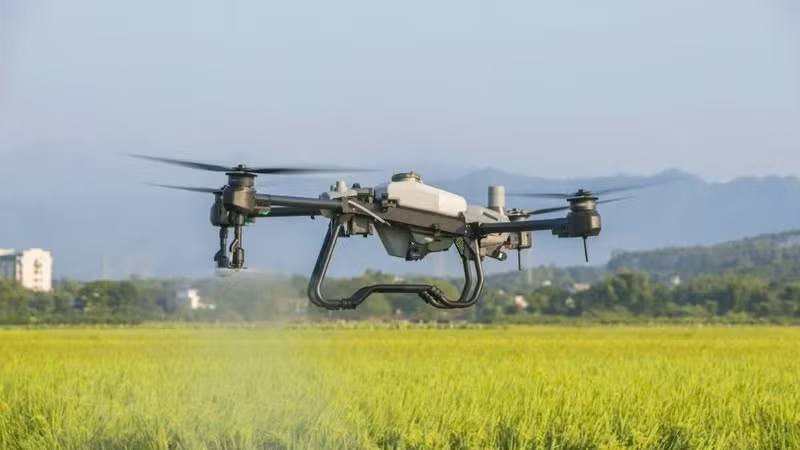
At present, drones are primarily used for spraying crop protection products, fertiliser application, direct seeding, localised irrigation and crop monitoring. Among these applications, spraying crop protection products accounts for the largest share, owing to its significant advantages in terms of time efficiency, cost savings and operational safety.
According to Huynh Tan Dat, Director of the Plant Production and Protection Department under the Ministry of Agriculture and Environment, the adoption of drones has delivered positive results, contributing to the modernisation and sustainability of agricultural production. The technology helps address rural labour shortages through greater speed and precision. More accurate and uniform application reduces wastage of agricultural inputs—including crop protection products, fertilisers and water—while lowering production costs. At the same time, farmers are no longer required to come into direct contact with hazardous chemicals, helping to protect both human health and the environment.
Despite these achievements, several operational challenges remain, with one of the most significant being the compatibility of crop protection products with drone applications.
Nguyen Van Son, Chairman of the Viet Nam Crop Protection Association (VIPA), noted that many people believe specialised crop protection products should be developed exclusively for drone use. In reality, however, drones are simply a delivery platform for applying pesticides to crops. What needs to change is not the active ingredient itself, but the method of application. Unlike conventional spraying, which requires large volumes of water, drones operate using low-volume spraying techniques. Changes in droplet size, spraying speed and the way spray solutions interact with crops mean that manufacturers must reassess these factors when developing products.
"Most crop protection products currently on the market can be applied using drones if appropriate technical guidance and operating procedures are followed. However, to achieve higher efficiency, manufacturers need to refine product formulations to improve their suitability for drone applications. The focus is not solely on the active ingredients but also on the physical properties of the products, including solubility, dispersion in water, solution stability, adhesion to leaf surfaces, and the ability to minimise losses caused by evaporation or wash-off. Each crop, ecological region and pest requires its own dataset to determine the optimal water volume, dosage and spraying technique," Son said.
Historically, most performance data for crop protection products has been developed for conventional spraying methods. As a result, many technical indicators now need to be reassessed for drone-based applications. According to industry representatives, what is needed most is robust scientific data, appropriate operating procedures and reliable technical guidelines that enable farmers to fully realise the benefits of this technology.
Sharing this view, Nguyen Thanh Dat, Deputy General Director of Nicotex Group JSC, said that the same crop protection product may require different application methods for rice, fruit trees and industrial crops. Even within the same crop, factors such as canopy height, target pests, water volume, drone flight altitude and flight speed can significantly influence treatment effectiveness.
Therefore, in addition to improving product formulations, companies should develop integrated solutions that combine crop protection products, drone equipment and standardised operating procedures. In the context of modern agriculture, businesses can no longer simply supply products. Instead, they need to provide comprehensive solution ecosystems, ranging from technical guidance to close collaboration with professional drone service providers.
Maximising the effectiveness of agricultural drones depends not only on advances in technology or improvements in crop protection products, but also on seamless coordination across every stage of practical operation. However, efforts by businesses alone will not be sufficient.
Industry representatives have called on relevant authorities to continue reviewing and refining technical guidelines, strengthen training programmes, and expand certification for both flight safety and chemical safety. They also recommend encouraging cooperatives and enterprises to develop professional drone service models to replace fragmented, small-scale operations, thereby improving regulatory oversight and enabling drones to deliver their full potential in agricultural production.