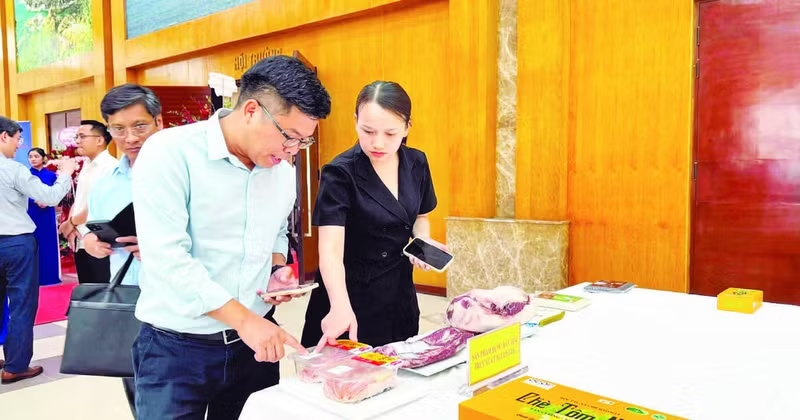
Serving as both a national database and a commitment to transparency across the entire production chain, the system lays the foundation for greater consumer confidence and higher added value for Vietnamese agricultural products.
At the launch ceremony, recently held at the Ministry of Agriculture and Environment, delegates experienced the system first-hand by scanning QR codes on products including fruit, rice, meat, and tea using their smartphones. Within seconds, detailed information appeared on their screens, including the exporting enterprise, growing area code, producer's name, packaging facility, production date, expiry date, and batch number.
Notably, the system provides complete transparency throughout the product's journey before it reaches consumers. Information is available on every stage of production, including crop cultivation, flowering treatments, fertiliser and crop protection product applications, sweetness testing, harvesting, and packaging.
According to the Ministry of Agriculture and Environment, from July 1, consumers nationwide have been able to access this information by scanning QR codes on the products participating in the system, enabling them to verify product details before making purchasing decisions.
Nguyen Khanh Linh, a resident of Nghia Do Ward in Ha Noi, said: "Previously, some agricultural products also carried QR codes, but the information was quite limited, usually showing only the company name or place of origin. Now, if I can see the entire journey of a product, I'll feel much more confident when buying it. When choosing between similar products, I'll definitely give priority to those with complete and transparent traceability information."
The system is currently capable of processing around 1,000 search requests per second, supporting 30,000 simultaneous QR code scans, handling more than 85 million scans each day, and processing approximately 50 data transmissions of 2 MB per second.
To Nguyen Thanh, a representative of Netacom — one of the technology partners responsible for implementing the platform — said the system is capable of connecting with more than 500,000 traceability software solution providers, serving approximately 200,000 manufacturing and processing enterprises along with around nine million farmers and agricultural cooperatives. Its storage capacity is sufficient to manage data for around 1.5 billion products generated annually, while its processing capability can accommodate approximately 7.7 billion QR code scans each year, meeting the demands of both national and international deployment.
According to Do Thi Thu Nga, Director of Legal Affairs and External Relations at Masan MEATLife, the company was among the first businesses to integrate its systems with the Ministry's Agricultural Product Traceability System. The platform has already been applied to chicken products, while technical preparations are under way to extend traceability to the company's chilled pork products.
Masan MEATLife has also established the technological infrastructure, data systems, and operational processes necessary for large-scale traceability. At present, 100% of the company's pork and chicken products carry QR codes, while data covering production, slaughtering, processing, and distribution has been fully digitised and monitored throughout the entire supply chain.
"Practical experience has shown that the system enables businesses to retrieve essential product information immediately whenever inspections or incident management are required. It has also significantly strengthened quality management and, when necessary, has facilitated regulatory inspections," said Do Thi Thu Nga, Director of Legal Affairs and External Relations at Masan MEATLife.
Looking ahead, many businesses believe that further improvements are needed to ensure the system operates at its full potential. They have called for continued expansion and enhancement of the traceability database to ensure that information is complete, standardised, and interoperable across provinces and businesses. They also recommend introducing support mechanisms to help enterprises, cooperatives, and farming households adopt digital technologies as well as integrating the platform with databases covering growing area codes, packaging facilities, plant and animal quarantine, quality certification, and e-commerce platforms. Such integration would create a seamless data chain linking production with consumption. In addition, raising public awareness and encouraging consumers to routinely scan QR codes and verify product information before making purchases will be essential to fully realise the value of the system.

![[Infographic] VN-Index rises 0.34% on October 6](https://en-cdn.nhandan.vn/images/j0QNt7m_5iy1OXpnUKiwG61aYhTv_B140GWhfriF26IM-hJLr-YyB-igcHJ7cLRKshCXmgI3hJXGVRYJMfGPzA/chung610-8460.jpg.avif)